The life of Philippus Theophrastus Bombast of Hohenheim : known by the name of Paracelsus, and the substance of his teachings concerning cosmology, anthropology, pneumatology ... Extracted and translated from his rare and extensive works and from some unpublished manuscripts / by Franz Hartmann.
- Franz Hartmann
- Date:
- 1887
Licence: Public Domain Mark
Credit: The life of Philippus Theophrastus Bombast of Hohenheim : known by the name of Paracelsus, and the substance of his teachings concerning cosmology, anthropology, pneumatology ... Extracted and translated from his rare and extensive works and from some unpublished manuscripts / by Franz Hartmann. Source: Wellcome Collection.
Provider: This material has been provided by the Augustus C. Long Health Sciences Library at Columbia University and Columbia University Libraries/Information Services, through the Medical Heritage Library. The original may be consulted at the the Augustus C. Long Health Sciences Library at Columbia University and Columbia University.
33/282 page 13
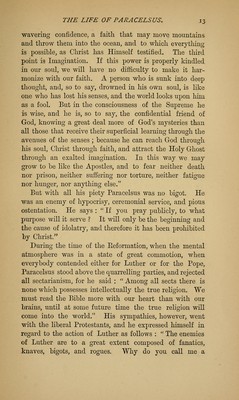
![wavering confidence, a faith that may move mountains and throw them into the ocean, and to which everything is possible, as Christ has Himself testified. The third point is Imagination. If this power is ]3roperly kindled in our soul, we will have no difficulty to make it har- monize with our faith. A person who is sunk into deep thought, and, so to say, drowned in his own soul, is like one who has lost his senses, and the world looks upon him as a fool. But in the consciousness of the Supreme he is wise, and he is, so to say, the confidential friend of God, knowing a great deal more of God's mysteries than all those that receive their superficial learning through the avenues of the senses ; because he can reach God through his soul, Christ through faith, and attract the Holy Ghost through an exalted imagination. In this way we may grow to be like the Apostles, and to fear neither death nor prison, neither suffering nor torture, neither fatigue nor hunger, nor anything else. But with all his piety Paracelsus was no bigot. He was an enemy of hypocrisy, ceremonial service, and pious ostentation. He says : If you pray publicly, to what purpose will it serve ? It will only be the beginning and the cause of idolatry, and therefore it has been prohibited by Christ/' During the time of the Eeformation, when the mental atmosphere was in a state of great commotion, wdien everybody contended either for Luther or for the Pope, Paracelsus stood above the quarrelling parties, and rejected all sectarianism, for he said : Among all sects there is none which possesses intellectually the true religion. We must read the Bible more with our heart than with our brains, until at some future time the true rehgion will come into the world. His sympathies, however, went with the liberal Protestants, and he expressed himself in regard to the action of Luther as follows : The enemies of Luther are to a great extent composed of fanatics, inaves, bigots, and rogues. Why do you call me a](https://iiif.wellcomecollection.org/image/b21219576_0033.jp2/full/800%2C/0/default.jpg)




 No text description is available for this image
 No text description is available for this image
 No text description is available for this image