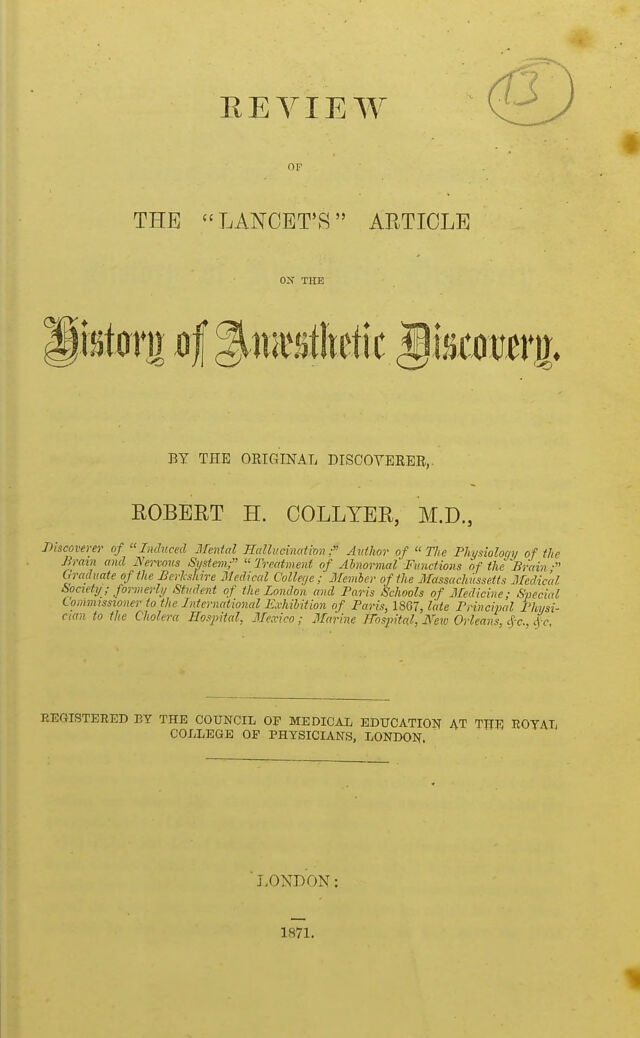
Review of the "Lancet's" article on the history of anaesthetic discovery / by the original discoverer, Robert H. Collyer, M.D.
- Collyer, Robert H.
- Date:
- 1871
Licence: Public Domain Mark
Credit: Review of the "Lancet's" article on the history of anaesthetic discovery / by the original discoverer, Robert H. Collyer, M.D. Source: Wellcome Collection.
Provider: This material has been provided by The University of Glasgow Library. The original may be consulted at The University of Glasgow Library.
5/20
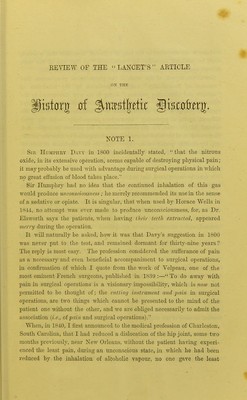
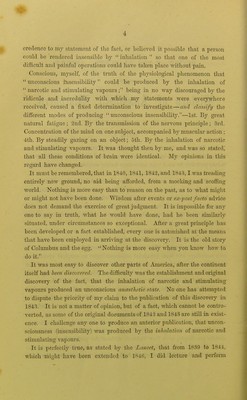
![BE^IEW OF THE LANCET'S ABTICLE ox THF. NOTE 1. Sm Humphry Davy iu 1800 incidentally stated, that the nitrous oxide, ill its extensive operation, seems caiDable of destrojdng physical pain; it may probably be used with advantage during siu'gical operations in -wliiclx no great effusion of blood takes place. Sir Humphry had no idea that the continued inhalation of this gas would produce unconsciousness; he merely recommended its use in the sense of a sedative or opiate. It is smgular, that when used by Horace Wells in 1844, no attempt was ever made to ]5roduce unconsciousness, for, as Dr. Elswortli saj's the patients, when having Hieir teeth extracted, appeared merry during the operation. It will naturally be asked, how it was that Davy's suggestion in 1800 was never put to the test, and remained dormant for tlm-ty-nine years? The reply is most eas3^ The profession considered the sufferance of pain as a necessary and even beneficial accompaniment to sm-gical operations, in confirmation of which I quote fi'om the work of Velpeau, one of the most eminent French surgeons, published in 18.39 :— To do away with pain in sui'gical operations is a visionary impossibility, which is now not permitted to be thought of; the cutting instrument and 2^ain in surgical operations, are two things which cannot be presented to the mind of the patient one without the other, and we are obHged necessarilj' to admit the association (i.e., oipain and surgical operations). When, in 1840,1 first annoimced to the medical profession of Charleston, South Carolina, that I had reduced a dislocation of the hip joint, some two months previously, near New Orleans, without the patient having experi- enced the least pain, diu'ing an unconscious state, in which he had been reduced by the inhalation of alcoholic vapour, no one gave the least](https://iiif.wellcomecollection.org/image/b21479458_0005.jp2/full/800%2C/0/default.jpg)