Möller's operative veterinary surgery / translated and edited from the second enlarged and improved edition of 1894 by Jno. A.W. Dollar.
- Date:
- 1895
Licence: Public Domain Mark
Credit: Möller's operative veterinary surgery / translated and edited from the second enlarged and improved edition of 1894 by Jno. A.W. Dollar. Source: Wellcome Collection.
Provider: This material has been provided by the Royal College of Physicians of Edinburgh. The original may be consulted at the Royal College of Physicians of Edinburgh.
650/768 page 622
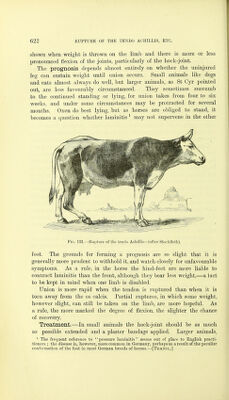
![shown when weight is thrown on the limb and there is more or less pronounced flexion of the joints, particularly of the hock-joint. The prognosis depends almost entirely on whether the uninjured leg can sustain weight until union occurs. Small animals like dogs and cats almost always do well, but larger animals, as St Cyr pointed out, are less favourably circumstanced. They sometimes succumb to the continued standing or lying, for union takes from four to six weeks, and under some circumstances may be protracted for several months. Oxen do best lying, but as horses are obliged to stand, it becomes a question whether laminitis ^ may not supervene in the other Pig. 131.—Rupture of the tendo Acliillis—(after Stockfleth). foot. The grounds for forming a prognosis are so slight that it is generally more prudent to withhold it, and watch closely for unfavourable symptoms. As a rule, in the horse the hind-feet are more liable to contra:ct laminitis than the front, although they bear less weight,—a lact to be kept in mind when one limb is disabled. Union is more rapid when the tendon is ruptured than when it is torn away from the os calcis. Partial ruptures, in which some weight, however slight, can still be taken on the limb, are more hopeful. As a rule, the more marked the degree of flexion, the slighter the chance of recovery. Treatment.—In small animals the hock-joint should be as much as possible extended and a plaster bandage applied. Larger animals, ^ The frequent reference to pressure laminitis seems out of place to English practi- tioners ; the disease is, however, more common in Germany, perhaps as a result of the peculiar conformation of the foot in most German breeds of horses.—[Tkansl.]](https://iiif.wellcomecollection.org/image/b2193986x_0650.jp2/full/800%2C/0/default.jpg)