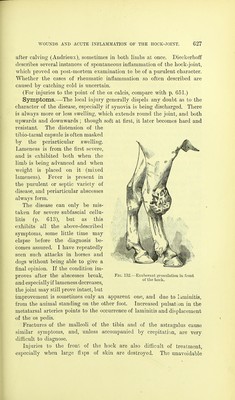
Möller's operative veterinary surgery / translated and edited from the second enlarged and improved edition of 1894 by Jno. A.W. Dollar.
- Date:
- 1895
Licence: Public Domain Mark
Credit: Möller's operative veterinary surgery / translated and edited from the second enlarged and improved edition of 1894 by Jno. A.W. Dollar. Source: Wellcome Collection.
Provider: This material has been provided by the Royal College of Physicians of Edinburgh. The original may be consulted at the Royal College of Physicians of Edinburgh.
658/768 page 630
![Horn draws off the contents with a trochar, and applies, in place of a pressure bandage, a thick layer of glue, in which finely chopped tow is mixed to increase its stl'ength. Incising the swelling is not unattended hj danger, even where full antiseptic precautions are taken, because the animal sometimes rubs off the dressing. Acupuncture has been recom- mended by Gloag and others. The swelling is perforated on either side to a depth of |- of an inch by an apparatus composed of four needles thrust into a cork, when the fluid-contents escape. In five days the operation is repeated, iodine ointment rubbed in, an elastic bandage applied over all, and left in position for twenty-four hours. V.-CHRONIC INFLAMIVIATION OF THE HOCK. SPAVIN. ARTHRITIS CHRONICA DEFORMANS TARSI. Ger. Spat. Lit.: Havemann, Anleitung zur Beurtheihmg d. Pferdes. 2. Aufl. 1805, p. 186. L a f 0 s s e, Journ. des vet. dunied. 1846, p. 489. Dieckerlioff, Der Spat d. Pferde. Berhn, 1875. Schrader, Gurit u. Hertwig. 3, p. 257, u. 5, p. 95. Peters, Bericht des Vereins meckl. Thier. 1854, p. 11, u. 1857, p. 10. M 011 e r, Berl. Arch. 6, p. 182. S c h ii 11, Gurlt u. Hert- wig. 19, p. 255. Kuobloch, Lehrbegriff der Pferdearznei. vol. 3, p. 229. Schubert, Dresd. Ber. 1866, p. 74. Hoffmann, Her. Eep. vol. 54. Kosters, Jabrb. 1891. B a 11 a z z i, ref. B. T. W. 1892, p. 9. Schiitz, Virch. Arch. 1869. It is not surprisiirg that so common a disease as spavin should early have attracted attention. ' We find the disease described by Jordanus Euffus and Marx Fugger, and treated of by almost every veterinary author. Owing to ignorance of pathological processes early observers attached undue importance to outward appearances and distinguished many kinds of spavin on the ground of their physical differences. This was the basis of the terms ^parvin calleux and eparvin sec, invented by SoUeysel, and still used in France to the present day, and of the English bog and bone spavin. ^ In Germany Kersting distinguished five kinds of spavin. To the same cause was due the identification of spavin with stringhalt. For a long time the nature of the disease remained obscure, and it was sometimes thought to be a bone affection, sometimes an affection of the ligaments. Havemann first directed attention to the disease of the articular surfaces, and afterwards Schrader and Schiitz described ' Prof. Mijller here seems to be under a slight misappreliension.—[Tkansl.]](https://iiif.wellcomecollection.org/image/b2193986x_0658.jp2/full/800%2C/0/default.jpg)