The effect of vagal stimulation on intra-auricular block produced by pressure or cooling / by T. Lewis and A.N. Drury.
- Thomas Lewis
- Date:
- [1923]
Licence: Public Domain Mark
Credit: The effect of vagal stimulation on intra-auricular block produced by pressure or cooling / by T. Lewis and A.N. Drury. Source: Wellcome Collection.
3/26
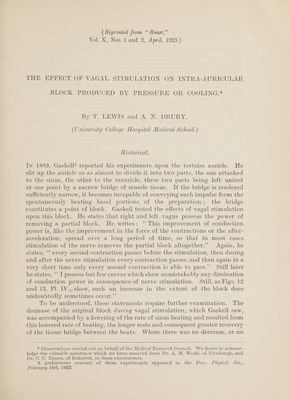
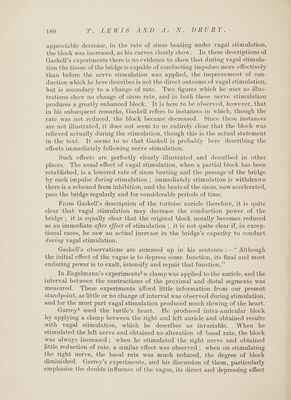
![[ Reprinted from ‘ Heart,” Vol. X, Nos. 1 and 2, April, 1923.] THE EFFECT OF VAGAL STIMULATION ON INTRA-AURICULAR BLOCK PRODUCED BY PRESSURE OR COOLING.* By T. LEWIS and A. N. DRURY. (University College Hospital Medical School.) Historical. In 1883, Gaskell reported his experiments upon the tortoise auricle. He slit up the auricle so as almost to divide it into two parts, the one attached to the sinus, the other to the ventricle, these two parts being left united at one point by a narrow bridge of muscle tissue. If the bridge is rendered sufficiently narrow, it becomes incapable of conveying each impulse from the spontaneously beating basal portions of the preparation; the bridge constitutes a point of block. Gaskell tested the effects of vagal stimulation upon this block. He states that right and left vagus possess the power of removing a partial block. He writes: “ This improvement of conduction power is, like the improvement in the force of the contractions or the after- acceleration, spread over a long period of time, so that in most cases stimulation of the nerve removes the partial block altogether.’ Again, he states, “‘ every second contraction passes before the stimulation, then during and after the nerve stimulation every contraction passes, and then again in a very short time only every second contraction is able to pass.” Still later he states, “‘ I possess but few curves which show unmistakably any diminution of conduction power in consequence of nerve stimulation. Still, as Figs. 12 and 13, Pl. IV., show, such an increase in the extent of the block does undoubtedly sometimes occur.” To be understood, these statements require further examination. The decrease of the original block during vagal stimulation, which Gaskell saw, was accompanied by a lowering of the rate of sinus beating and resulted from this lowered rate of beating, the longer rests and consequent greater recovery of the tissue bridge between the beats. Where there was no decrease, or no * Observations carried out on behalf of the Medical Research Council. We desire to acknow- ledge the valuable assistance which we have received from Dr. A. M. Wedd, of Pittsburgh, and Dr. C. C. Iliescu, of Bukarest, in these experiments. A preliminary account of these experiments appeared in the Prec. Physiol. Soc., February 18th, 1922.](https://iiif.wellcomecollection.org/image/b33430482_0003.jp2/full/800%2C/0/default.jpg)