Liturgies, eastern and western : being the texts, original or translated, of the principal liturgies of the church / edited with introductions and appendices by F.E. Brightman on the basis of the former work by C.E. Hammond. Vol. 1. Eastern liturgies.
- Charles Edward Hammond
- Date:
- 1896
Licence: Public Domain Mark
Credit: Liturgies, eastern and western : being the texts, original or translated, of the principal liturgies of the church / edited with introductions and appendices by F.E. Brightman on the basis of the former work by C.E. Hammond. Vol. 1. Eastern liturgies. Source: Wellcome Collection.
31/714
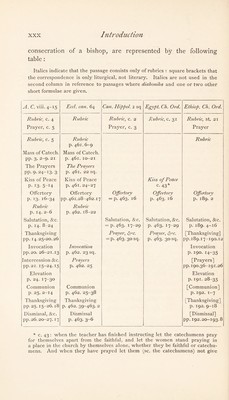
![370-80. A. C. vi. 24 sq. implies a date well after the conversion and legislation of Constantine, while the reference to the position of the Jews under the empire suggests an allusion to the measures of Constantius in 353 and the re-enactment of Hadrian’s edict (Gibbon D. and F. xxiii vol. iii. p. 155, ed. Smith : Gratz Geschichte d. Juden Leipz. 1866, iv. p. 342): a reference to Julian’s 5 failure to rebuild the temple would have been apposite if the writer had lived after 363 ; but on the other hand he might regard an overt reference to so recent an event as precluded by the apostolic fiction. The ecclesiastical organization is identical with that of the canons of Laodicea, about 363, where singers are first mentioned (notice also that subdeacons are called vnr/peTat as in io A. C. i-vi). The cycle of great feasts in v. 13, viii. 33 is identical with that of S. Chrys. hom. in s. Philog. 3 (i. 497 c) in 386, and it includes Christmas which was unknown to S. Epiphanius in 375 (haer. li. 16, 27^ and was first observed in Antioch c. 378 (S. Chrys. in Natal. 1 [ii. 355 a]), and was well established in Asia in 387 ^C. H Turner in Stadia biblica ii. p. 132). The feast of S. Stephen 15 (viii. 33 § 3) is otherwise first mentioned in a martyrology of the end of the fourth century (Duchesne Origines, p. 254) and by S. Greg. Nyss. in 379 (or. in s. Bas. init. [Migne P. G. xlvi. 790 a]) and feasts of apostles also in S. Greg. Nyss. ibid. The practical co-ordination of the sabbath with Sunday is implied in some sort in c. 363 in Can. Laod. 16, 49, 51 (but see 29), in S. Bas. ep. xciii 20 (iii. 186 d) before 373, and is noticed as sporadic by S. Epiph. de Fide 24 in 376 or 377, and implied in S. Chrys. in Jo. xi. 1 (viii. 62 b), xxv. i (143 b), in 1 Tim. v. 3 (xi. 577 e) after 398. The observance of Christmas would be decisive for c. 380 were it not that it is possible that A. C. was intended to develop the festal cycle, and in fact did so. Funk’s grounds for a date after 400 are insufficient, 25 and in fact amount to very little ; while the dogmatic position, which is Harnack’s main ground for so early a date as 343, is too indeterminate to be secure, even if it could be granted that A. C. was necessarily written at the moment of the greatest influence of the party which it represented. On the other hand the scantiness of allusion to monks (only in the liturgy) and a certain hesitation as to virgins (iv. 14, viii. 24), so far as they go, favour an early date. On the whole Lightfoot’s general conclusion must be acquiesced in, and the work assigned merely to the second half of the fourth century ; in the positive indications there is some balance in favour of 370-380, while the negative indications may suggest 350-360. The Apostolic Constitutions then are the work of the pseudo- Ignatius, and were compiled in Antioch or its neighbourhood in the latter half of the fourth century. iii. The Liturgical forms. 1. The Clementine Liturgy. The relations of the documents, so far as relates to the 40](https://iiif.wellcomecollection.org/image/b29353233_0031.jp2/full/800%2C/0/default.jpg)