Liturgies, eastern and western : being the texts, original or translated, of the principal liturgies of the church / edited with introductions and appendices by F.E. Brightman on the basis of the former work by C.E. Hammond. Vol. 1. Eastern liturgies.
- Charles Edward Hammond
- Date:
- 1896
Licence: Public Domain Mark
Credit: Liturgies, eastern and western : being the texts, original or translated, of the principal liturgies of the church / edited with introductions and appendices by F.E. Brightman on the basis of the former work by C.E. Hammond. Vol. 1. Eastern liturgies. Source: Wellcome Collection.
35/714
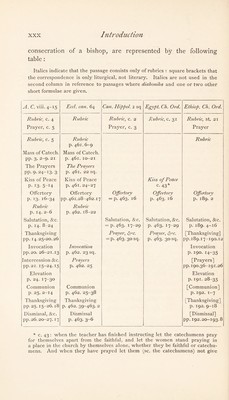
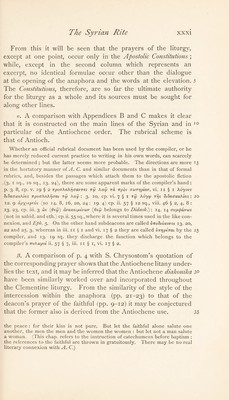
![invocation, p. 190. 14-20, underlies that of the Clementine, pp. 20. 28-21. 11 : the other parallels marked by Achelis Can. Hippol. pp. 52-60 are either too slight to be of any importance or more than accidental (190. 1 was carried in the womb, 19. 2376701/61/ ev fir/Tpa : 190. 6 burst the bonds of Satan, 20. 8 pr]£r] Ta Secrpa tov 5m@uXov), or are fanciful, or are mere inevitable liturgical common- 5 places. The coincidence in the invocation may be accidental so far as affects the present question : that is to say, the ethiopic translator may have incorporated an existing Ab3/ssinian anaphora which happened independently to have derived its invocation from the same source as A. C. On the other hand, if the common source of C. O. and A. C. contained an anaphora, it is obvious that either the 10 ethiopic or A. C. or both have departed very widely from the source. L Whatever sources the compiler has used, it is plain that he has dealt very freely with them, and that in particular the prayers are substantially his own work. (i) This is antecedently probable on the ground of his 15 procedure elsewhere. (1) The long thanksgiving in vii. 33-38 is obviously the work of the same hand as that of the prayers of the liturgy, while it cannot be regarded as a public formula, but is rather a form of private devotion : there is no obvious place for it in 20 the public liturgical organization, nor is there anything in the text to suggest that it is intended for public use. (2) Liturgical formulae are not regarded by the compiler as rigidly fixed : in the regulations for the catechumenate and initiation in the seventh book at some points he gives only the 25 drift of the prayers without prescribing a formula. See vii. 39 § 2 the prayer for the catechumen, 42 the consecration of the oil, 43 § 1 the consecration of the water, where in § 2 he passes into a formula : in 44 § 1 he gives the beginning of a formula of confirmation, and in § 2 continues TavTa teal to. tovtols a/eoXovOa XeyeTOJ' enaOTov 'yap rj hvvapis tt)s yeipofleofa? IotIv 30 avT7y eav yap prj els enact tov tovtojv ev'ucXrjcns yevrjTac vapa tov everefiovs lepicus ToiavTt) tis els vhcop puvov nara^cuvei ktX, thus explicitly leaving the wording to the discretion of the bishop. In the liturgy itself the formulae seem some- times only suggested as types: 5. 14 evXoylav Toiavde, 9. 1 Toiade. (3) He has dealt freely with known formulae, e. g. with the 35 Creed and the Gloria in excelsis. (a) The creed is in vii. 41. If this be compared with the Antiochene creed as reconstructed by Dr. Hort (Two dissertations Camb. 1876, p. 148) it will be found that the differences consist in additions which largely bear the marks of the C](https://iiif.wellcomecollection.org/image/b29353233_0035.jp2/full/800%2C/0/default.jpg)