Interim report : industrial efficiency and fatigue / Health of Munition Workers Committee.
- Great Britain. Health of Munition Workers Committee.
- Date:
- 1917
Licence: Public Domain Mark
Credit: Interim report : industrial efficiency and fatigue / Health of Munition Workers Committee. Source: Wellcome Collection.
21/134 (page 19)
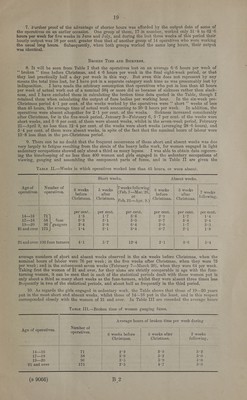
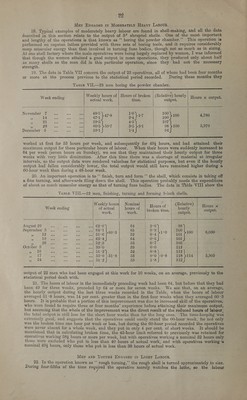
![7. Kurther proof of the advantage of shorter hours was afforded by the output data of some of the operatives on an earlier occasion. One group of them, 17 in number, worked only 51°8 to 62°6 hours per week for five weeks in June and July, and during the last three weeks, of this period their hourly output was 18 per cent. greater than that of another group of 14 operatives who were working the usual long hours. Subsequently, when both groups worked the same long hours, their output was identical. . BRoKEN TIME AND SICKNESS. 8. It will be seen from Table I that the operatives lost on an average 6°6 hours per week of ““ broken ’’ time before Christmas, and 4°6 hours per week in the final eight-week period, or that they lost practically half a day per week in this way. But even this does not represent by any means the total time lost, for I have put in a separate category such time as was presumably lost by indisposition. I have made the arbitrary assumption that operatives who put in less than 45 hours per week of actual work out of a nominal 584 or more did so because of sickness rather than slack- ness, and I have excluded them in calculating the broken time data quoted in the Table, though I retained them when calculating the output of fuze bodies per working hour. In the six-week pre- Christmas period 4:1 per cent. of the weeks worked by the operatives were “‘ short ’’ weeks of less than 45 hours, the average time of actual work amounting to 30-2 hours per week. In addition, the operatives were absent altogether for 2:1 per cent. of the weeks. Sickness increased considerably after Christmas, for in the five-week period, January 3—February 6, 5:7 per cent. of the weeks were short weeks, and 3°6 per cent. of them were absent weeks, whilst in the seven-week period, February 21—April 9, no less than 12°4 per cent. of the weeks were short weeks (averaging 28°6 hours), and 5:4 per cent. of them were absent’ weeks, in spite of the fact that the nominal hours of labour were 10-8 less than in the pre-Christmas period. 9. There can be no doubt that the frequent occurrence of these short and absent weeks was due very largely to fatigue resulting from the strain of the heavy lathe work, for women engaged in light sedentary occupations showed only about a third as many lapses. I was able to obtain data concern- ing the timekeeping of no less than 400 women and girls engaged in the sedentary occupations of viewing, gauging and assembling the component parts of fuzes, and in Table IT are given the Taste I].—Weeks in which operatives worked less than 45 hours, or were absent. Short weeks. Absent weeks. Age of Number of 7 weeks following operatives.| operatives. aries 5 meals (Feb. 7—Mar. 26, pis 5 le fi weeks Christmas. Christmas. Feb. arts Apr. 9.) Christmas. Christmas. following. per cent. per cent. per cent. | per cent. per cent. | per cent. 14—16 et | ime Tay 3°6 2°9 1:7 1°4 17—18 58 | - fuze 0-3 Ec Del) 0°7 Same toed: 19—20 96 ( gaugers 2°4 2°8 6°4 2°0 aay 3°3 21 and over| 175 : 1:4 Bot 3°4 Oa7 2-1 1°8 21 and over |100 fuze turners cad ey 12°4 yi | 3°6 5°4 average numbers of short and absent weeks observed in the six weeks before Christmas, when the nominal hours of labour were 76 per week; in the five weeks after Christmas, when they were 75 per week; and in the subsequent seven weeks (February 7—March 26), when they were 64 per week. Taking first the women of 21 and over, for they alone are strictly comparable in age with the fuze- turning women, it can be seen that in each of the statistical periods dealt with these women put in only about a third as many short weeks as the fuze-turners, whilst they were absent three times less frequently in two of the statistical periods, and about half as frequently in the third period. 10. As regards the girls engaged in sedentary work, the Table shows that those of 19—20 years put in the most short ahd absent weeks, whilst those of 14—16 put in the least, and in this respect corresponded closely with the women of 21 and over. In Table III are recorded the average hours Taste II].—Broken time of women gauging fuzes. Average hours of broken time per week during . Number of — ae ae ee A SR Age of operatives. : cece! 6 weeks before 5 weeks after 7 weeks Christmas. Christmas. following. 14—16 or eg 2°9 3°9 3:2 17—18 58 3°9 5:2 3°0 19—20 96 3°5 5°9 4:0 21 and over 175 2°5 4:7 3°0](https://iiif.wellcomecollection.org/image/b32179303_0021.jp2/full/800%2C/0/default.jpg)