Interim report : industrial efficiency and fatigue / Health of Munition Workers Committee.
- Great Britain. Health of Munition Workers Committee.
- Date:
- 1917
Licence: Public Domain Mark
Credit: Interim report : industrial efficiency and fatigue / Health of Munition Workers Committee. Source: Wellcome Collection.
23/134 (page 21)
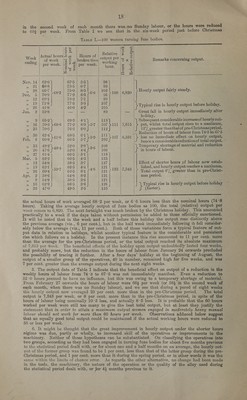
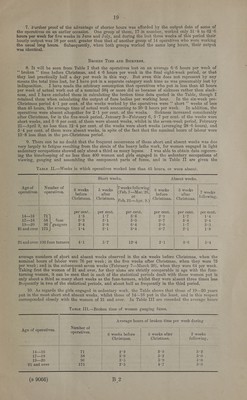
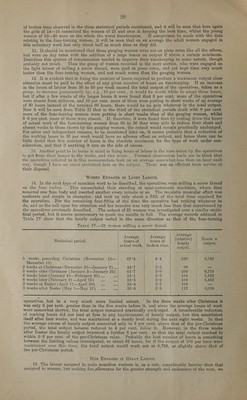
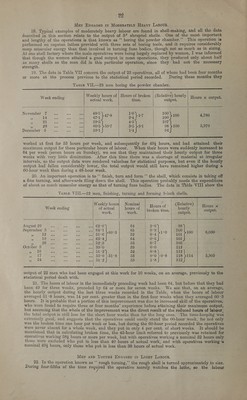
![find that his output is similarly affected by a reduction in the hours of labour. One of the most fatiguing types of munition work so far investigated by me is that of “* sizing.’”’ In the sizing of fuze bodies the article is usually subjected to four separate operations, in each of which it is clamped to a small fly-wheel and handle, and is screwed through a steel tap so as to cut a screw thread on it. The operations require no manual dexterity, but they are a great and continuous strain on the muscles of one arm and shoulder, and to a less extent on those of the back. ‘The operatives seldom use both arms, as they prefer to keep the “* screwing ’’ hand dry, and use the other one for picking up the oil-covered fuze bodies. ‘The output of a group of 27 operatives was investi- gated, and the mean results are given in Table V. The hours of labour were always shorter than TasLe V.—27 men sizing fuze bodies. ; Average Average WE ieee Statistical period. hours of ie ere? Homnh2 actual work. shies peas . pees 6 weeks preceding Christmas (November 8—December 19) 61°5 100 [6,100 2 weeks at Christmas (December 2U—January 2) ie 38°3 89 — 6 weeks after Uhristmas (January 3—lebruary 13)... d1-1 109 5,570 8 weeks later (february 21—April 16) ... ot a d5°4 / 122 6,759 2 weeks at Haster (April 17—April 3V) ... SF ret - 41-0 112 — 3 weeks later (May 1—Muay 21) ... ay ay al 06°2 124 6,969 those worked by the women. They never exceeded 71 hours in any one week, and seldom included Sunday labour. The hourly output showed a marked drop during the Christmas fortnight, and a considerable rise ‘(to 118) for the first week after this fortnight, but the average output during the six weeks after Christmas was only 9 per cent. greater than that of the pre-Christmas period, in spite of the fact that the weekly hours of labour were 10°4 shorter. Evidently the operatives took a long time to adapt their rate of production to the shorter hours, for the hourly output subsequently averaged 22 per cent. in excess of that of the pre-Christmas period. ‘l'his caused the total output to be no less than 10 per cent. greater, and it is probable that even this figure does not represent the full effect of reducing the hours of labour, for after Haster the hourly output improved a further 2 per cent., and the total output was increased to 13 per cent. above that of the pre-Christmas period. However, a part of this improvement may have been only the temporary effect of the holiday. The week I’ebruary 14—20 is omitted, as the operatives worked only 41 hours owing to shortage of material. - 16. The broken time is not quoted in the above table as the nominal hours of labour were rather uncertain. Moreover, the operatives appeared to have had some freedom in selecting their own hours of work. The plan adopted in calculating the weekly hours of actual work was different from that observed in the other data quoted in this memorandum, for all weeks were included in which 20 hours or more were worked. ‘The reason of this change was that these sizers, though they were absent altogether for only 1:8 per cent. of the weeks included in the statistical period dealt with, were in the habit of putting in short weeks of 40 hours or less with some frequency. . If only those operatives who put in 45 hours or more had been included, the average weekly hours of actual work would have come to about two hours more than the figures quoted in the table. 17. The operatives engaged in sizing fuze bodies were all full-grown men, but certain other sizing operations were performed by youths. The output of one of these groups may be quoted, but in that it concerns only nine operatives, the data are not so reliable as those just recorded. The youths, 14 to 17 years of age, were sizing steel base plugs, and from Table VI we see that their hourly Taste VI.—9 youths sizing base plugs. a. : Average hours |Average (relative)} Hours x Sgmgee of actual work. hourly output. output. 5 weeks preceding Christmas (November 15—Decem- 68°3 100 6,830 ber 19) 2 weeks at Christmas (December 20—January 2) Bae 46°3 | 106 — 4 weeks after Christmas (January 3—January re eos 70°3 116 8,155 11 weeks later (January 31—April 16) ... e Be 57°0 142 8,094 2 weeks at Waster (April 17—April 30) . a ae 42°] 135 — 3 weeks later (May 1—May.21) ... a fe oie 60°9 155 9,440 output was 16 per cent. greater in the four weeks after Christmas than it had been before, in spite of a slight increase in the hours of labour, whilst it was no less than 42 per cent. greater in the 11 subsequent weeks when the hours of labour were reduced from 70°3 to 57:0. In consequence, the total output attained a value 19 per cent. in excess of that of the pre-Christmas period. ven this value does not represent the full effect of the reduced hours of labour, for in the three weeks after Easter the hourly output was 55 per cent. above that of the pre-Christmas period, and the total output 88 per cent. above it. Such results are so astonishing that one is naturally inclined to doubt their validity, but there appears to be no reason for denying their substantial accuracy. The boys must have been seriously overworked by the long hours, and hence the 8 to 12-hour reduction of the working week accelerated their rate of production much more than did the 6-hour reduction accelerate ao of the men “‘ sizers.’](https://iiif.wellcomecollection.org/image/b32179303_0023.jp2/full/800%2C/0/default.jpg)