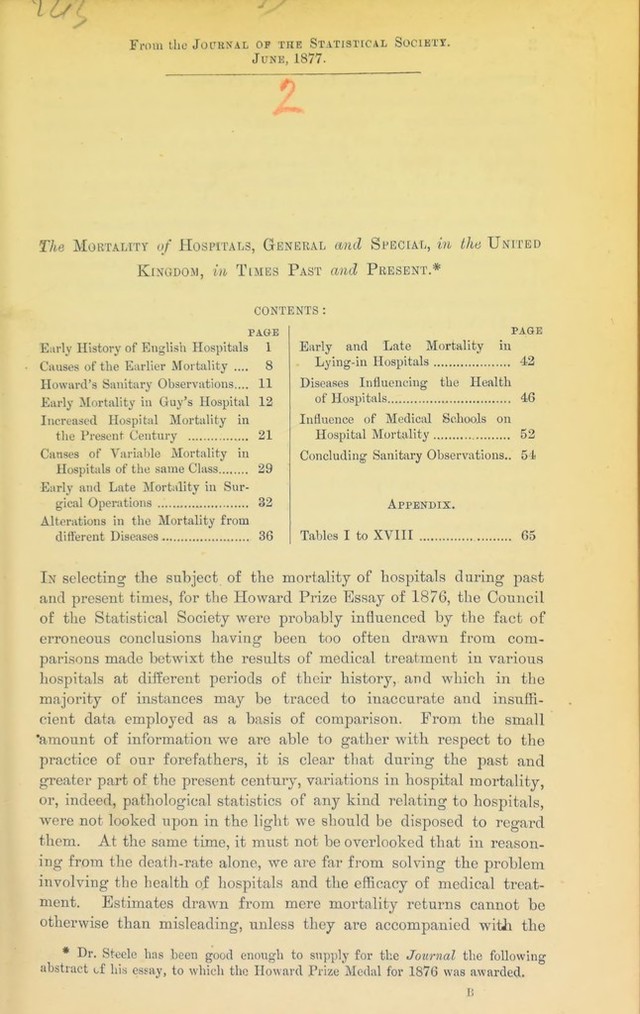
The mortality of hospitals, general and special, in the United Kingdom, in times past and present.
- Steele, J. C.
- Date:
- 1877
Licence: Public Domain Mark
Credit: The mortality of hospitals, general and special, in the United Kingdom, in times past and present. Source: Wellcome Collection.
Provider: This material has been provided by The Royal College of Surgeons of England. The original may be consulted at The Royal College of Surgeons of England.
4/90 page 2
![numerous collateral data bearing on their origin and descriptive of the administrative and other peculiarities of the establishment from which they have been separately obtained. Bearing these things in mind, it will be my object in the following pages to attempt an investigation of the causes which from time to time have modified the death-rate in different hospitals in the past, and which will probably continue to influence their relative mortality in the future. In pursuing this inquiry, it is primarily necessary that I should deal only with facts and figures obtained from sources of undoubted veracity, and discard all such as have had their origin in the records of ill-methodised experience, notwithstanding their popular acceptance. As the task is associated with the early history and growth of asylums for the sick throughout the country, not less as health resorts than as schools of medical instruction, it is desirable that it should be prefaced by a short sketch of the origin and development of these institutions. From the scanty information we possess of such, and their non-existence, with two notable exceptions, at the commencement of the eighteenth century, it has been customary to consider that this country was a great way behind its neighbours in providing for the sick and afflicted ; but there is every reason to believe that long prior to the suppression of the monasteries, our ancestors were not unmindful of the paramount claims of the sick and needy. We learn fi'om works like the Monasticon Anglicanum and Monasticon Hibernicum, as well as from numerous historical records,* that there were hospitals for the sick, lying-in hospitals, asylums for the aged, the impotent and the insane, and that the charities of the middle ages were neither few nor small. These establishments, which in the woi-ks referred to are calculated by hundreds, were for the most part separate foundations, the gifts of pious persons, and usually, though not always, in close relation to religious establishments, and under the exclusive jurisdiction of the monks. They were generally constituted in the departments of the monasteries set aside for the sick brethren, and were placed under the charge of an officer, or infirmarius, who was supposed to possess a better knowledge of the healing art than the rest of his order. Even prior to the introduction of Christianity, we have a faint glimmer of the existence of a primeval hospital in the Broin Bearg, or. Home of Sorrow, in the legendary lore of Ireland, where the sick and wounded were provided with an asjdum near to the royal residence, and there can be little doubt that refuges of a correspond- ing character have existed in all ages. The most authentic informa- * Sop o^]ieci;illv Historicnl Collections of a Citizen of London in the Fifteentli Cei.tury, printed for the Camden Sociely.](https://iiif.wellcomecollection.org/image/b22272124_0004.jp2/full/800%2C/0/default.jpg)