Wellcome Collection homepage
  • Visit us
  • What’s on
  • Stories
  • Collections
  • Get involved
  • About us
Sign in to your library account
Search for anything
Library account

Ceres

Roman goddess of agriculture

Wikidata
Source:
Wikidata

On this page

  • Images from the collections
  • Works from the collections
  • Related topics

Images from the collections

Images featuring Ceres

14 images from works
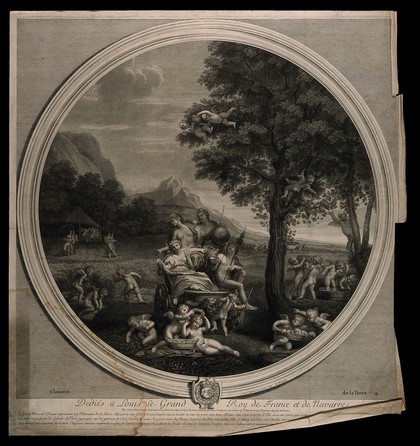
  • Cybele, Bacchus, Ceres and Flora on a chariot drawn by lions surrounded by all forms of natural abundance and cherubs, symbolising the element earth. Engraving by E. Baudet, 1695, after F. Albani.
  • The origin of the fig: Ceres gives the first fig to Phytalus in thanks for his hospitality. Etching by S. Rosa.
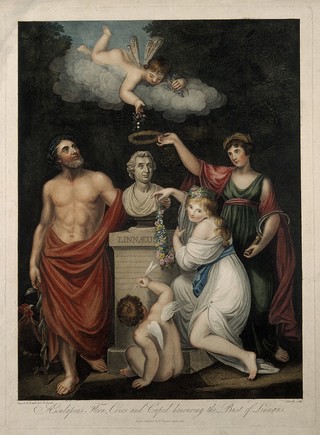
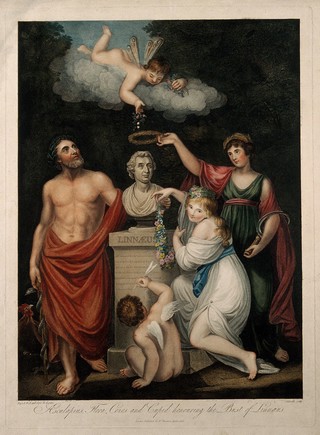
  • Carolus Linnaeus receives honour from Aesculapius, Flora, Ceres and Cupid. Coloured stipple engraving by J. Caldwall, 1806, after J. Russell and J. Opie.
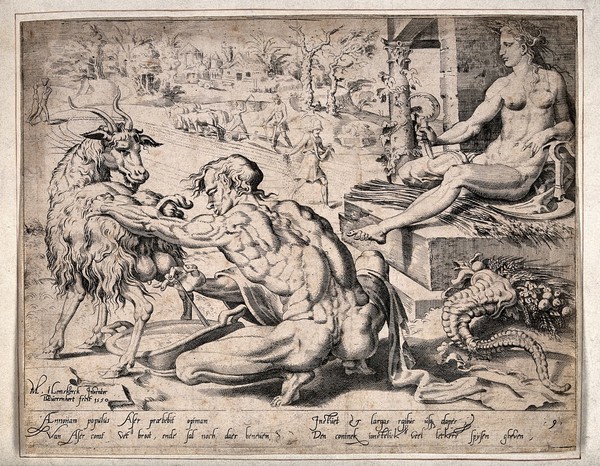
  • The patriarch Asher milking a goat, men ploughing and sowing the fields, and the goddess Ceres holding a scythe; a cornucopia lies on the ground. Etching by D. Coornhert after M. van Heemskerck.
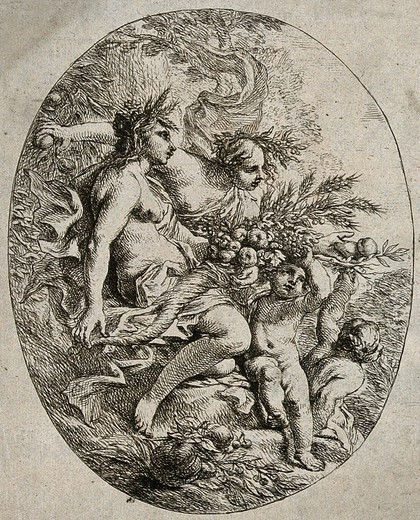
  • Bacchus, Ceres and Pomona with a cornucopia of fruit and corn. Etching by C. Schut I.
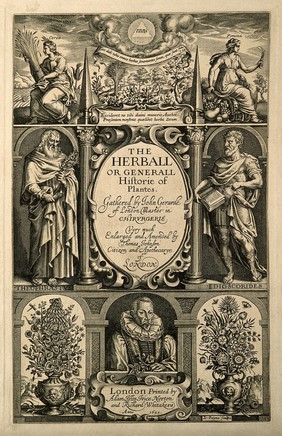
  • John Gerard: portrait and botanical motifs. Line engraving by J. Payne, 1633.
  • Carolus Linnaeus receives honour from Aesculapius, Flora, Ceres and Cupid. Coloured stipple engraving by J. Caldwall, 1806, after J. Russell and J. Opie.
  • Ceres on a chariot with children representing the months March, April and May, surrounded by forms of natural abundance, corybantes and cherubs, symbolising the element earth. Etching by A. Tempesta, 1592.
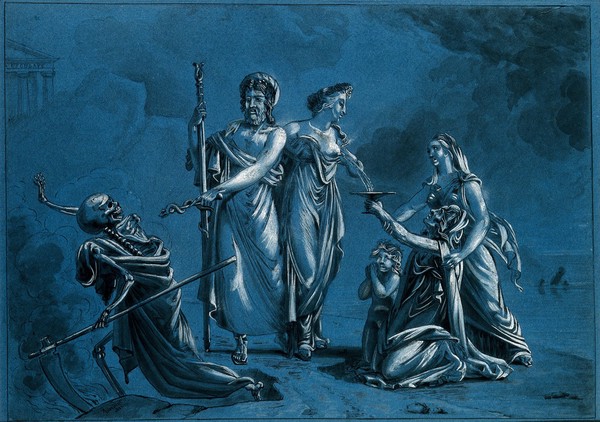
  • Aesculapius (representing medicine) routing death, Ceres (?) supplying milk to the starving. Drawing attributed to J.-C. Bordier du Bignon, 1822.
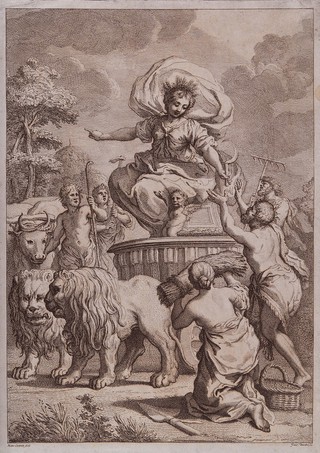
  • Ceres (Demeter) on a chariot drawn by lions receives offerings from peasants; representing harvest. Etching by G. Zocchi after P. da Cortona.
View all

Works from the collections

24 works

    • Pictures

    Ceres making love to a horse (Neptune); representing the joining of the land and the sea. Engraving by B. Picart, 1708.

    Q559929 | Date: 1708 | Reference: 2853401i
    • Pictures

    The story of Cupid and Psyche: Psyche puts in order a store of agricultural equipment, sacred to Ceres, but Ceres refuses to help her to find Cupid. Engraving by the Master of the Die, 15--, after M. Coxie, 153-.

    Michiel Coxie | Date: [between 1500 and 1599] | Reference: 2944964i
    • Pictures
    • Online

    Ceres (Demeter) on a chariot drawn by lions receives offerings from peasants; representing harvest. Etching by G. Zocchi after P. da Cortona.

    Pietro da Cortona | Reference: 39015i
    • Pictures
    • Online

    Ceres punishes Erysichthon of Thessaly with perpetual hunger. Engraving by J. Matheus, 1619.

    Matheus, Jean, active approximately 1619. | Date: 1619 | Reference: 11243i
    • Pictures
    • Online

    The patriarch Asher milking a goat, men ploughing and sowing the fields, and the goddess Ceres holding a scythe; a cornucopia lies on the ground. Etching by D. Coornhert after M. van Heemskerck.

    Maarten van Heemskerck | Date: [1550] | Reference: 30141i
View all

Related topics

Cupid and Psyche (Tale)
Family problems
Agriculture
Chariots
Earth, Planet
Agricultural implements
Wheat
Nature
Flowers
Scythes

Wellcome Collection

183 Euston Road
London NW1 2BE

+44 (0)20 7611 2222
info@wellcomecollection.org

  • Getting here

Today’s opening times

  • Galleries
    closed
  • Library
    closed
  • Café
    closed
  • Shop
    closed

Opening times

Our building has:

  • Step free access
  • Hearing loops

Access information

  • Visit us
  • What’s on
  • Stories
  • Collections
  • Get involved
  • About us
  • Contact us
  • Jobs
  • Media office
  • Developers
  • Privacy and terms
  • Cookie policy
  • Manage cookies
  • Modern slavery statement
TikTok
Facebook
Instagram
YouTube

Except where otherwise noted, content on this site is licensed under a Creative Commons Attribution 4.0 International Licence