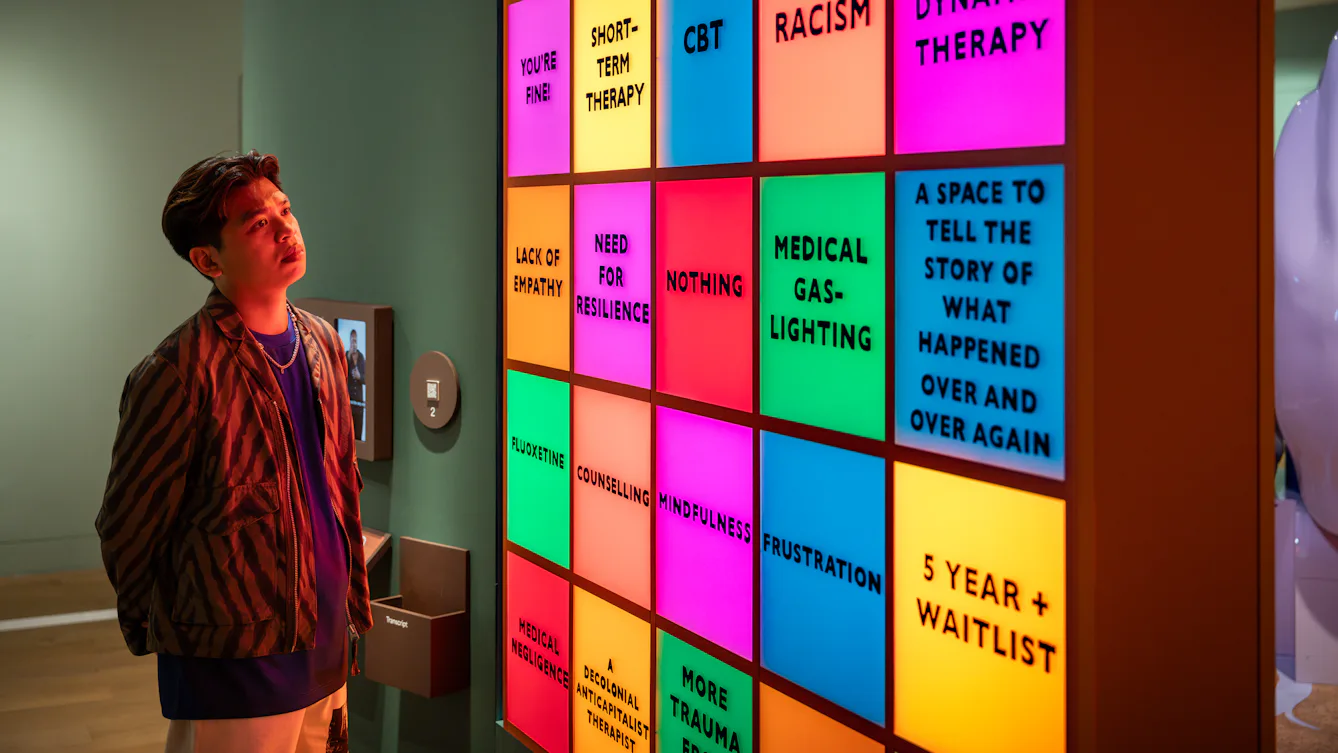
To your right if you are facing the QR code is ‘The Search for Care / The Lack of Care’, a sculpture that takes the form of a double-sided lightbox. It appears like a grid of five by five cubes made of colourful acrylic tiles.
The cubes have an assortment of colours, including green, light pink, pastel blue, dark yellow and coral red. Each contains a word or phrase written in thick black paint, the brush marks creating grooves like those on a vinyl record. You are invited to touch these words if you want, and feel how the thickness of the paint makes their surface slightly raised from the smooth acrylic of the lightbox.
The words and phrases all relate to experiences of seeking mental health care. The names of commonly prescribed drugs such as fluoxetine and sertraline sit alongside words like “CBT” (which stands for cognitive behavioural therapy), “lack of empathy”, “5 year+ wait list”, or simply “nothing”.
The sculpture is freestanding on a low plinth, so the back of the lightbox is also visible if you walk around to the other side. On that side of the sculpture, Loewe has painted phrases that reflect what care could look like instead. These include “a community of understanding”, “crisis support”, “decolonial anticapitalist care practices”, and “space to recover”.
Lit from within, the cubes illuminate one at a time, drawing our attention to one phrase and then another in quick succession. The artist intends this to be reminiscent of a bingo card, with one side reflecting how commonplace disappointing one-size-fits-all approaches to care can be, and the other side, dreams of a world in which generous and liberatory care could be experienced by everyone – in other words, the care they are searching for.
The tactile symbol displayed on the label that accompanies this work has at its centre a circle with a dot in the middle. Growing out of the top of the circle is a thick black line that curves to the right in a shape reminiscent of an ear, down to a set of six slightly curved lines like the roots of a plant. You are invited to touch it.
Next to the tactile symbol is a text by Rudy Loewe, which they will now read for you:
“From an early age, you learn ‘we don’t ask for help’, not from doctors, hospitals or the police. But willingly or unwillingly, you find yourself in the GP office/hospital/psychiatric unit. And at this moment of need, you are told ‘you’re fine/ you need to calm down/ you’re making a big deal out of nothing. You’re/you’re/you’re.’ There is no witness to your grief.
“But there are seeds sown within you of what care could look like. Long-forgotten practices or treatments that the GP would laugh away as inconceivable. In your spirit, you know it to be possible.
“The tactile element for this artwork is about searching for something important and having the agency to create what you need.”
This is the end of track 2. If you are facing the QR code, then the tactile path continues to your right down a short corridor-like space to the next artwork.