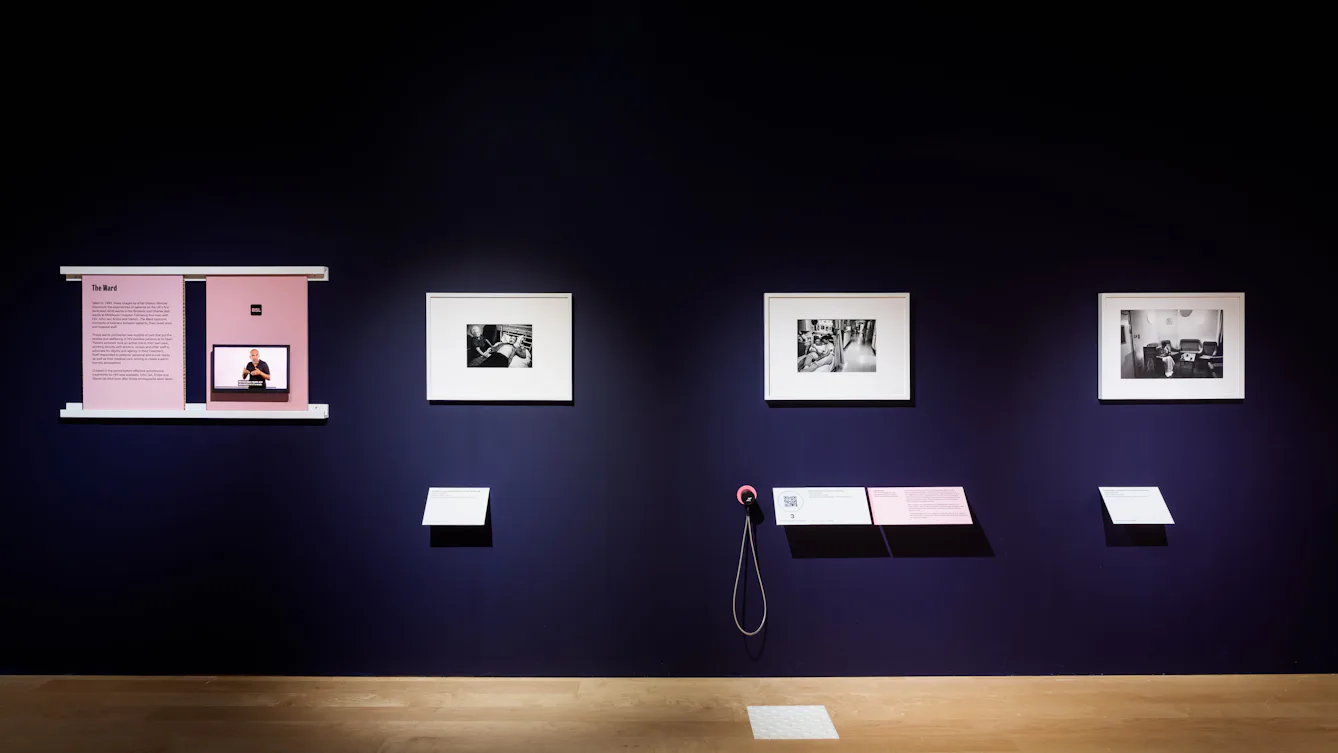
I was a ward sister on the Broderip and Charles Bell Wards at Middlesex Hospital. They were amongst the first dedicated AIDS wards in the UK.
This black-and-white image of John and his partner epitomises everything we were trying to do in encouraging patients, partners and their families to be themselves.
On the left-hand side of the photograph there’s a hospital bed, with its curtain pushed back so that it’s open to the corridor on the right-hand side. In the distance, a nurse is heading towards us.
Two white men in their late twenties are reclining on the bed, heads leaning together in conversation. They’re both in white t-shirts, one wearing shorts, the other jeans, their legs stretched out in front of them, comfortably leaning against each other in the narrow space. Above the bed, half a dozen cards are stuck to the wall, some decorated with hearts and the word LOVE, L - O - V - E.
As a student nurse, I learned about the concept of individualised patient care but never saw it in practice.
On the AIDS wards, we had the chance to make this a reality, compelled by the determination of gay and HIV activists who were fighting against stigma and for the right to high-quality, compassionate care.
We discarded the old rules. We flattened the hierarchies between doctors, nurses and patients. And we established a model of care based on choice, honesty, human rights and safety.
This was a radical shift from norms where ‘doctor knows best’, and where emotions were seen as unprofessional. In fact, as a student nurse, I was reprimanded for sitting on a patient’s bed just to comfort them.
Of course, working with patients with AIDS was tough. We dealt with difficult and tragic situations, many deaths, and attended a lot of funerals. We shed many tears but there were tears of laughter too.
We were so well supported by the gay community, the volunteers and the activists. The community put on fabulous cabarets and parties for everyone to come to, including the porters. We supported patients to go out for coffees or special events like the theatre, to help to normalise their lives.
For me, touch, shown so clearly in this photograph, was at the heart of these wards.
While some patients were deprived of human contact and love, we welcomed them with hugs, kisses and handshakes, as you do in everyday life. It showed we weren't frightened. And it showed that we cared.
The power of this one image is that it expresses what has taken me so much longer to explain in words.
And I have to say that my time on this ward was the greatest privilege in my life.
This is the end of stop 3.
To get to the next stop, turn your back on the Gideon Mendel photographs and head diagonally towards the right-hand wall.
The next exhibit is in a display case.