Please note, this exhibit contains a human umbilical cord and a depiction of a surgery.
---
I was first diagnosed with HIV in 1992, at a time when we didn’t have effective medication, and many were given just six months to live after diagnosis.
Women living with HIV were encouraged to create Memory Boxes for our children, something to remember us by after we were gone.
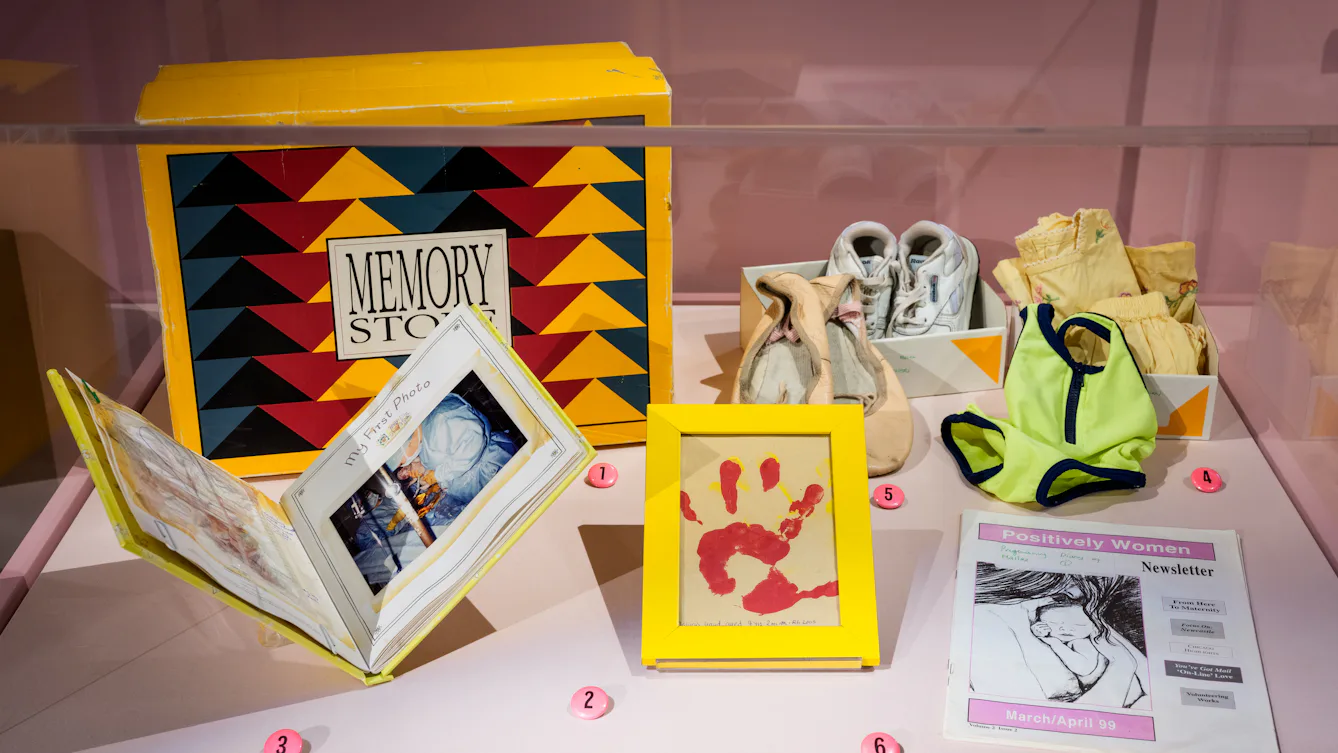
Mine is at the back of the case. It’s a bright yellow cardboard box. A colourful contrast to the dark times we were living through.
It has patterns of blue, black and red triangles at the front, resembling a woven textile and a label: ‘Memory Store’. It holds six pull-out drawers which include items important to me.
First of all, a red handprint that my daughter made at nursery school, with a bright yellow frame.
A printed baby book is opened to a page labelled ‘My First Photograph’ and I’ve added a photograph taken during the caesarean operation when she was born. I’m on the operating table, and a doctor in a blue surgical gown and mask is lifting my daughter up, still connected to me by the umbilical cord.
A piece of that umbilical cord is attached to the opposite page, in a transparent bag, along with both our hospital identification wristbands.
Folded into two drawers are some of her baby clothes: her first swimsuit, first dress, first pair of white and blue trainers. I also included her first ballet shoes of pale pink leather. From a very early age, she went to tap, jazz, ballet and African dance classes.
I put three issues of ‘Positively Women’ magazine from 1999 into the box. There’s a line drawing of a woman holding a baby on the cover of one issue.
The magazines contain my diary, published under the title ‘Pregnancy Journey’, a rare thing to talk about during this period.
Looking back on the ‘Memory Store’, I can see how the peer support I received early on in my diagnosis helped me to cope and realise my dream.
It inspired me to co-found the 4M Network of Mentor Mothers. 4M stands for my health, my choice, my child, my life.
It’s a small charity that trains and supports women living with HIV, empowering them to mentor peers through pregnancy and also support their own personal development.
It’s a reminder of just how vital one-to-one human support is for people living with HIV in all our diversities.
The final stop is in the next room.
A few steps to your right is a wide doorway.
Directly ahead is a freestanding display, including a colour photo of a South African couple embracing on a bed that echoes the black and white photo of John and his partner we heard about on the previous stop. Instead of going forward to this display, follow the wall of the room round to the left.