Hi, my name is Virginia.
I volunteer for a charity and I teach gardening classes. I try to encourage people living with HIV to reconnect with their food and the natural world through gardening.
Ever since I learned how to walk, my granddad used to bring me to the botanical gardens in Buenos Aires. In London, I work with nature every day of my life. There is beauty in nature.
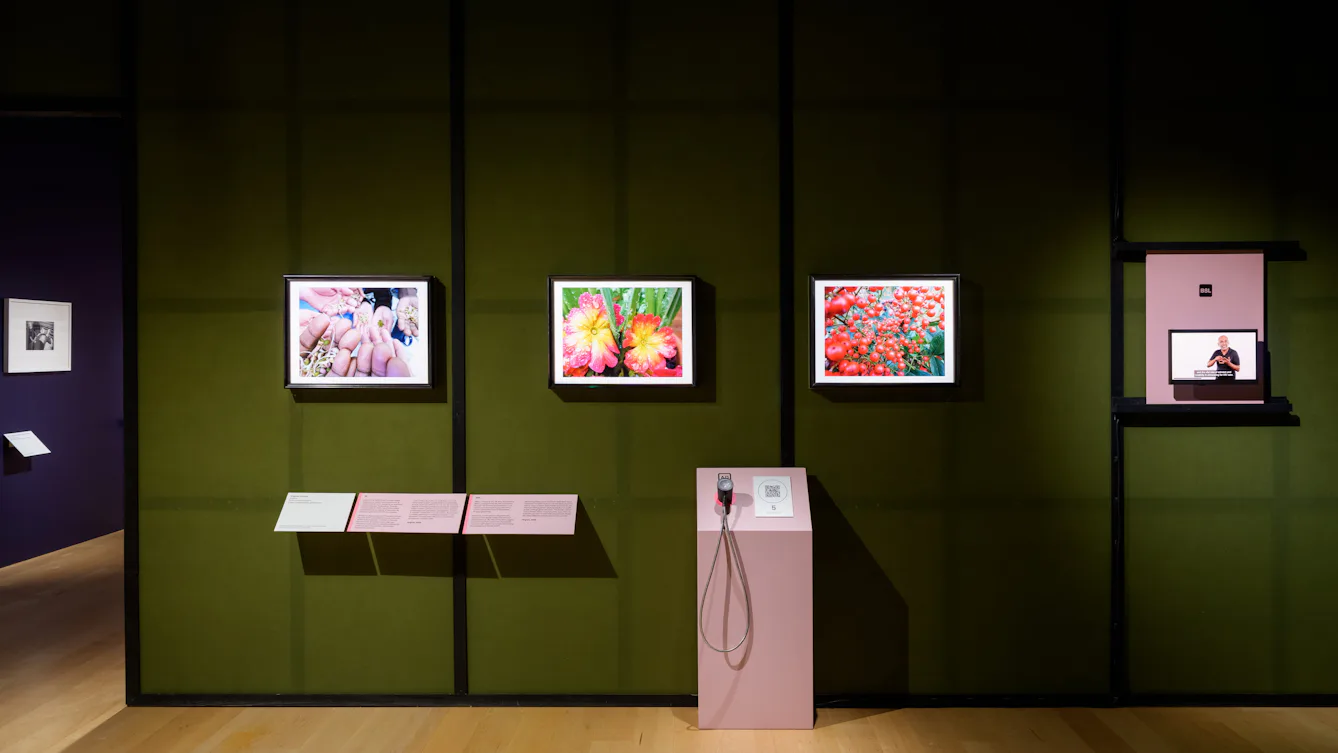
There are three photos on this wall. I am going to talk about two of them. They show my connection with nature.
One picture is a close-up of small red berries called Nandina domestica. They are glossy round berries on tiny stalks. They look like atoms exploding, with dark green leaves in the background.
The camera is so close to the bush that it feels as if you have buried your nose in the berries, like a bee searching for nectar.
Living with HIV, we need various medications and to eat well to stay healthy. Often, we don’t know what’s in the medicine we take or the food we eat.
Through interacting with plants, actually touching and growing them ourselves, we can understand and take better care of ourselves.
Through gardening, you see the cycles of life, growth, renewal, mortality and change.
The second photo is a close-up of two primroses. They have broad petals that open out flat, with a beautiful wavy edge. The petals are pale yellow in the centre, but the edges are a deep blush red. It’s a beautiful combination.
Lush green grass shoots up behind them. It’s been raining, and fat raindrops cling to the petals.
The primroses are crying. But it’s the rain that helps them to thrive.
Beautiful things make me smile.
But there are other things that you can’t photograph: all the kindness and support you experience through relationships with people.
Being an immigrant, the network I have built up in London is very important to me, including people at the clinic, at the gym, and at the gardens where I work.
This is what I say to people:
“You think you will not recover, but you must always hold on to hope.”
This is the end of the final stop.
If you keep moving around the room to your right, you will come to a round table with seating for about five people, where you’re invited to leave feedback or make a placard inspired by the exhibition.
Do let a member of staff know if you need any support.
To exit the exhibition, return to the first room.