Hello, my name is Sebastian Crutch, and I’m Professor of Neuropsychology at the Dementia Research Center at UCL, where I have the privilege of working with people with young-onset and rarer forms of dementia.
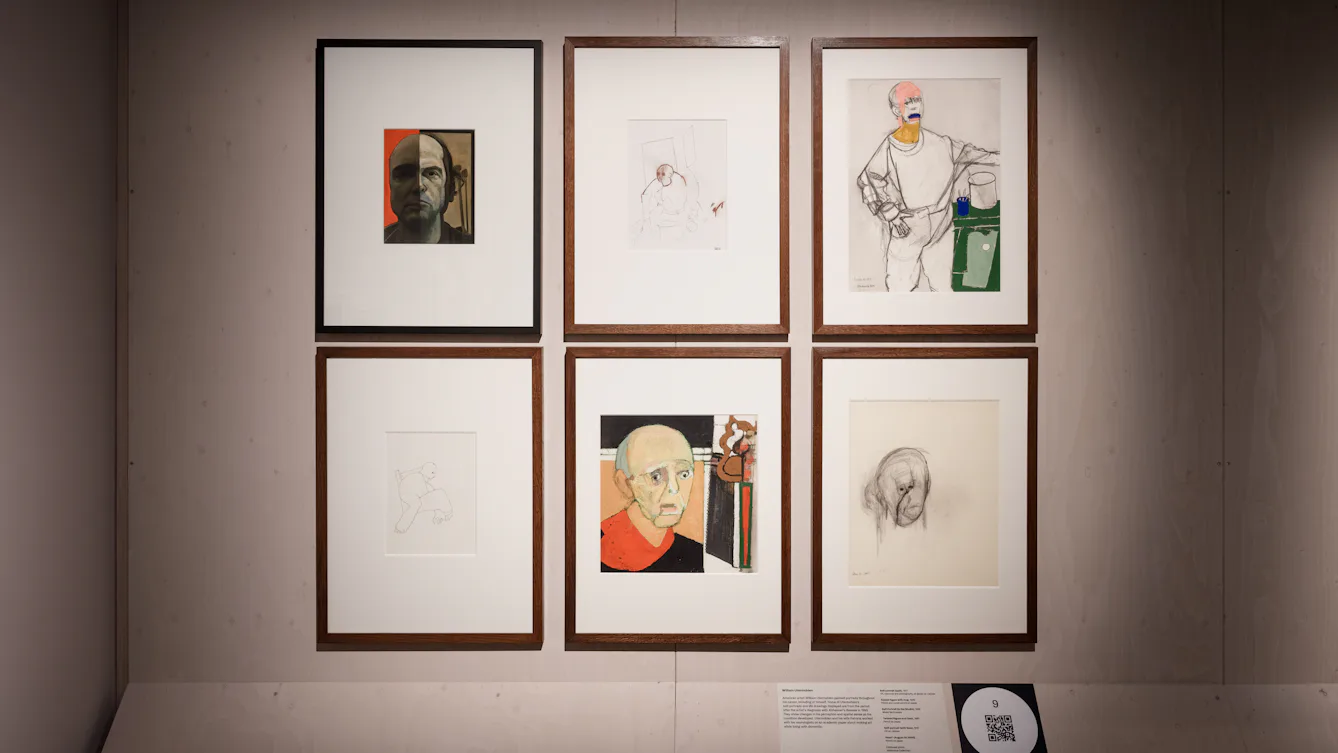
You are now facing a wall of self-portraits by William Utermohlen. This series of six self-portraits, arranged in two rows of three show changes in his perception and spatial sense as his Alzheimer’s disease progressed.
The first is the self-portrait on the upper row, furthest to the left. This work, titled ‘Split’, was produced in 1977 – 18 years before Utermohlen’s Alzheimer’s diagnosis.
Measuring 25.5 cm high by 20 cm wide and combining paint, charcoal and photography, this work is characterised by a sharp vertical division down the centre that splits the portrait into two distinct halves. Utermohlen, a light-skinned man, is shown from the neck up, directly facing the viewer, with a strong but calm expression on his face.
A perfectly straight vertical line runs down the centre of the canvas, sharply dividing his face and the background. On the left side, his head, face and neck are depicted in deep brown and grey shadows, making his features visible but heavily obscured against a solid, vibrant red background. The right side of his face is brightly lit with a pale complexion using shades of white, light blue and hints of yellow and green. On this side, his eye is clearly defined, and wisps of dark, wavy hair are visible near his ear against a muted, brownish-gold background.
The other self-portrait I will describe is on the bottom row, furthest to the right. This work, ‘Head 1’, measuring 61 cm high by 45 cm wide and dating from 2000, is one of the last Utermohlen produced before he died in 2007. It is a pencil drawing of a minimalist, abstract self-portrait of a head. It is composed of frantic, dense layers of greyish-black pencil lines that form a roughly oval shape.
The most prominent feature is a deep, dark vertical crevice that curves through the centre of the head. There are two small, dark circular marks that suggest eyes or nostrils. The overall shape is lumpy and irregular.
The linework is heavy and energetic. At the bottom the pencil strokes become looser and more vertical, bleeding downward into the white space of the paper. The surrounding background remains entirely blank, emphasising the isolated, floating nature of the head.
I was introduced to Bill by a wonderful lead research nurse called Ron Isaacs when I joined the Dementia Research Centre as a research assistant. Bill also later volunteered for a brain-imaging study involving multiple scans over the course of a year, providing lots of opportunity for conversation during his and his wife Pat’s visits to our hospital in Queen Square.
I remember being particularly struck a sense of Bill’s uncertainty in some of his earlier works. He showed us one portrait, for example, of him sitting at a table below a partially open skylight, gripping the edges of the table, and indicating that he was torn between holding on for dear life and trying to get out; this seemed particularly poignant.
We were particularly intrigued by the way that Bill and Pat said during his career he had often painted and then rubbed out and repainted sections of his paintings. We were keen to try to understand whether, as his dementia-related visual challenges developed, whether this happened more often.
Certainly in the years since, we’ve understood more about how people with similar conditions have a reduced “effective field of vision”, meaning it can be difficult to perceive a whole scene or face as one intuitive whole, and instead people have to inspect each element individually, as if to pull together the pieces of a puzzle.
We also were informed by a line drawing that Bill drew once for us with pencil and paper on one of his visits to our offices. The figure he created was drawn fluently and confidently and was infinitely more stylish and dynamic than anything I could produce. But when he finished, Bill sensed there was something not quite right about what he had drawn, but he couldn’t tell what the problem was. He couldn’t see at that moment that he had drawn both arms protruding from the same shoulder socket.
In our conversations and time with Bill and Pat, it became clear what an important part art-making was of everyday life, and that indeed just prior to his diagnosis Bill was continuing with the daily rhythm of going to his studio even when he had actually stopped painting at that point.
Bill’s paintings and his descriptions of the act of creating them helped me to understand how Alzheimer’s disease, which many people think just affects memory, can affect our spatial and perceptual skills and other abilities.
As I often say when I share Bill’s story, in my talks around the world, his self-portraits convey much more about both the lived experience and the biology of living with Alzheimer’s disease than any brain scan or graph I could ever show you. And I remain unendingly grateful to Bill and Pat for allowing such an intimate testimony to be shared, and for the resilient creativity it took for Bill to make the works you see before you.
This is the end of Stop 9.