Hi, my name is Serena Korda and I’ll be talking to you about my work ‘Wild Apples’.
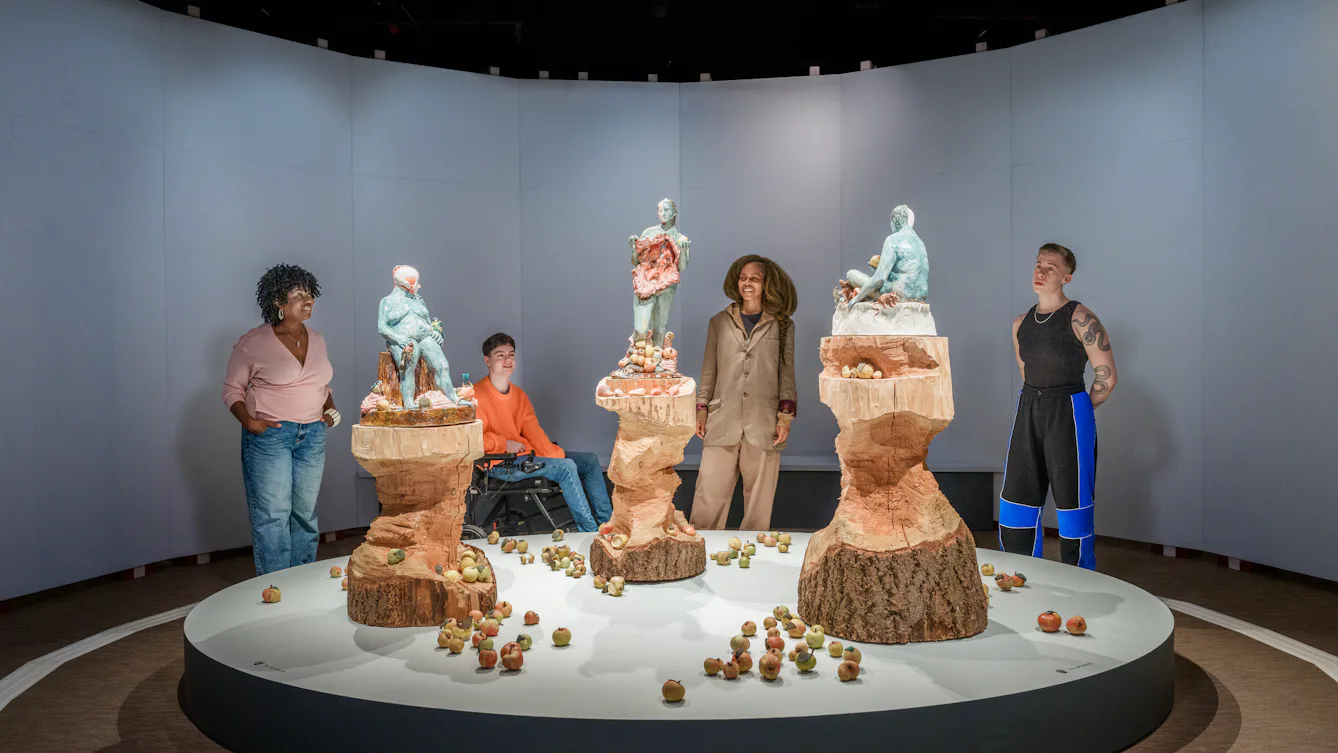
In the circular room in front of you are three ceramic sculptures of female figures. Each figure is smaller than life-size and modelled from real women: Jill, Babs and me. Their bodies are detailed and individual. The curve of a back, the softness of a stomach and the particular way each figure holds herself were carefully sculpted in clay.
The three ceramic figures have a bluey-green glaze. The figure furthest to the left, Jill, is seated with her legs crossed, her head tilted downward, contemplating the apple she is holding in her right hand. One side of her face has been stripped of flesh, exposing a white skull and eyeball.
Her abdomen is open, revealing sculpted internal organs in pink and red tones, outlined in blue and red.
The figure in the centre is me. I’m standing upright with my right leg bent slightly at the knee. Like Jill, the right side of my face is stripped of flesh, exposing a white skull, eyeball, and pink and red flesh-coloured muscles. The wide, forward-facing eyes create an intense gaze. The front of my torso is splayed open whilst my right hand delicately holds a flap of skin. This reveals a scientific rendering of the abdominal cavity in red, blue, pink and dark brown. On the tree-trunk shelf, the internal organs are displayed. The exposed interior is framed by thick, textured layers that resemble fatty tissue. In one hand I hold a yellow, shrivelled apple.
The woman to the right, Babs, is resting on a brown tree stump. Like the two other figures, her head is divided down the centre. Half is bluey-green and textured like the rest of the body. The other half has the white skull, eyeballs and muscle exposed. She is gazing down. She seems to be focused on a small bird with blue and yellow feathers that’s perched on her arm.
Another small red and brown bird is perched on one of her thighs. Two more birds are perched around the tree stump. One of the birds is picking at intestines around the bottom of the tree stump.
The three women stand on roughly carved tree trunks. The wood is hacked and uneven, in deliberate contrast to the careful modelling of the bodies. Around the base of each sculpture are hand-painted ceramic apples scattered across the floor. Some are bruised and misshapen, others smoother and brighter, creating a sense of both playfulness and decay. The audio playing in the space captures field recordings of wassailing, an ancient Somerset ritual in which people sing to apple trees, warding off evil spirits.
‘Wild Apples’ grew out of my long-standing interest in the different stages of womanhood: the Maiden, the Mother, the Wild Woman and the Crone, and the pressures placed on women at these significant moments of transition. At the time, I was experiencing perimenopause and wanted to reframe this profound hormonal shift away from narratives of loss and decline, and toward celebration, power and ritual. The work was also shaped by the recent loss of my mother, becoming a space to grieve both her and wider cultural attitudes to ageing and older women. Through the project, I gave form to my anger around the gender health gap and challenged the ways older women are so often overlooked or erased, attempting to reclaim the word ‘crone’ whilst doing so.
I was also responding to art-historical and medical representations of women, particularly the slashed Venuses used as diagnostic tools from the 18th century onwards. These were often hypersexualised wax depictions of the dissected female figure. My figures draw from and mock this tradition, reclaiming agency by appearing, to some extent, in control of their own dissection.
The women who took part came through an open call and had never modelled before. They were in perimenopause, menopause, or beyond, and their willingness to undertake such a vulnerable process shaped the work profoundly.
Working in clay connects me to a long material history, and these sculptures deliberately distort the domestic ornaments I remember from my childhood, challenging narrow ideas of femininity and beauty. The hacked tree trunks create a deliberate tension between intricacy and destruction.
Folklore and ritual also inform the work. The hand-painted apples reference Eve, reimagined as wise and curious, and the tradition of wassailing, an act of care for ageing trees. As symbols of ovaries and fertility, they suggest that even older bodies retain creative potential.
Making ‘Wild Apples’ transformed how I see ageing, allowing me to recognise the beauty, wisdom, and power of women in their crone phase whilst carrying that understanding into my own life.
This is the end of Stop 8.