121 results filtered with: Psychology - History
- Pictures
The brain, sectioned vertically; showing the sites of some phrenological faculties. Process print, 1901, after etching, 1809.
Date: 1901Reference: 28020i
- Pictures
- Online
Head of a boy in profile, used to illustrate phrenological classifications of mental pathology.
Date: [1900?]Reference: 28357i
- Pictures
- Online
Joseph Millot Severn, a British phrenologist, examining a boy. Colour process print, c. 1929.
Date: [1929]Reference: 27599i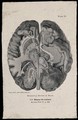
- Pictures
- Online
The brain seen from the underside, sectioned horizontally; with attention to the part associated by Hollander's system of phrenology with memory for numbers. Process print, 1901, after etching, 1809.
Date: 1901Reference: 28017i
- Pictures
- Online
A man challenges another; exhibiting boldness, classed phrenologically under the 'propensity' of combativeness. Steel engraving by Contenau, 1847, after H. Bruyères.
Bruyères, Hippolyte.Date: [1847]Reference: 27614i- Books
Elements of psychology : included in a critical examination of Locke's Essay on the human understanding / by Victor Cousin ... translated from the French, with an introduction, notes, and additions, by C.S. Henry.
Victor CousinDate: 1834
- Pictures
- Online
Medusa presiding over groups of satyrs who are gambling; representing gambling or gaming as a passion. Etching by J. Audran after C. Gillot.
Claude GillotReference: 26876i
- Pictures
- Online
Child's head with large temporal lobes and depressed frontal lobe. Drawing, c. 1900.
Date: c. 1900Reference: 28388i
- Pictures
- Online
Two sections of the brain, divided into different lobes and faculties, according to Hollander's system of phrenology. Pen drawing, c. 1902.
Date: 1902Reference: 27965i- Pictures
Skull of a New Hollander (native Australian): profile. Lithograph, c. 1835.
Date: 1835Reference: 28127i
- Pictures
- Online
The human head, divided according to the system of phrenology. Coloured lithograph by C. Ingrey, 1824.
Date: 1824Reference: 27671i- Books
Geschichte der deutschen Psychologie im 20. Jahrhundert : ein Überblick / Mitchell G. Ash, Ulfried Geuter (Hrsg.).
Date: [1985], ©1985
- Pictures
- Online
A man woos a woman in a garden; representing the sanguine temperament. Engraving by R. Sadeler after M. de Vos.
Maerten de VosReference: 26879i- Books
Working with Piaget : essays in honour of Bärbel Inhelder / edited by Anastasia Tryphon and Jacques Vonèche.
Date: 2001
- Pictures
- Online
Head of woman showing musical ability, according to phrenological classification. Drawing, c. 1900.
Date: c. 1900Reference: 28389i
- Pictures
- Online
A phrenologist and some society people in a parlour. Coloured lithograph by H. Jannin after L.C. Bommier (?).
Bommier, L. C., active 1841-1862.Date: [between 1850 and 1862]Reference: 27461i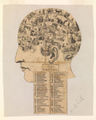
- Pictures
- Online
A head divided into thirty seven compartments, each containing an image representing a phrenological faculty. Wood engraving, after O.S. Fowler, c. 1840.
Orson S. FowlerReference: 27714i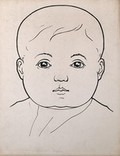
- Pictures
- Online
Head of a child with large cheeks. Drawing, c. 1900.
Date: c. 1900Reference: 28390i
- Pictures
Four heads of men who each exhibit one of the four temperaments: (clockwise from top left) lymphatic, sanguine, bilious, and nervous. Engraving by W. Johnson and A.K. Johnson, early 19th century.
Reference: 35144i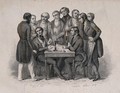
- Pictures
- Online
A crowd watches as two men gamble; representing the phrenological faculty of acquisitiveness. Steel engraving by L.A. Portier, 1847, after H. Bruyères.
Bruyères, Hippolyte.Date: [1847]Reference: 27617i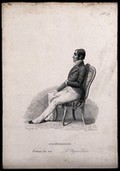
- Pictures
- Online
A man sitting erect on a chair; representing pride as a type of the 'sentiment' of self esteem, a phrenological 'faculty'. Steel engraving by C. Devrits, 1847, after H. Bruyères.
Bruyères, Hippolyte.Date: [1847]Reference: 27619i
- Pictures
A depressed scholar surrounded by mythological figures; representing the melancholy temperament. Etching by J.D. Nessenthaler, ca. 1750.
Nessenthaler, Johann David, 1717?-1766.Reference: 26893i
- Pictures
- Online
Death mask of Martin, a parricide. Lithograph, c. 1835.
Date: [1835]Reference: 28231i
- Pictures
- Online
A woman in evening dress, attended by a man; the woman representing the 'sentiment' of self esteem, a 'faculty' according to phrenology. Steel engraving by J-I-L. Desjardins, 1847, after H. Bruyères.
Bruyères, Hippolyte.Date: [1847]Reference: 27618i
- Pictures
Cupid presides over a group of naked women who sit separated from groups of yearning men; symbolising the passion of love. Etching by J. Audran after C. Gillot.
Claude GillotReference: 26874i