When researcher and curator Kierri Price finally got to examine a 500-year-old medieval scroll in person, the experience was unexpectedly emotional. Being able to 'touch' the past was a privilege that was accompanied by a sense of responsibility to protect this frail object for future generations.
Close encounter with a medieval birth scroll
Words by Dr Kierri Pricephotography by Benjamin Gilbertaverage reading time 6 minutes
- Article

Dr Kierri Price with a facsimile of birthing scroll MS 632. Photo: Benjamin Gilbert. Attribution-NonCommercial 4.0 International (CC BY-NC 4.0).
Wellcome Collection holds an incredibly rare manuscript – a medieval English birth girdle – listed in the catalogue as Wellcome MS.632(view in catalogue). Dating to roughly 1500 CE, this three-metre-long parchment roll – the length of an average town car – is incredibly fragile. Over the past 500 years it has been used so extensively that many sections of text are completely illegible, and illustrations throughout are barely visible. Every time this manuscript is unrolled and rerolled, there is a risk of damage.
My PhD research focused on the relationship between bodies and books as physical objects. I’d seen a digitised version of the scroll before, but I wanted to understand the manuscript better as a tactile object, so a face-to-face encounter was hugely important. On 13 March 2020, I got to see Wellcome MS.632 in person.
Normally, viewing items from the stores at Wellcome Collection is a relatively straightforward process: you request the item from the online catalogue, and it is delivered to the Rare Materials Room in the library. Viewing Wellcome MS.632 is very different. I had to get special permission to examine it in the museum’s conservation studio, in the presence of the conservator, Stefania Signorello.
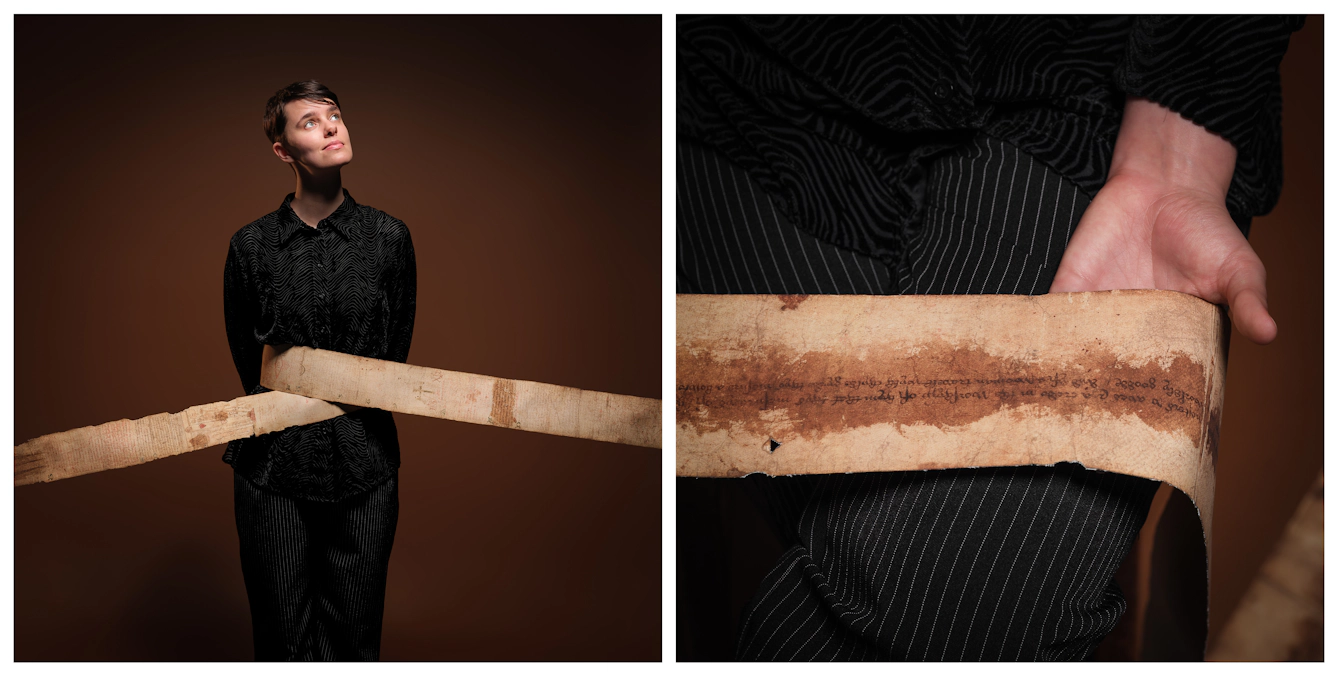
Dr Kierri Price with a facsimile of birthing scroll MS 632. Photo: Benjamin Gilbert. Attribution-NonCommercial 4.0 International (CC BY-NC 4.0).
Dr Kierri Price with a facsimilie of the medieval birth scroll, Wellcome MS.632. The reproduction was created for the 'Expecting: Birth, Belief and Protection' display at Wellcome Collection, 24 October 2025 – 19 April 2026.
Touching the past
I was struck by my sense of anticipation – consulting manuscripts is always exciting for me – but this was different. In the conservation studio, the table surface had been specially cleaned in preparation, a set of disc-like archival weights for holding the manuscript in place set out in readiness.
With a delicate sense of ceremony, Stefania removed the roll from its storage box and gently unrolled it section by section, while I placed a tape measure (initially the wrong way up) beside it. Stefania and I were the only ones in the conservation studio, and the room felt appropriately hushed in recognition of this special moment.
Stefania was the one to manipulate the manuscript, which could only be unrolled a small section at a time. I was another pair of hands where needed, and we only did what she was comfortable to do with the girdle. Over the course of an hour, under her protective direction, I took some photographs, measured the sections of parchment that were stitched together to make this long roll, and, keeping tentatively to the margins, even touched it with bare fingertips.
When I reached some stains on the parchment, I had to pause to gather myself. These were marks left behind by people long dead, a tangible connection to the past. It feels quite radical to talk about your feelings when doing archival research, as though there’s something inherently un-academic about having an emotional response. For me, getting to see this manuscript in person made it real in a way that viewing a digital proxy simply couldn’t recreate. The actual size, shape and texture added a poignant recognition of the manuscript’s current fragility.
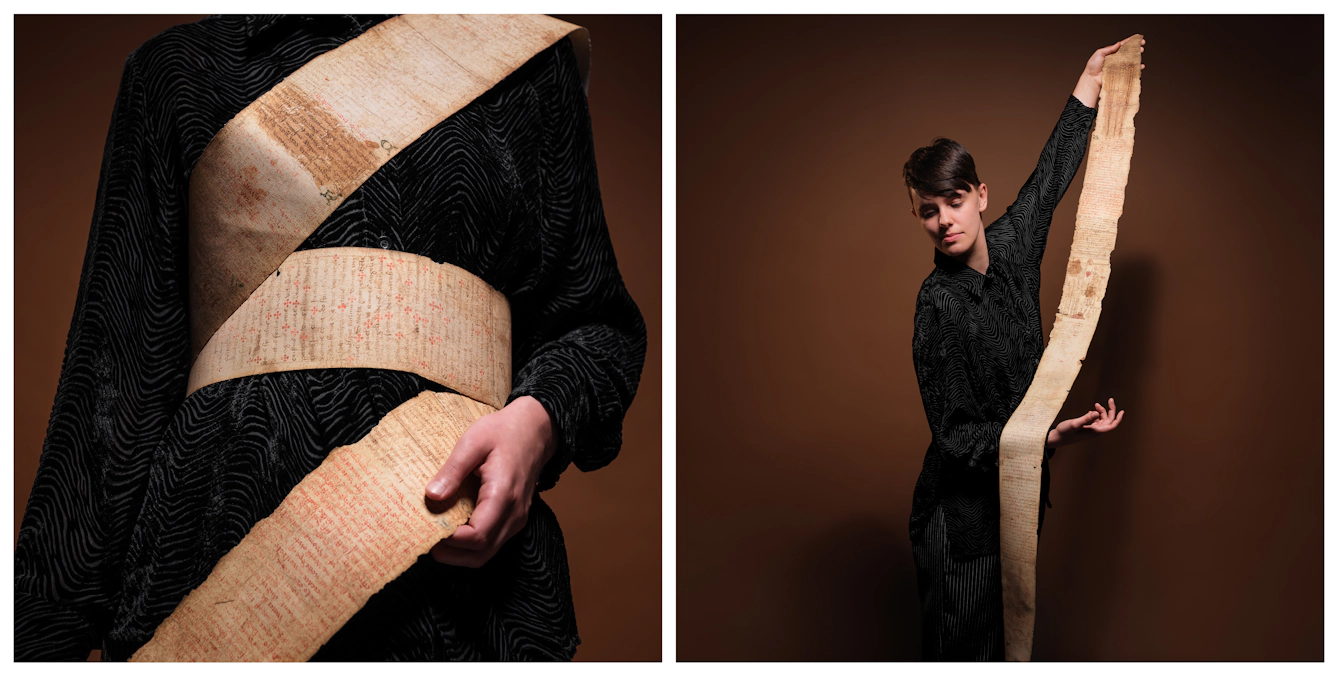
Dr Kierri Price with a facsimile of birthing scroll MS 632. Photo: Benjamin Gilbert. Attribution-NonCommercial 4.0 International (CC BY-NC 4.0).
Kierri demonstrates how the canvas facsimile, which reproduces all the text, images and markings of the original, allows the modern user to experience it as a physical object in relation to the body.
Virtual recreations vs real objects
Digitised manuscripts are a wonderful resource and research tool in one. They allow you to travel the globe virtually from the comfort of your own device while researching in your pyjamas at 2 am! You can glean more information through zooming in, or by changing contrast and brightness settings; you can download and print your own personal copy and create your own archive of rare materials. When archives closed during the Covid pandemic, digital facsimiles were the only way I could continue my PhD studies.
But what digitised manuscripts don’t give you is the sounds, smells and feel of the physical manuscript. MS.632, on that day, in the conservation studio, was a real object and the impact of this encounter wasn’t lost on me. Seeing and handling the manuscript in person was a privilege, but one that risked causing further damage to an already delicate object.
For every request to see the scroll in person, Wellcome’s conservation team has to weigh up the potential benefits of new understandings and avenues for scholarly exploration against their duty to preserve the manuscript for future generations. My single research session with the scroll eventually led to a temporary exhibition – ‘Expecting: Birth, Belief and Protection’ – where MS.632 was put on public display, enabling thousands of visitors a rare chance to have their own personal encounter with this 500-year-old medieval birth girdle.
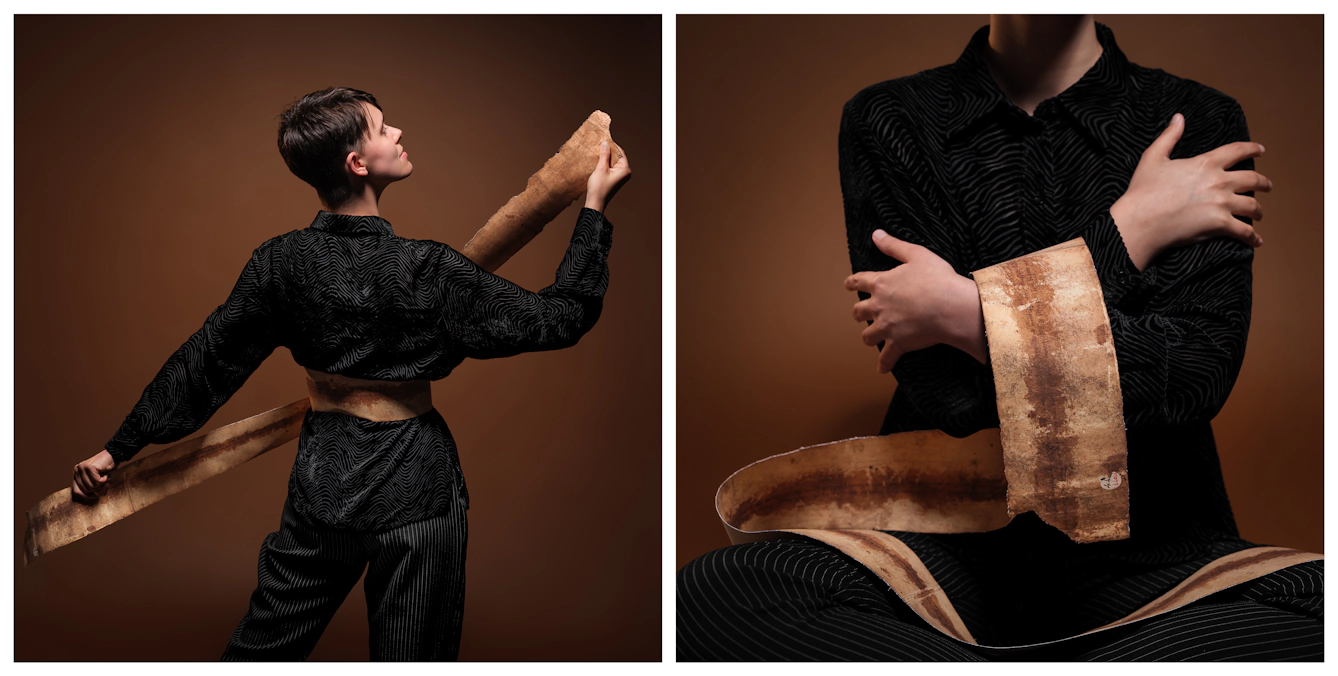
Dr Kierri Price with a facsimile of birthing scroll MS 632. Photo: Benjamin Gilbert. Attribution-NonCommercial 4.0 International (CC BY-NC 4.0).
The facsimile scroll and the online digitised copy(view in catalogue) are ways to protect the original manuscript from further damage while allowing researchers to understand the scroll for themselves.
Medieval encounters
The manuscript was written on sheepskin parchment, which is both robust and flexible, and ideal for a portable scroll intended for heavy use and manipulation. Inevitably, 500 years of wear and tear have turned it into the fragile and vulnerable object that now rests at Wellcome Collection. As with all the few remaining medieval birth girdles in the world, it can only be seen and used in a sterile, contained and restricted environment.
For medieval people, the scroll offered protection against a number of perilous situations, including childbirth, battle and the plague. Through a combination of images, prayers and instructions to the reader/user, the birth girdle invoked the protective intervention of saints and other holy figures in in several ways.
A user could touch or even kiss images to venerate them (resulting in the worn-away ink on an illustration of Christ’s side wound on the face (front) side of the manuscript). One instruction for general protection was simply to “beryth thys mesure uppon hym” [carry this length upon them] and recite a short number of prayers.
For a pregnant or labouring woman, the instruction was to “gyrde thys mesure abowte hyr wombe” [wrap this length around her belly] for a successful delivery. ‘Wearing’ MS.632 as a girdle created friction against the body, further degrading the surface of the parchment, and recent biochemical analysis of material from the parchment confirms that stains and marks on the surface are evidence of its use during labour and childbirth.
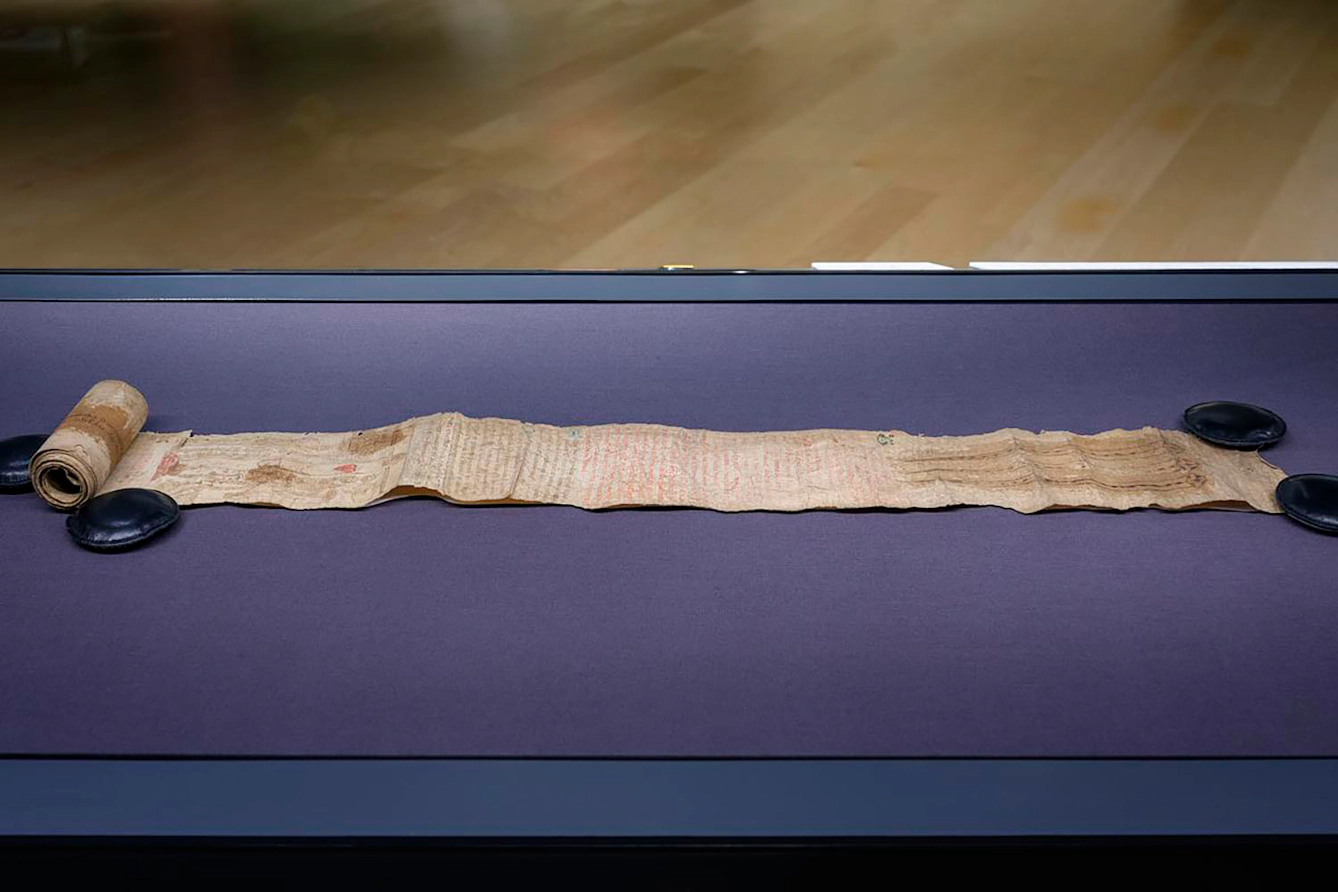
Birth scroll with prayers and invocations to Saints Quiricus and Julitta Saints Quiricus & Julitta, Photographer: Steven Pocock, 2025. Source: Wellcome Collection. © Wellcome Collection. Attribution-NonCommercial-NoDerivatives 4.0 International (CC BY-NC-ND 4.0).
The original birth scroll Wellcome MS.632 (seen here) was on display in the 'Expecting' exhibition for six months under carefully controlled environmental conditions. It was then returned to the museum stores for safe-keeping.
Ultimately, MS.632 was a communal object, likely circulated within a particular network, and handed down from one generation to the next, creating a lineage of people who drew on it for reassurance and support.
The archival research I conduct as a medievalist is a very different kind of ‘use’ of the birth girdle, but I can still remain sensitive to MS.632’s immensely personal origins. It was an artefact used in intense, stressful situations, and – through stains, smudges, rips, and tears – it holds a tangible record of the emotional experiences of people which might otherwise be lost. Recognising and permitting my own emotional response to encountering MS.632 feels somehow respectful.
About the contributors

Dr Kierri Price
(they/them)
Author
Kierri is one of the curators of the Wellcome Collection exhibition ‘Expecting: Birth, Belief and Protection’. They are an independent researcher and former CHASE Arts and Humanities Research Council-funded PhD student, based jointly at Birkbeck, University of London and Wellcome Collection. Their research focuses on the manuscripts and artefacts of late medieval England, particularly those that relate to interactivity, accessibility and the protection of the body and the soul.

Benjamin Gilbert
Photographer
Ben is a senior photographer for Wellcome. He is happiest when telling stories with his photographs, whether that be the health implications of rural-to-urban migration in India, or the dedication of the workers who power the NHS.
Lalita Kaplish
(she/her)
Commissioning editor
Lalita is a digital content editor at Wellcome Collection with particular interests in the histories of science and medicine and discovering hidden stories in our collections.