Improvements in and relating to nail cutters and the like / [Ernst Kaufmann].
- Kaufmann, Ernst
- Date:
- 1903
Licence: Public Domain Mark
Credit: Improvements in and relating to nail cutters and the like / [Ernst Kaufmann]. Source: Wellcome Collection.
1/4
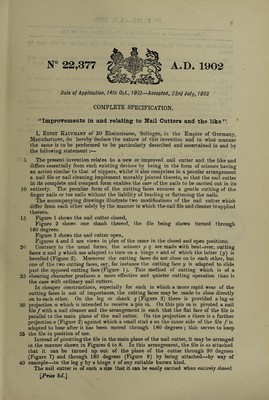
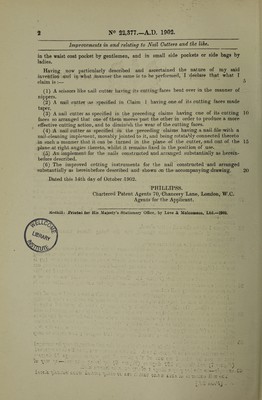
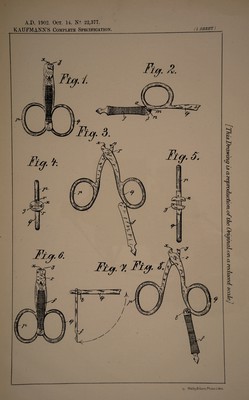
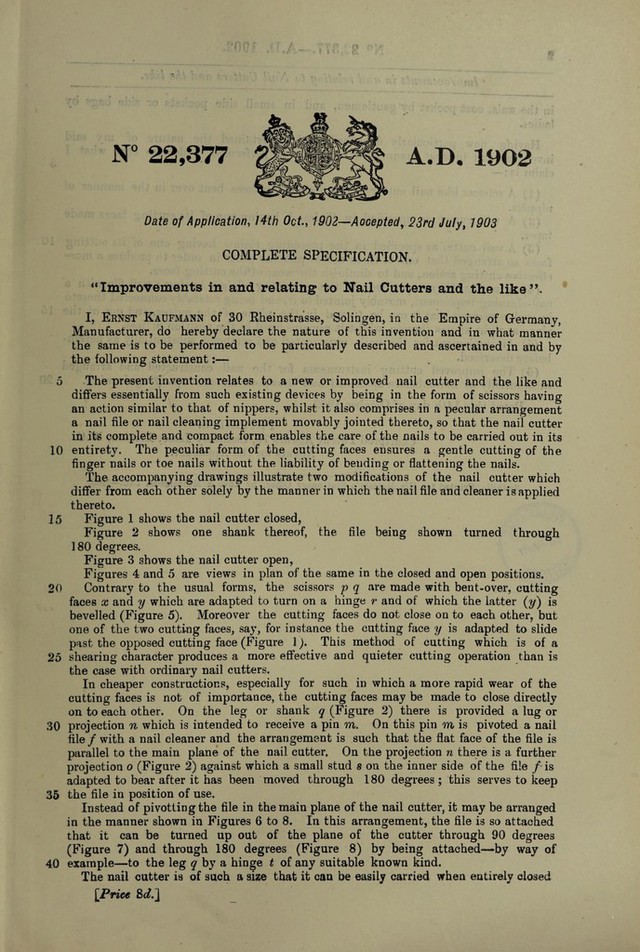
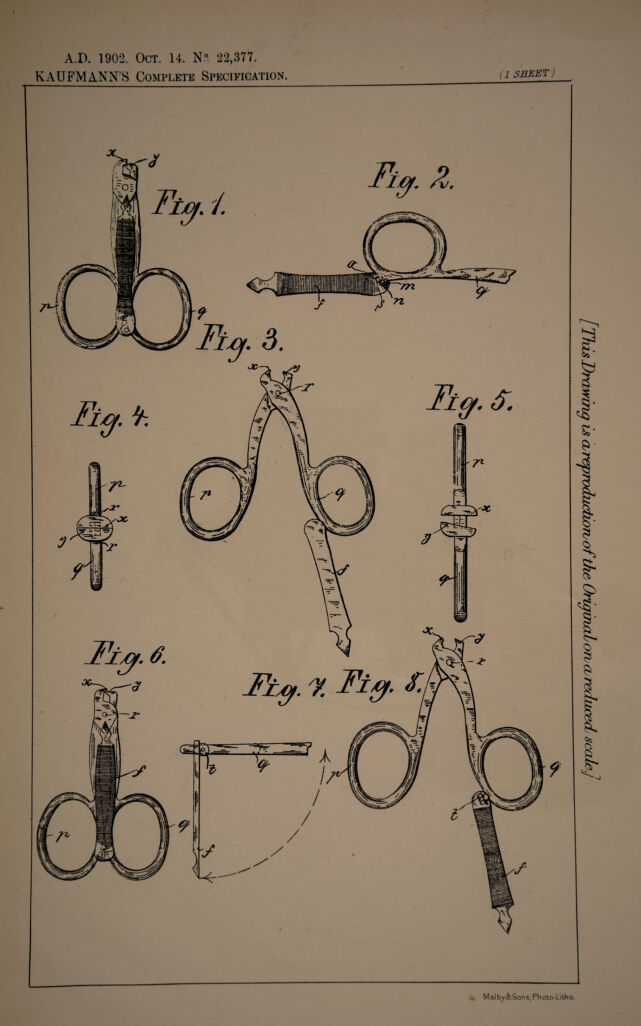
![()■ f I l ' F; n.,- N° 22,377 A.D. 1902 Date of Application, 14th Oct., 1902—Accepted, 23rd July, 1903 COMPLETE SPECIFICATION. ‘‘Improvements in and relating to Nail Cutters and the like”. I, Ernst Kaufmann of 30 Rheinstrasse, Solingen, in the Empire of Germany, Manufacturer, do hereby declare the nature of this invention and in what manner the same is to be performed to be particularly described and ascertained in and by the following statement:— 5 The present invention relates to a new or improved nail cutter and the like and differs essentially from such existing devices by being in the form of scissors having an action similar to that of nippers, whilst it also comprises in a pecular arrangement a nail file or nail cleaning implement movably jointed thereto, so that the nail cutter in its complete and compact form enables the care of the nails to be carried out in its 10 entirety. The peculiar form of the cutting faces ensures a gentle cutting of the finger nails or toe nails without the liability of bending or flattening the nails. The accompanying drawings illustrate two modifications of the nail cutter which differ from each other solely by the manner in which the nail file and cleaner is applied thereto. 15 Figure 1 shows the nail cutter closed, Figure 2 shows one shank thereof, the file being shown turned through 180 degrees. Figure 3 shows the nail cutter open, Figures 4 and 5 are views in plan of the same in the closed and open positions. 20 Contrary to the usual forms, the scissors p q are made with bent-over, cutting faces x and y which are adapted to turn on a hinge r and of which the latter (y) is bevelled (Figure 5). Moreover the cutting faces do not close on to each other, but one of the two cutting faces, say, for instance the cutting face y is adapted to slide past the opposed cutting face (Figure 1). This method of cutting which is of a 25 shearing character produces a more effective and quieter cutting operation than is the case with ordinary nail cutters. In cheaper constructions, especially for such in which a more rapid wear of the cutting faces is not of importance, the cutting faces may be made to close directly on to each other. On the leg or shank q (Figure 2) there is provided a lug or 30 projection n which is intended to receive a pin m. On this pin m is pivoted a nail file / with a nail cleaner and the arrangement is such that the flat face of the file is parallel to the main plane of the nail cutter. On the projection n there is a further projection o (Figure 2) against which a small stud s on the inner side of the file / is adapted to bear after it has been moved through 180 degrees ; this serves to keep 35 the file in position of use. Instead of pivottingthe file in the main plane of the nail cutter, it may be arranged in the manner shown in Figures 6 to 8. In this arrangement, the file is so attached that it can be turned up out of the plane of the cutter through 90 degrees (Figure 7) and through 180 degrees (Figure 8) by being attached—by way of 40 example—to the leg q by a hinge t of any suitable known kind. The nail cutter is of such a size that it can be easily carried when entirely closed [Price 8c?.]](https://iiif.wellcomecollection.org/image/b30738945_0001.jp2/full/800%2C/0/default.jpg)