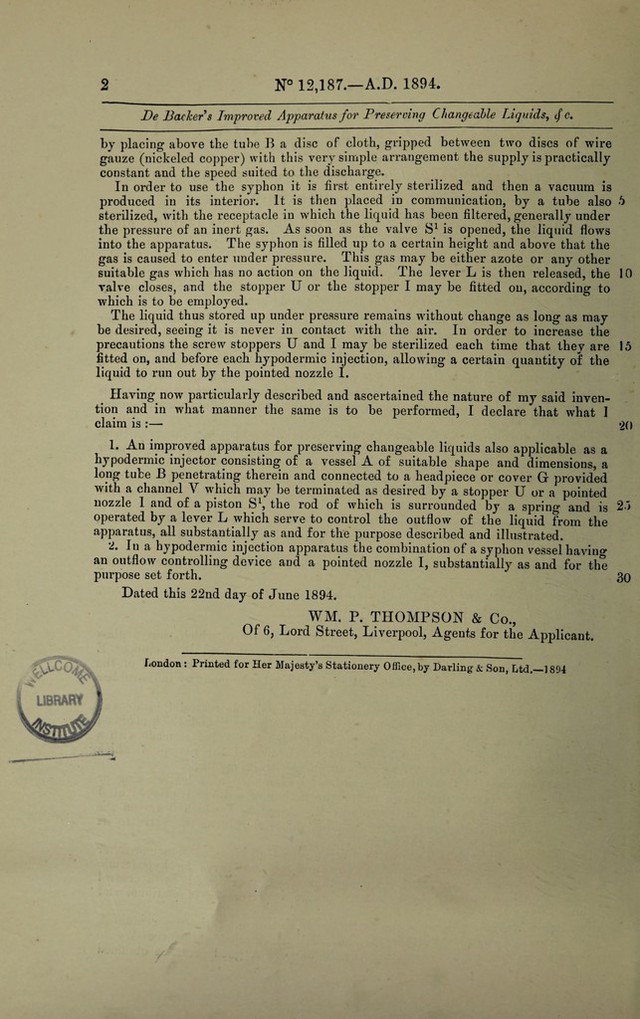
An improved apparatus for preserving changeable liquids, also applicable as a hypodermic injector / [Felix De Backer].
- Backer, Félix de, 1851-1927.
- Date:
- 1894
Licence: Public Domain Mark
Credit: An improved apparatus for preserving changeable liquids, also applicable as a hypodermic injector / [Felix De Backer]. Source: Wellcome Collection.
1/4
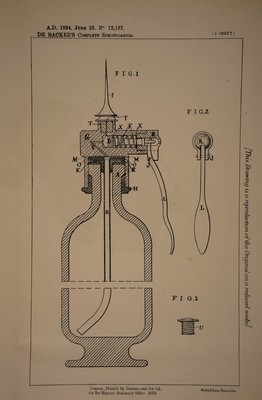
![N° 12,187 A.D. 1894 Date of Application, 23rcl June, 1894—Accepted, 28th July, 1894 COMPLETE SPECIFICATION. An Improved Apparatus for Preserving* Changeable Liquids, also applicable as a Hypodermic Injector. I, Felix de Backer, of 53, Hue de la Chaussee d’Antin, Paris, in the Republic of France, Doctor of Medicine, do hereby declare the nature of this invention and in what manner the same is to be performed, to be particularly described and ascertained in and by the following statement:— A certain number of liquids cannot be preserved in contact with the air, either because the presence of oxygen produces in these bodies fermentation or decom¬ position, or on account of the germs which the air contains. These liquids have indeed been momentarily enclosed for the purpose of hypodermic injections in phials or vessels of glass sealed with a lamp, and which are opened at the moment 10 of using, but the moment the mouth of the vessel is broken contact with the air is established which is immediately deleterious, and further any liquid which remains over must be thrown away. The syphon which forms the object of this invention avoids these inconveniences and solves completely the problem of preserving changeable liquids, and of their 15 easy use when required. In fact this syphon which may be made of any suitable dimensions may contain as much liquid as desired; the liquid itself enclosed under pressure is drawn from it as required, and the bottle whilst being emptied never allows the external air to penetrate. Finally for hypodermic injections a needle is fixed at the mouth of the syphon, 2b so that the liquid passes from the interior of the bottle under the skin without any contact with the air. The apparatus is shown in section on an enlarged scale in the accompanying drawing. Figure 1 is a sectional elevation of the whole apparatus, 25 Figure 2 a separate view of the lever, and Figure 3 a separate view of the screw stopper. It is composed of a bottle A of thick glass in the centre of which runs a glass tube B which descends to the bottom. This tube is mounted in a stopper E preferably of pure tin. A screwed ring H also of tin, allows the head of the 30 syphon to be fixed to the neck of the bottle ; tight joints are made by india-rubber washers K and O. This head piece G of nickeled bronze or any other suitable material inside and outside, has a cylindrical recess which receives a piston valve S1 and which is closed by a screw stopper R also made of similar material. The valve is made with a 35 plug point for closing or opening as desired the mouth of the passage Y which places the interior of the stopper in communication with its mouth. The part forming the tight fitting piston head is composed of a leather ring or washer D. The valve is withdrawn under the action of a lever L pivoted at J which passes through two lugs of the stopper R. A spring F which bears on the 41’ two discs X of nickeled copper or other suitable material returns the valve to its seat as soon as the hand quits the lever L. The mouth of the syphon is closed by a screw plug U of nickeled bronze or other suitable material (see Figure 3). When the apparatus is to serve for hypodermic injections the plug U is replaced by. another one T perforated by a central 45 passage Y and surmounted by a pointed nozzle I preferably of platinum and iridium, Figure 1. Tbe liquor being driven out of the bottle by the pressure of the gas contained, which pressure naturally decreases as the bottle is emptied, it is necessary to employ an arrangement for regulating the discharge. A good result is obtained [ Price 8d.]](https://iiif.wellcomecollection.org/image/b3073888x_0001.jp2/full/800%2C/0/default.jpg)