Portable apparatus for treating a patient with a medicated or tempered atmosphere / [Auguste Cazaux].
- Cazaux, Auguste.
- Date:
- 1893
Licence: Public Domain Mark
Credit: Portable apparatus for treating a patient with a medicated or tempered atmosphere / [Auguste Cazaux]. Source: Wellcome Collection.
1/6
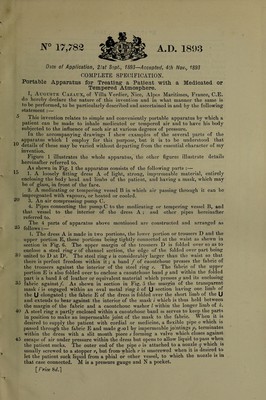
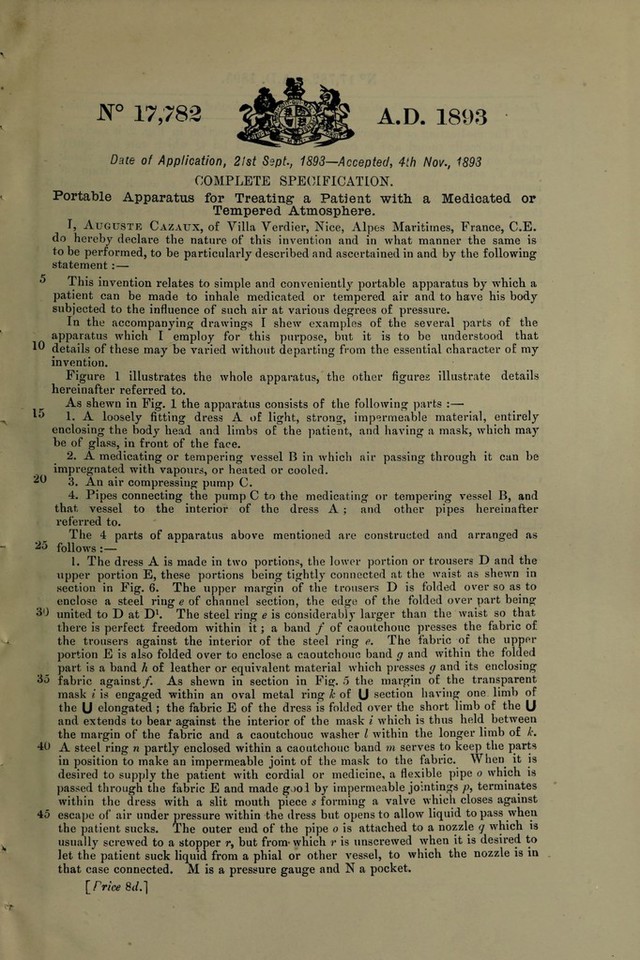
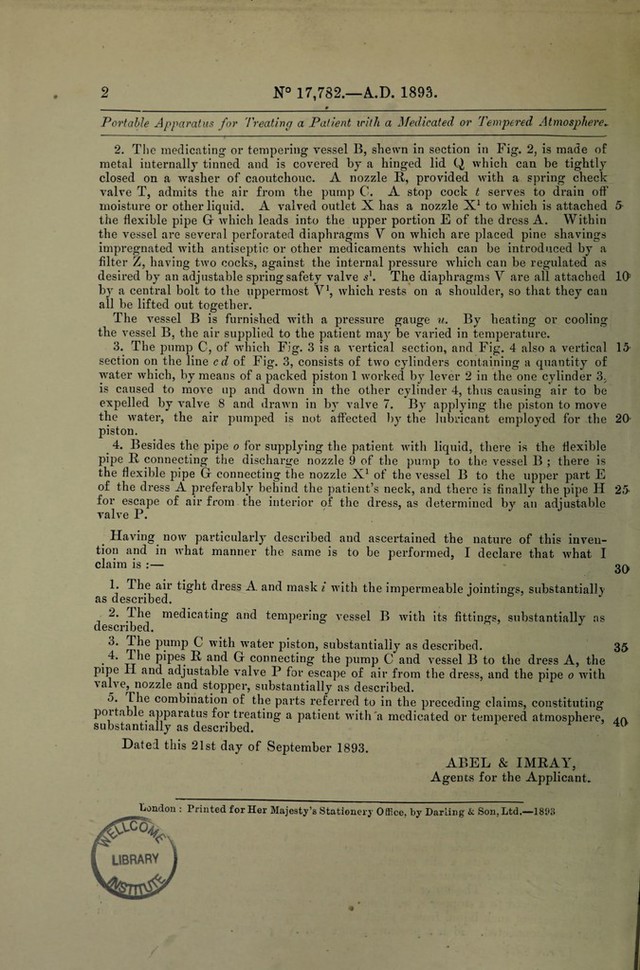
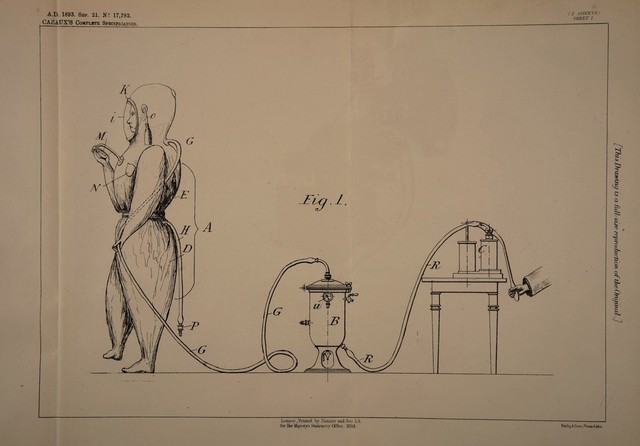
![N° 17,782 A.D. 1893 10 15 20 Date of Application, 21st Sept., 1893—Accepted, 4th Nov., 1893 COMPLETE SPECIFICATION. Portable Apparatus for Treating1 a Patient with a Medicated or Tempered Atmosphere. I, Auguste Cazaux, of Villa Verdier, Nice, Alpes Maritimes, France, C.E. do hereby declare the nature of this invention and in what manner the same is to be performed, to be particularly described and ascertained in and by the following statement This invention relates to simple and conveniently portable apparatus by which a patient can be made to inhale medicated or tempered air and to have his body subjected to the influence of such air at various degrees of pressure. In the accompanying drawings I shew examples of the several parts of the apparatus which I employ for this purpose, but it is to be understood that details of these may be varied without departing from the essential character of my invention. Figure 1 illustrates the whole apparatus, the other figures illustrate details hereinafter referred to. As shewn in Fig. 1 the apparatus consists of the following parts :— 1. A loosely fitting dress A of light, strong, impermeable material, entirely enclosing the body head and limbs o£ the patient, and having a mask, which may be of glass, in front of the face. 2. A medicating or tempering vessel B in which air passing through it can be impregnated with vapours, or heated or cooled. 3. An air compressing pump C. 4. Pipes connecting the pump C to the medicating or tempering vessel B, and that vessel to the interior of the dress A ; and other pipes hereinafter referred to. The 4 parts of apparatus above mentioned are constructed and arranged as follows :— 1. The dress A is made in two portions, the lower portion or trousers D and the upper portion E, these portions being tightly connected at the waist as shewn in section in Fig. 6. The upper margin of the trousers D is folded over so as to enclose a steel ring e of channel section, the edge of the folded over part being united to D at D1. The steel ring e is considerably larger than the waist so that there is perfect freedom within it; a band / of caoutchouc presses the fabric of the trousers against the interior of the steel ring e. The fabric of the upper portion E is also folded over to enclose a caoutchouc band g and within the folded part is a band h of leather or equivalent material which presses g and its enclosing 55 fabric against/. As shewn in section in Fig. 5 the margin of the transparent mask i is engaged within an oval metal ring k of U section having one limb of the U elongated ; the fabric E of the dress is folded over the short limb of the U and extends to bear against the interior of the mask i which is thus held between the margin of the fabric and a caoutchouc washer l within the longer limb of k. TO A steel ring n partly enclosed within a caoutchouc band m serves to keep the parts in position to make an impermeable joint of the mask to the fabric. When it is desired to supply the patient with cordial or medicine, a flexible pipe o which is passed through the fabric E and made gool by impermeable jointings p, terminates within the dress with a slit mouth piece s forming a valve which closes against 45 escape of air under pressure within the dress but opens to allow liquid to pass when the patient sucks. The outer end of the pipe o is attached to a nozzle g which is usually screwed to a stopper r, but from- which r is unscrewed when it is desired to let the patient suck liquid from a phial or other vessel, to which the nozzle is in that case connected. M is a pressure gauge and N a pocket. [Frice 8d.] 25 30](https://iiif.wellcomecollection.org/image/b30738106_0001.jp2/full/800%2C/0/default.jpg)