Improvements in artificial tooth sections and in the method of attaching the same / [Charles Henry Land].
- Land, Charles Henry.
- Date:
- 1890
Licence: Public Domain Mark
Credit: Improvements in artificial tooth sections and in the method of attaching the same / [Charles Henry Land]. Source: Wellcome Collection.
1/6
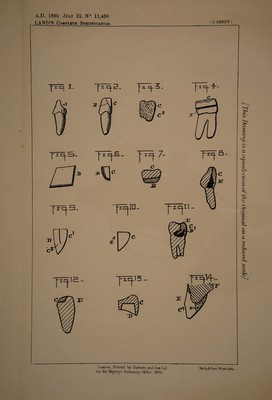
![A.D. L890 Date of Application, 22nd July, 1890—Accepted, 18th Oct., 1890 COMPLETE SPECIFICATION. Improvements in Artificial Tooth Sections and in the Method of Attaching* the same. I, Charles Henry Land of 271, Woodward Avenue, Detroit, Michigan, United States of America, Dentist, do hereby declare the nature of this invention and in what manner the same is to be performed, to be particularly described and ascer¬ tained in and by the following statement:— 5 My invention relates to certain improvements in li artificial dentures,” having in view a novel article of manufacture and a novel process of applying the same, all as more fully hereinafter described and claimed and more particularly illustrated in the accompanying drawings, in which :— Figure 1 is a side elevation showing a defective tooth. 10 Figure 2 is a similar view of a tooth repaired. Figure 3 is a separate view of my improved section showing the biscuit surface. Figure 4 is a modification where a crown is applied to the tooth. Figure 5 is a view of the matrix. Figure 6 is a separate view of a section having a metal surface. In Figure 7 shows a crown with a metal surface. Figure 8 is a modification. Figure 9 shows a veneer built up with porcelain body. Figure 10 shows a section having a porous face. Figures 11, 12 and 13 illustrate modifications. 20 Figure 14 shows a gum section united to a base. It is well known that the compound commonly called amalgam, being a composite of mercury and other metals, has a peculiar affinity for gold and silver, and readily unites therewith- Amalgam is therefore a desirable means for attaching a section or o n plug to a tooth. 25 1 carry out my invention as follows :— A, represents a tooth cavity or lost portion of a tooth to be filled or built up as the case may be. The tooth being properly prepared in the usual manner, I burnish or swage thereupon a piece of platinum foil, to form a matrix or mould. The foil may be conformed either to a cavity or to the surface of a decayed or defective tooth, and 30 either fdr the formation of a filling section, or a crown or partial crown, or any other desired tooth section. By the aid of this matrix, I form a tooth section of desired form and of any desired material. Thus, for example, I may mould, upon sai l matrix or there¬ into, porcelain body or paste, which, when fused, shall constitute the desired 35 section. I would have it distinctly understood, however, that I do not herein limit myself to any specific material solely, in the construction of said toorh sections, as mv vitreous or other suitable substance, as porcelain, glass, metal and anything else found suited to the purpose may be employed within the scope of my invention. Accordingly, B denotes the matrix, and C an artificial tooth section of any required form and 40 material. Upon the sections so constructed, I fuse a coating of gold, as at D. In order to make the gold adhere to the tooth section, my invention contemplates, as one of its features, a more definite construction also of said section, although I do not limit myself exclusively thereto. Instead of building up the entire artificial tooth section from the matrix as a mould 45 by the use of plastic or molten material, 1 design, wherever desired, to select a suitable artificial veneer which may constitute a crown, a partial crown or other section. A lining of porcelain body may then be employed to conform the veneer to the matrix, said body being applied between the veneer and the matrix and fused upon the veneer. The veneer will ordinarily have a glazed surface, upon which a coating \Price 8d.]](https://iiif.wellcomecollection.org/image/b30739627_0001.jp2/full/800%2C/0/default.jpg)