The inhibition of lactic acid formation in cancer and muscle / by Sylvia Thurlow Harrison and Edward Mellanby.
- Harrison, Sylvia Thurlow.
- Date:
- [1930?]
Licence: In copyright
Credit: The inhibition of lactic acid formation in cancer and muscle / by Sylvia Thurlow Harrison and Edward Mellanby. Source: Wellcome Collection.
1/20
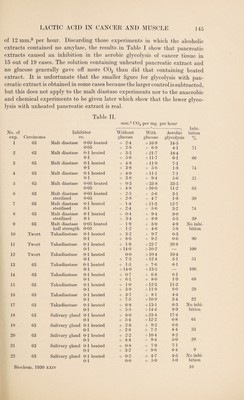
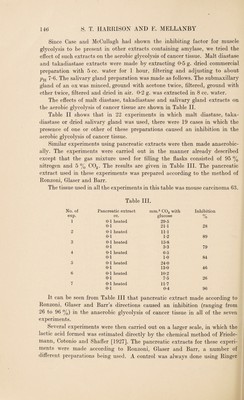
![[All Rights reserved] XX. THE INHIBITION OF LACTIC ACID FORMATION IN CANCER AND MUSCLE. By SYLVA THURLOW HARRISON and EDWARD MELLANBY. 1 From the Department of Pharmacology, Sheffield University. (Received December 5th, 1929.) From a chemical standpoint, the problem of cancerous growth may be com sidered in two ways, either that disordered growth is caused by the presence of a chemical factor not present in normal tissue, or that disordered growth is caused by the absence of some factor normally present in adult tissue. The latter point of view seems, perhaps, to be the more plausible when one con¬ siders that, in certain respects, the metabolism of embryonic tissue and that of cancer tissue are similar [Warburg, 1924]. It seems reasonable to assume that with the development of the embryo there also develops a factor which checks certain phases of embryonic metabolism. This factor, present in normal adult tissue, would act as a growth regulator. If, in later life, the factor for any reason disappears, the tissue would again assume certain embryonic charac¬ teristics. In this paper experiments are described which were carried out to determine whether the addition of normal tissue extracts to cancer could change the characteristic metabolism of malignant tissue. As is well known, the work of Warburg [1923-1926] has shown that the most characteristic of the differences so far observed between the metabolism of cancerous tissue and that of normal tissue is the marked glycolytic power of the former. The line of experimentation followed, then, was to observe the change in glycolytic activity of cancer tissue brought about by the addition of extracts of various normal tissues. Different regions of the body seem to possess a markedly different suscepti¬ bility to cancerous growths. The small intestine apparently affords a site very unfavourable to the growth of malignant tissue, since cancer in that region is extremely rare. On the line of thought suggested above, it might be supposed that the small intestine contained some chemical factor which checked cancerous growth, a factor either produced by the intestine itself or by one of those organs which empty their secretions into the small intestine. The pancreas thus suggested itself as the first tissue to use for our experi¬ mental purpose. A further reason for this choice was afforded by the obser¬ vation of Winfield and Hopkins [1915], and later of Foster and Woodrow [1924] and Foster [1925], that extracts of pancreas had an inhibiting effect on lactic acid formation by muscle hash. McCullagh [1928] showed that pan-](https://iiif.wellcomecollection.org/image/b30628428_0001.jp2/full/800%2C/0/default.jpg)