Process for producing medicinal preparations of haemoglobin / [Friedrich Hanssen].
- Hanssen, Friedrich.
- Date:
- 1902
Licence: Public Domain Mark
Credit: Process for producing medicinal preparations of haemoglobin / [Friedrich Hanssen]. Source: Wellcome Collection.
1/4
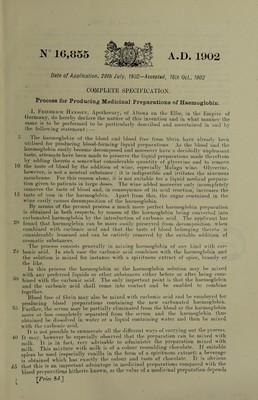
![A.B. 1902 16,855 Date of Application, 29th July, 1902-~Accepted, 76lh Oct., 7902 20 COMPLETE SPECIFICATIOjSL Process for Producing Medicinal Preparations of Haemoglobin, I, litiEDiiicii Ha’stSvSEN, x\.potliecary, of Altoiia, on tlie Elbe, in the Empire of Ijeiman^, do hereby declare the nature of this invention and in what manner the same is to be performed to be particulaidy described and ascertained in and by the followino' statement: — '■> Ihe haemoglobin of the blood and blood free from fil)rin have already been utilised for producing blood-forming liquid prer)a]’ations. As the blood and the haemog-lobin easily become decomposed and moreover have a decidedly unpleasant taste, attempts have been made to preserve the liquid preparations made therefrom by adding thereto a somewhat considerable quantitv of glycerine and to remove ^ 3 ^ tic n of wine, especially Malaga wine. Glycerine, however, is not a neutral substance; it is indigestible and irritates the mucuous membrane, bor this reason alone, it is not suitable for a liquid medical prepara¬ tion given to patients in large doses. The wine added moreover only incompletely removes the taste of blood and, in consequence of its acid reaction, increases the lo taste of iron in the haemoglobin. Apart from this, the sugar contained in the wine easily causes decomuosition of the haemoglobin. t * By means of the present process a much more perfect haemoglobin preparation is obtained in both respects, by reason of the haemoglobin being converted into carbonated haemoglobin by the introduction of carbonic acid. The applicant has found that haemoglebin can be more easily ])reserved from decoiiqiositioii when combined with carbonic acid and that the taste of blood belonyino- tliereio is considerably lessened and can be entirely removed by the suitable addition of aromatic substances. The process consists generally in mixing haemoglobin of anv kind with car¬ bonic acid. In such case the carbonic acid combines with the haemoglobin and the solution is mixed for instance with a spirituous extract of spice, brandy or the like. In this process the haemoglobin or the haemoglobin solution may be mixed with any preferred liquids or other sul)stances either before or after being com¬ bined with the carbonic acid. The only imj)ortant point is that the haemoglobin and the carbonic acid shall come into contact and be enal)led to combine together. Jilood free of fibrin may also be mixed with carbonic acid and be employed for ])roducing blood preparations containing the new carbonated haemoglobin. Eurther, Hie serum may be partially eliminated from the blood or the haenioglobiii more or less completely separated from the seruin and the haemoglobin ihus obtained be dissolved in water or a liquid containing water and then be mixed with the carbonic acid. It is not possible to enumerate all the different ways of carrying out tln^ ])rocess. It mav, however be es'i)ecially observed that tlie prejiaration can^ be mixed with milk. ' It is in fact, very advisable to administer the preparation mixed^ with milk.' This mixture with milk is of a colour resembling chocolate. If suiitable spices be used (especially vanilla in the form of a spirituous extract) a beverage is obtained which has e'xactly the colour and taste of chocolate. It is obvious 15 that this is an important advantage in medicinal preparations compared with the blood preparations hitherto known, as the valuo of a medicinal preparation depends (Price 8f?.] 2b do do 40](https://iiif.wellcomecollection.org/image/b30737576_0001.jp2/full/800%2C/0/default.jpg)