Licence: Public Domain Mark
Credit: On the isolation of the missing sulphur urea / by J. Emerson Reynolds. Source: Wellcome Collection.
Provider: This material has been provided by the Royal College of Physicians of Edinburgh. The original may be consulted at the Royal College of Physicians of Edinburgh.
1/16
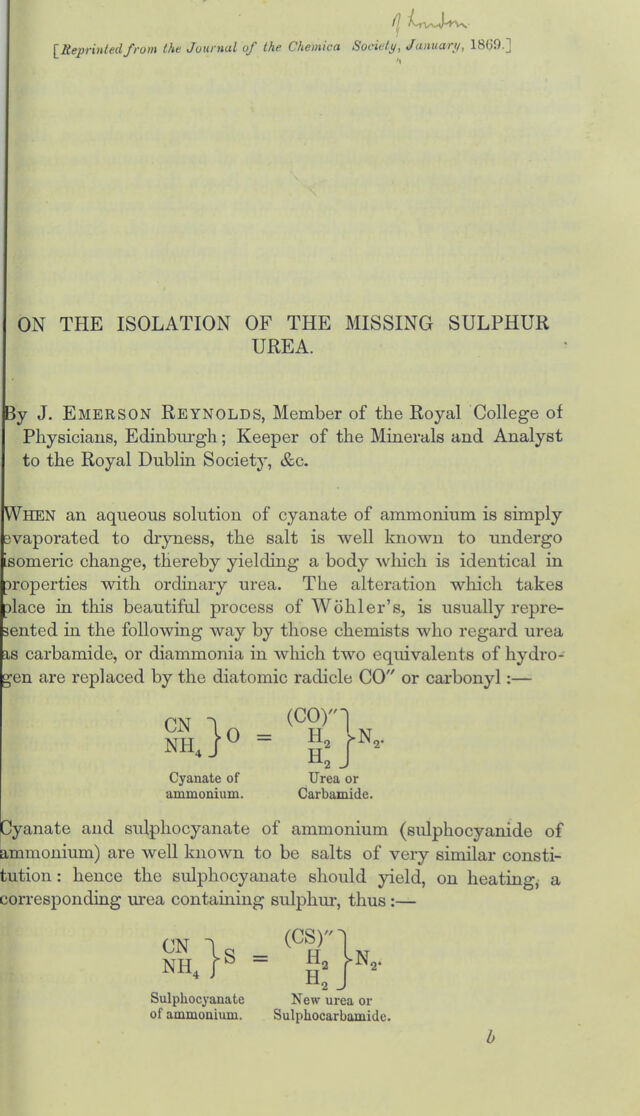
![\_Repnnledfrom the Journal of the Chemica Society, January, 18(;59.] i\ \ ON THE ISOLATION OF THE MISSING SULPHUR UREA. 3y J. Emerson Reynolds, Member of the Royal College of Physicians, Edinbm-gh; Keeper of the Minerals and Analyst to the Royal Dublin Society, &c. When an aqueous solution of cyanate of ammonium is simply Bvaporated to dryness, the salt is well known to undergo isomeric change, thereby yielding a body which is identical in Droperties with ordinary urea. The alteration which takes Dlace in this beautiful process of Wohler’s, is usually repre- sented in the following way by those chemists who regard urea IS carbamide, or diammonia in which two equivalents of hydro- gen are replaced by the diatomic radicle CO or carbonyl:— Cyanate of Urea or ammonium. Carbamide. Cyanate and sulphocyanate of ammonium (sulphocyanide of ammonium) are well known to be salts of very similar consti- tution : hence the sulphocyanate should yield, on heating, a corresponding urea containing sulphm*, thus :— Sulphocyanate of ammonium. (CS)1 Hg >N„. hJ New urea or Sulphocarbamide. b](https://iiif.wellcomecollection.org/image/b21954847_0003.jp2/full/800%2C/0/default.jpg)