The development of the arteries of the abdomen and their relation to the peritoneum / by C.B. Lockwood ; communicated by W.S. Savory.
- Charles Barrett Lockwood
- Date:
- 1885
Licence: Public Domain Mark
Credit: The development of the arteries of the abdomen and their relation to the peritoneum / by C.B. Lockwood ; communicated by W.S. Savory. Source: Wellcome Collection.
Provider: This material has been provided by The Royal College of Surgeons of England. The original may be consulted at The Royal College of Surgeons of England.
1/16
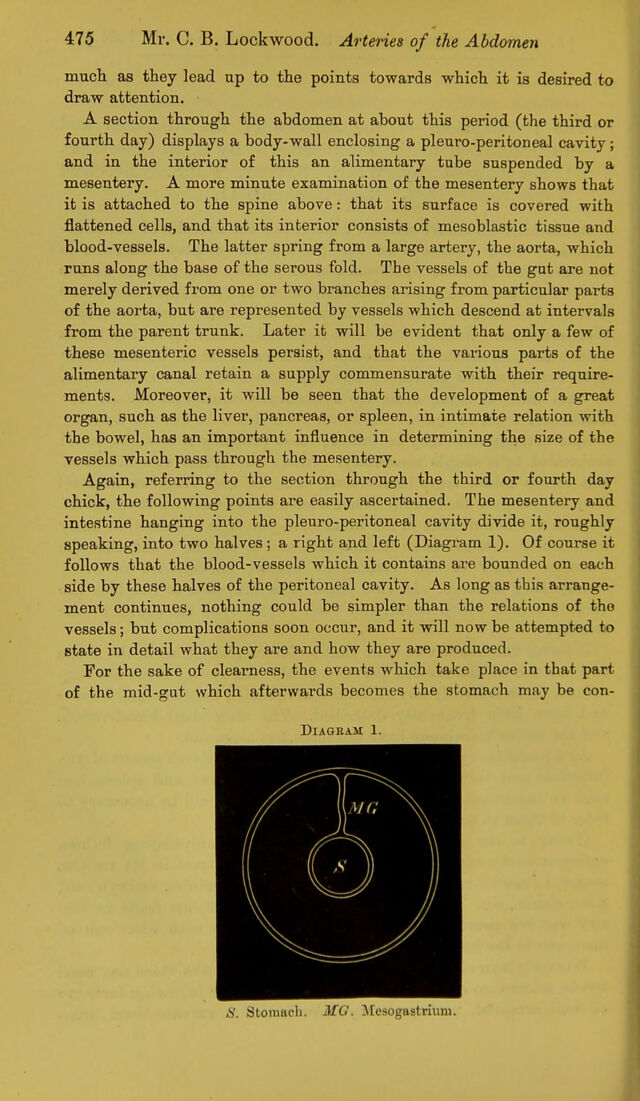
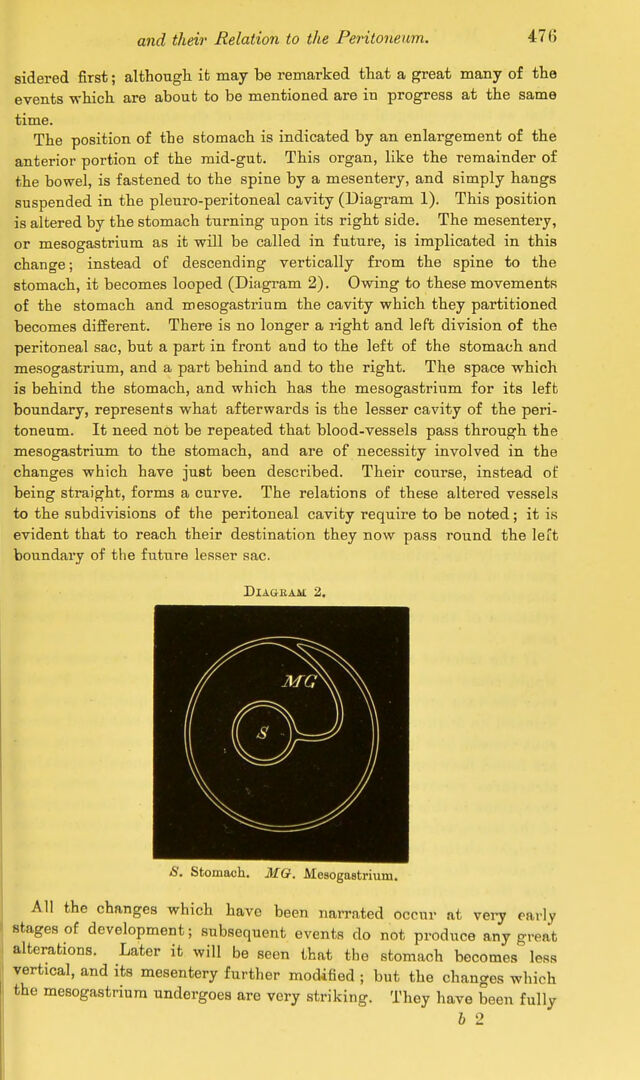
![[From the Proceedings of the Royal Society, No. 238,1885.] The Development of the Arteries of the Abdomen and their Relation to the Peritoneum. By C. B. LoCKWOOD. Communicated by W. S. Savory, F.R.S. Received November 18, 1884. Read December 11. Anatomists who have written concerning the arteries of the abdo- men and their relations to the peritoneum display considerable divergence of opinion. This want of uniformity may perhaps be due to the fact, that owing to the complications of the serous membrane it is hard to trace the course of the vessels without seriously disturbing their relations. Another and most important reason is, that so far as I am aware, no methodical attempt has been made to elucidate them upon developmental grounds. The importance of such an endeavour, in this case, is made clear by a moment's consideration. If the alimentary tract of one of the lower vertebrates be examined a very simple arrangement may be found; most probably a straight bowel suspended by a simple mesentery. Along the spinal attachment of this serous fold a large blood-vessel extends, and branches descend from it to supply the bowel. When such a scheme as this is compared with that which obtains in the human subject, it is evident that many complicated changes have taken place, and it will be found that the vascular supply of the abdominal organs participates in every change they undergo. In this paper it is proposed to consider the various events which occur, and their effects upon the course of the arteries. It seems unnecessary to state that so far as alterations in the shape and position of the various portions of the alimentary canal are con- cerned, there is hardly any difference of opinion; they are well known and have been frequently described. The abdominal blood-vessels and the serous membrane have attracted less attention. _ As a preliminary, it may be stated that as the development of the intestines and their appendages, the liver, pancreas, and spleen, has such an important influence upon the arteries, it will be necessary to refer to them at some length. Owing to the difficulty of obtaining and manipulating human embryos young enough to display the alimentary tract in its earliest stages I found it convenient to study these by examining embryo rats, mice, chicks, &c. Evidently the truth of observations made in this way requires constant verification by comparison with what can be made out in the human subject. When embryo chicks are used changes prior to the third day need not be taken into consideration ; and although the following facts are well accepted, perhaps I may be permitted to narrate them, inas- b](https://iiif.wellcomecollection.org/image/b22294454_0003.jp2/full/800%2C/0/default.jpg)