[Report 1944] / Medical Officer of Health, Guisborough U.D.C.
- Guisborough (England). Urban District Council.
- Date:
- 1944
Licence: Attribution 4.0 International (CC BY 4.0)
Credit: [Report 1944] / Medical Officer of Health, Guisborough U.D.C. Source: Wellcome Collection.
1/10
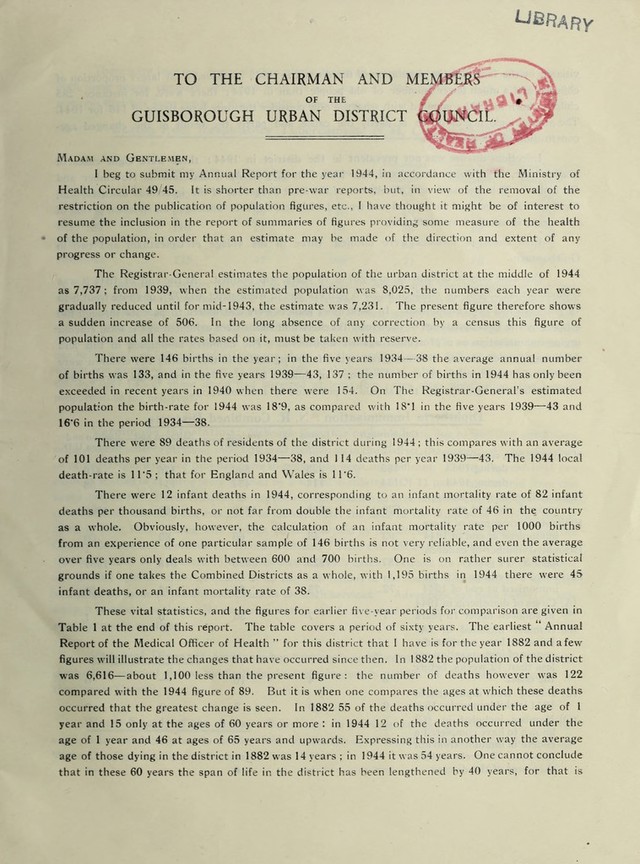
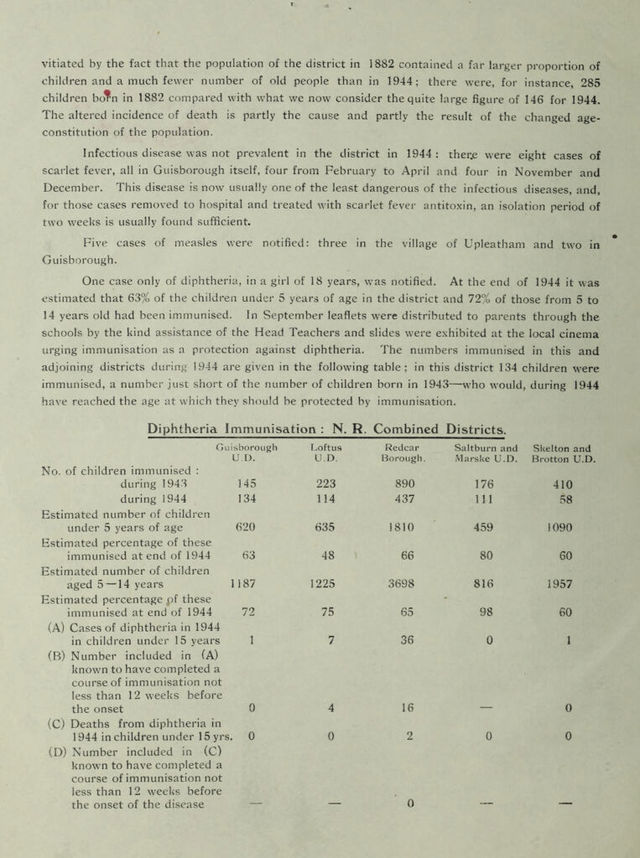
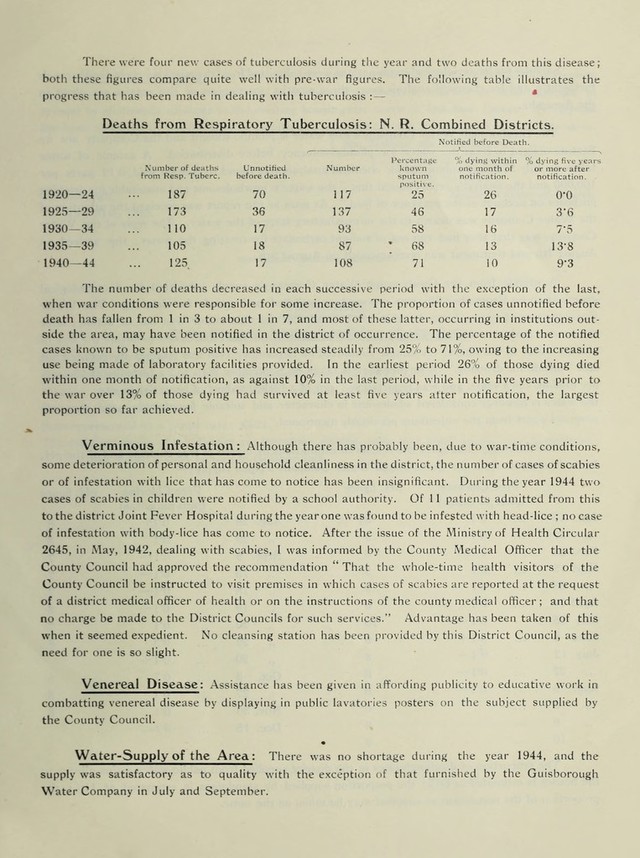
![UBR^Fty TO THE CHAIRMAN AND ] OF THE GUISBOROUGH URBAN DISTRICT Madam and Gentlemen, I beg to submit my Annual Report for the year 1944, in accordance with the Ministry of Health Circular 49 45. It is shorter than pre-war reports, but, in view of the removal of the restriction on the publication of population figures, etc., I have thought it might be of interest to resume the inclusion in the report of summaries of figures providing some measure of the health of the population, in order that an estimate may be made of the direction and extent of any progress or change. The Registrar-General estimates the population of the urban district at the middle of 1944 as 7,737; from 1939, when the estimated population was 8,025, the numbers each year were gradually reduced until for mid-1943, the estimate was 7,231. The present figure therefore shows a sudden increase of 506. In the long absence of any correction by a census this figure of population and all the rates based on it, must be taken with reserve. There were 146 births in the year; in the five years 1934—38 the average annual number of births was 133, and in the five years 1939—43, 137 ; the number of births in 1944 has only been exceeded in recent years in 1940 when there were 154. On The Registrar-General’s estimated population the birth-rate for 1944 was 18*9, as compared with 18*1 in the five years 1939—43 and 16'6 in the period 1934—38. There were 89 deaths of residents of the district during 1944 ; this compares with an average of 101 deaths per year in the period 1934—38, and 1 14 deaths per year 1939—43. The 1944 local death-rate is 11*5; that for England and Wales is 11’6. There were 12 infant deaths in 1944, corresponding to an infant mortality rate of 82 infant deaths per thousand births, or not far from double the infant mortality rate of 46 in the country as a whole. Obviously, however, the calculation of an infant mortality rate per 1000 births from an experience of one particular sample of 146 births is not very reliable, and even the average over five years only deals with between 600 and 700 births. One is on rather surer statistical grounds if one takes the Combined Districts as a whole, with 1,195 births in 1944 there were 45 infant deaths, or an infant mortality rate of 38. These vital statistics, and the figures for earlier five-year periods for comparison are given in Table 1 at the end of this report. The table covers a period of sixty years. The earliest “ Annual Report of the Medical Officer of Health ” for this district that 1 have is for the year 1882 and a few figures will illustrate the changes that have occurred since then. In 1882 the population of the district was 6,616—about 1,100 less than the present figure: the number of deaths however was 122 compared with the 1944 figure of 89. But it is when one compares the ages at which these deaths occurred that the greatest change is seen. In 1882 55 of the deaths occurred under the age of 1 year and 15 only at the ages of 60 years or more : in 1944 12 of the deaths occurred under the age of 1 year and 46 at ages of 65 years and upwards. Expressing this in another way the average age of those dying in the district in 1882 was 14 years ; in 1944 it was 54 years. One cannot conclude that in these 60 years the span of life in the district has been lengthened by 40 years, for that is](https://iiif.wellcomecollection.org/image/b29270881_0001.jp2/full/800%2C/0/default.jpg)