Improvements in eye glass or spectacle cases / [William Edward Birmingham].
- Birmingham, William Edward.
- Date:
- 1904
Licence: Public Domain Mark
Credit: Improvements in eye glass or spectacle cases / [William Edward Birmingham]. Source: Wellcome Collection.
1/6
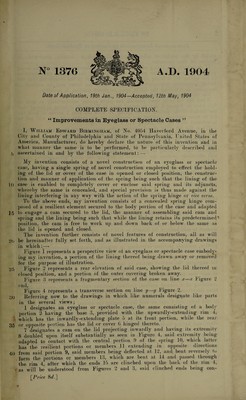
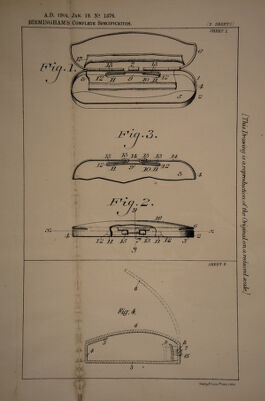
![Date of Application, 19th Jan., 1904—Accepted, 12th May, 1904 COMPLETE SPECIFICATION. “ Improvements in Eyeglass or Spectacle Cases ” I, William Edward Birmingham, of No. 4054 Haver ford Avenue, in the City and County of Philadelphia and State of Pennsylvania, United States of America. Manufacturer, do hereby declare the nature of this invention and in what manner the same is to be performed, to be particularly described and 5 ascertained in and by the following statement:—- My invention consists of a novel construction of an eyeglass or spectacle case, having a single spring of novel construction employed to effect the hold¬ ing of the lid or cover of the case in opened or closed position, the construc¬ tion and manner of application of the spring being such that the lining of the 10 case is enabled to completely cover or enclose said spring and its adjuncts, whereby the same is concealed, and special provision is thus made against the lining interfering in any way with the action of the spring hinge or vice verm. To the above ends, my invention consists of a concealed spring hinge com¬ posed of a resilient element secured to the body portion of the case and adapted 35 to engage a cam secured to the lid, the manner of assembling said cam and spring and the lining being such that while the lining retains its predetermined* position, the cam is free to work up and down back of or below the same as the lid is opened and closed. The invention further consists of novel features of construction, all as will 2(i be hereinafter fully set forth, and as illustrated in the accompanying drawings in which; -—- Figure 1 represents a perspective view of an eyeglass or spectacle case embody¬ ing my invention, a portion of the lining thereof being drawn away or removed for the purpose of illustration. 25 Figure 2 represents a rear elevation of said case, showing the lid thereof in closed position, and a portion of the outer covering broken away. Figure 3 represents a fragmentary section of the case on line x—x Figure 2 and, Figure 4 represents a transverse section on line y—y Figure 2. 30 Referring now to the drawings in which like numerals designate like parts in the several views; 1 designates an eyeglass or spectacle case, the same consisting of a body portion 2* having the base 3, provided with the upwardly-extending rim 4, which has the inwardly-extending plate 5 at its front portion, while the rear 35 or opposite portion has the lid or cover G hinged thereto. 7 designates a cam on the lid projecting inwardly and having its extremity 8 doubled upon itself substantially as seen in Figure 4, said extremity being- adapted to contact with the central portion 9 of the spring 10, which latter- lias the resilient portions or members 11 extending in opposite directions 40 from said portion 9, said members being deflected at 12, and bent reversely to form the portions or members 13, which are bent at 14 and passed through the rim 4, after which the ends 15 are clinched upon the back of the rim 4, * as will be’ understood from Figures 2 and 3, said clinched ends being con- [Price 8d.] *](https://iiif.wellcomecollection.org/image/b30738891_0001.jp2/full/800%2C/0/default.jpg)