The occurence in ergot and action of acetyl-choline : (preliminary communication) / by H.H. Dale.
- Henry Hallett Dale
- Date:
- [1914?]
Licence: Public Domain Mark
Credit: The occurence in ergot and action of acetyl-choline : (preliminary communication) / by H.H. Dale. Source: Wellcome Collection.
1/2
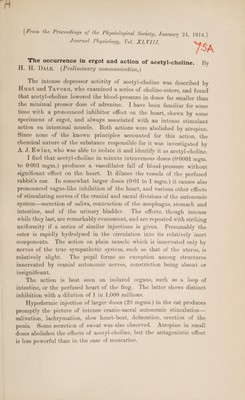
![[From the Proceedings of the Physiological Society, January 24, 1914.] Journal Physiology, Fo/. XL VI11. The occurrence in ergot and action of acetyl-choline. By H. H. Dale. (Preliminary communication.) The intense depressor activity of acetyl-choline was described by Hunt and Taveau, who examined a series of choline-esters, and found that acetyl-choline lowered the blood-pressure in doses far smaller than the minimal pressor dose of adrenine. I have been familiar for some time with a pronounced inhibitor effect on the heart, shown by some specimens of ergot, and always associated with an intense stimulant action on intestinal muscle. Both actions were abolished by atropine. Since none of the known principles accounted for this action, the chemical nature of the substance responsible for it was investigated by A. J. Ewins, who was able to isolate it and identify it as acetyl-choline. I find that acetyl-choline in minute intravenous doses (0-0001 mgm. to 0001 mgm.) produces a vasodilator fall of blood-pressure without significant effect on the heart. It dilates the vessels of the perfused rabbit’s ear. In somewhat larger doses (0 01 to 1 mgm.) it causes also pronounced vagus-like inhibition of the heart, and various other effects of stimulating nerves of the cranial and sacral divisions of the autonomic system—secretion of saliva, contraction of the oesophagus, stomach and intestine, and of the urinary bladder. The effects, though intense while they last, are remarkably evanescent, and are repeated with striking uniformity if a series of similar injections is given. Presumably the ester is rapidly hydrolysed in the circulation into its relatively inert components. The action on plain muscle which is innervated only by nerves of the true sympathetic system, such as that of the uterus, is relatively slight. The pupil forms an exception among structures innervated by cranial autonomic nerves, constriction being absent or insignificant. The action is best seen on isolated organs, such as a loop of intestine, or the perfused heart of the frog. The latter shows distinct inhibition with a dilution of 1 in 1,000 millions. Hypodermic injection of larger doses (20 mgms.) in the cat produces promptly the picture of intense cranio-sacral autonomic stimulation— salivation, lachrymation, slow heart-beat, defecation, erection of the penis. Some secretion of sweat was also observed. Atropine in small doses abolishes the effects of acetyl-choline, but the antagonistic effect is less powerful than in the case of muscarine.](https://iiif.wellcomecollection.org/image/b30620892_0001.jp2/full/800%2C/0/default.jpg)