[Report 1906] / Medical Officer of Health, Stockbridge (Union) R.D.C.
- Stockbridge (England). Rural District Council.
- Date:
- 1906
Licence: Attribution 4.0 International (CC BY 4.0)
Credit: [Report 1906] / Medical Officer of Health, Stockbridge (Union) R.D.C. Source: Wellcome Collection.
1/12
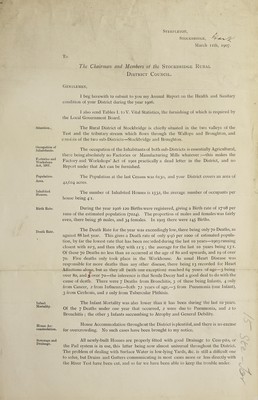
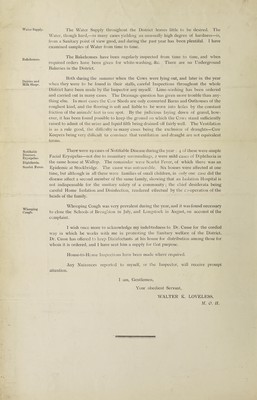
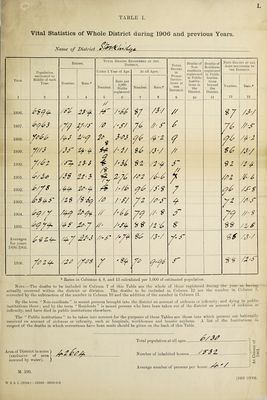
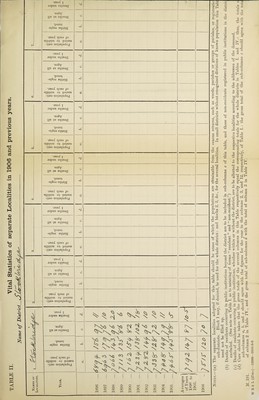
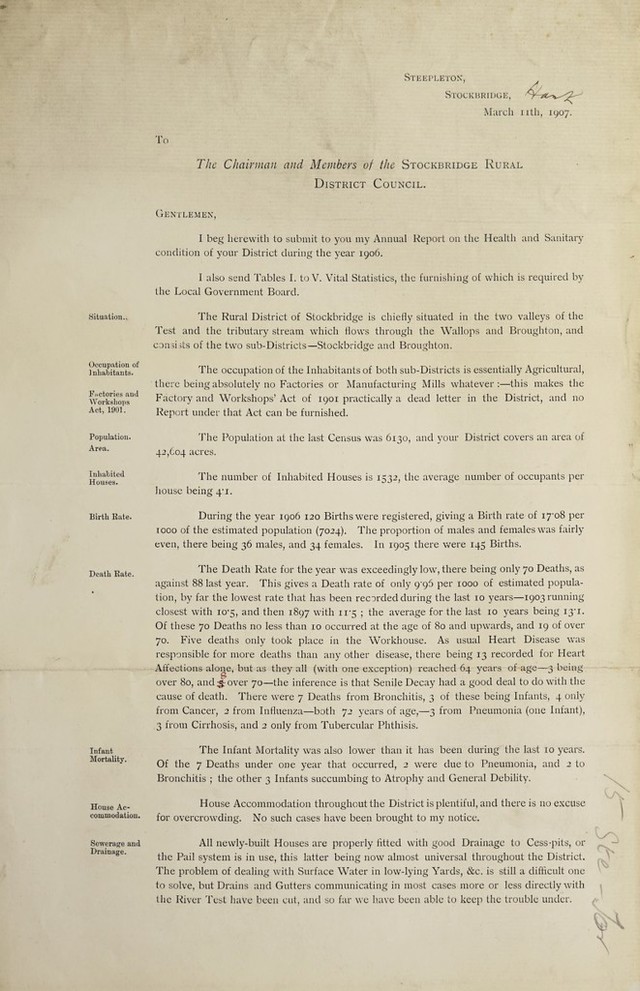
![Situation.. Occupation of ] nlmbitants. Factories and Workshops Act, 1901. Population. Area. Inhabited Houses. Birth Rate. Death Rate. Infant Mortality. House Ac¬ commodation. Sewerage and Drainage. Steepleton, Stockbridge, March nth, 1907. To The Chairman and Members of the Stockbridge Rural District Council. Gentlemen, I beg herewith to submit to you my Annual Report on the Health and Sanitary condition of your District during the year 1906. I also send Tables I. to V. Vital Statistics, the furnishing of which is required by the Local Government Board. The Rural District of Stockbridge is chiefly situated in the two valleys of the Test and the tributary stream which flows through the Wallops and Broughton, and consists of the two sub-Districts—Stockbridge and Broughton. The occupation of the Inhabitants of both sub-Districts is essentially Agricultural, there being absolutely no Factories or Manufacturing Mills whatever:—this makes the Factory and Workshops’ Act of 1901 practically a dead letter in the District, and no Report under that Act can be furnished. The Population at the last Census was 6130, and your District covers an area of 42,604 acres. The number of Inhabited Houses is 1532, the average number of occupants per house being 4,i. During the year 1906 120 Births were registered, giving a Birth rate of i7-o8 per 1000 of the estimated population (7024). The proportion of males and females was fairly even, there being 36 males, and 34 females. In 1905 there were 145 Births. The Death Rate for the year was exceedingly low, there being only 70 Deaths, as against 88 last year. This gives a Death rate of only 996 per 1000 of estimated popula¬ tion, by far the lowest rate that has been recorded during the last 10 years—1903 running closest with io'5, and then 1897 with 11*5 ; the average for the last 10 years being 13M. Of these 70 Deaths no less than 10 occurred at the age of 80 and upwards, and 19 of over 70. Five deaths only took place in the Workhouse. As usual Heart Disease was responsible for more deaths than any other disease, there being 13 recorded for Heart Affections alone, but as they all (with one exception) reached 64 years of age—3 being over 80, and ^ over 70—the inference is that Senile Decay had a good deal to do with the cause of death. There were 7 Deaths from Bronchitis, 3 of these being Infants, 4 only from Cancer, 2 from Influenza—both 72 years of age,—3 from Pneumonia (one Infant), 3 from Cirrhosis, and 2 only from Tubercular Phthisis. The Infant Mortality was also lower than it has been during the last 10 years. Of the 7 Deaths under one year that occurred, 2 were due to Pneumonia, and 2 to Bronchitis ; the other 3 Infants succumbing to Atrophy and General Debility. House Accommodation throughout the District is plentiful, and there is 110 excuse for overcrowding. No such cases have been brought to my notice. All newly-built Houses are properly fitted with good Drainage to Cess-pits, or the Pail system is in use, this latter being now almost universal throughout the District. The problem of dealing with Surface Water in low-lying Yards, &c. is still a difficult one to solve, but Drains and Gutters communicating in most cases more or less directly with the River Test have been cut, and so far we have been able to keep the trouble under.](https://iiif.wellcomecollection.org/image/b30137007_0001.jp2/full/800%2C/0/default.jpg)