A practical essay on the history and treatment of beriberi / By John Grant Malcolmson.
- Malcolmson, John Grant, -1844.
- Date:
- 1835
Licence: Public Domain Mark
Credit: A practical essay on the history and treatment of beriberi / By John Grant Malcolmson. Source: Wellcome Collection.
Provider: This material has been provided by London School of Hygiene & Tropical Medicine Library & Archives Service. The original may be consulted at London School of Hygiene & Tropical Medicine Library & Archives Service.
10/376
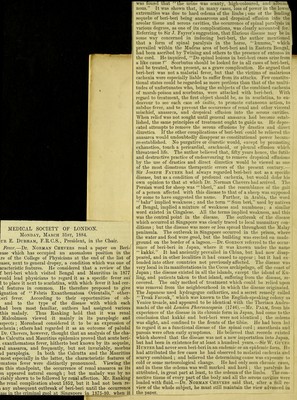
![MEDICAL SOCIETY OF LONDOK Monday, March 31st, 1884. UR E. Durham, F.R.C.S., President, in the Chair. Fever.—Dr. Norman Chevers read a paper on Beri- ease ^vhich has occupied an anomalous position in the ire of the College of Physicians at the end of the list of jases, next to general dropsy, a condition which was one of aracteristic features. He considered that a review of the f beri-beri which visited Bengal and Mauritius in 1877 i^ould lead physicians to regard it as a specific fever sui 1 to place it next to scarlatina, with which fever it had cer- id features in common. He therefore proposed to give Ignation of Febris Exanthematosa Orientalis, other- Deri fever. According to their opportunities of ob- and to the type of the disease with which each had been most familiar, authors had assigned various this malady. Thus Ranking held that it was renal Malcolmson viewed it mainly in its paraplegic and ispects ; Moreshead considered it to be an expression of ichexia ; others had regarded it as an outcome of paludal Dr. Chevers, however, thought that an analysis of the cha- lie Calcutta and Mauritius epidemics proved that acute beri- . exanthematous fever, hitherto best known by its sequelae, ral anasarca, and frequently, but not invariably, morbus id paraplegia. In both the Calcutta and the Mauritius most especially in the latter, the characteristic features of im^atous fever were distinctly pronounced. Yiewing the m this standpoint, the occurrence of renal anasarca as its )n appeared natural enough ; but the malady was by no .riably shown to be followed by renal affection. Mr. Ranking he renal complication about 1852, but it had not been re- L any subsequent outbreak of beri-beri until the occurrence ase in the criminal saol at Singapore in 1875-80, when it waslound that the urine was scanty, high-coloured, and album nous. It was shown that, in many cases, loss of power in the lowei extremities was due to hard oedema of the limbs ; one ot the leadin sequelae of beri-beri being anasarcous and dropsical effusion into th areolar tissue and serous cavities, the occurrence of spinal paralysis in various degrees, as one of its complications, was clearly accounted for Referring to Sir J. Fayrer's suggestion, that filarious disease may be in some way concerned in inducing beri-beri, the author mentione that a form of spinal paralysis in the horse, kumree, which prevailed within the Madras area of beri-beri and in Eastern Bengal had been ascribed by Twining and others to the presence of entozoa in the cord. He inquired, Do spinal lesions in beri-beri cases arise from a like cause ? Scorbutus should be looked for in all cases of beri-beri, and be treated, when present, as a grave complication. He argued that beri-beri was not a malarial fever, but that the victims of malarious cachexia were especially liable to suffer from its attacks. Few constitu- tional states could be regarded as more perilous than that of the multi- tudes of unfortunates who, being the subjects of the combined cachexia of marsh-poison and scorbutus, were attacked with beri-beri. With regard to treatment, the first object should be, as in scarlatina, to en- deavour to see each case ah initio, to promote cutaneous action, to subdue fever, and to prevent the occurrence of renal and other visceral mischief, anasarca, and dropsical elfusion into the serous cavities. When relief was not sought until general anasarca had become estalj- lished, the same principles of treatment ought to guide us. He depre- cated attempts to remove the serous efiusions by drastics and direct diuretics. If the other complications of beri-beri could be relieved the anasarca would undoubtedly disappear as constitutional power became re-established. No purgative or diuretic would, except by promoting- exhaustion, touch a pericardial, arachnoid, or pleural effusion whicli threatened life. The author l)elieved that, fifty years hence, the futili; and destructive practice of endeavouring to remove dropsical effusions by the use of drastics and direct diuretics would be viewed as one of the most disastrous therapeutic errors of the present century.— Sir Joseph Fayrer had always regarded beri-beri not as a specific disease, but as a condition of profound cachexia, but would defer his own opinion to that at which Dr. Norman Chevers liad arrived. The Persian word for sheep was bheri, and the resemblance of the gait of a person affected with this disease to that of a sheep Avas supposed by some to have suggested the name. Further, in Arabia, the word bahr implied weakness ; and the term Sum beri, used by natives of Bengal, implied a mixture of weakness and numbness; a similar word existed in Cingalese. All the terms implied weakness, and this was the central point in the disease. The outbreak of the disease which occurred at Singapore was clearly traced to local unsanitary con- ditions ; but the disease was more or less spread throughout the Malay peninsula. The outbreak in Singapore occurred in the prison, where the water and food were good, but the building was erected on made- ground on the border of a lagoon.—Dr. Gordon referred to the occur- rence of beri-beri in Japan, where it was known under the name kakke. It had anciently prevailed in China, but had now disap- peared, and in other localities it had ceased to appear ; but it had ex- tended into other countries not previously affected. The disease was very local in its manifestations in the Cocos archipelago, olf the coast of Japan; the disease existed in all the islands, except the island of Ku- ling, and patients taken to that island, suffering from the disease, re- covered. The only method of treatment which could be relied upon was removal from the neighbourhood in which the disease originated. The Japanese used hydragogue cathartics, and a secret remedy called Treak Farouk, which was known to the English-speaking colony as Yenice treacle, and appeared to be identical with the Theriaca Andro- machi of the old London Fharmacojjosia (1746).—i\Ir. Palm, from his experience of the disease in its chronic form in Ja})an, had come to the conclusion that kakke and beri-beri were not identical ; the a>dema was slight, and confined to the fronts of the tibii^. He had been led to regard it as a functional disease of the s]nnal cord ; anaesthesia and paresis were often early symptoms. He believed that records existed which showed that the disease was not a new importation into Japan, but had been in existence for at least a hundred years.—Sir W. CuYEii Hunter had never seen beri-beri in an endemic or an epidemic form. He had attributed the few cases he had observed to malaiial cachexia and scurvy combined ; and believed the determining cause was ex])osure to cold or some meteorological change. He had only seen chronic cases, and in these the oedema was well marked, and hard ; the paralysis he attributed, in great part at least, to the oedema of the limbs. The con- nective tissue of every part of the body and all the serous cavities were loaded with fluid.—Dr. Norman Chevers said that, after a full re- view of the whole subject, he must still maintain the view advanced in the paper.](https://iiif.wellcomecollection.org/image/b21364503_0010.jp2/full/800%2C/0/default.jpg)