Remarks on the best methods of displaying Entozoa in museums / by T. Spencer Cobbold, M.D.
- Thomas Spencer Cobbold
- Date:
- [cbetween 1800 and 1899?]
Licence: Public Domain Mark
Credit: Remarks on the best methods of displaying Entozoa in museums / by T. Spencer Cobbold, M.D. Source: Wellcome Collection.
Provider: This material has been provided by The University of Glasgow Library. The original may be consulted at The University of Glasgow Library.
1/4
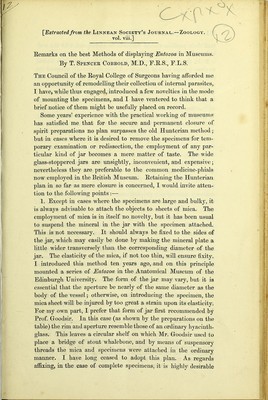
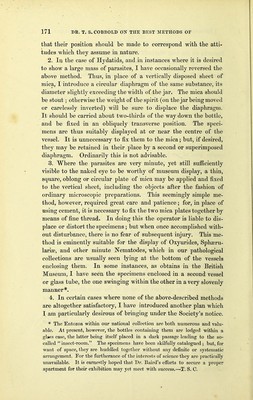
![[Extractedfrom the Linnean Society’s Journal. —Zoology, vol. viii.] Remarks on the best Methods of displaying Entozoa in Museums. By T. Spencee. Cobbold, M.D., F.R.S., F.L.S. The Council of the Royal College of Surgeons having afforded me an opportunity of remodelling their collection of internal parasites, I have, while thus engaged, introduced a few novelties in the mode of mounting the specimens, and I have ventered to think that a brief notice of them might be usefully placed on record. Some years’ experience with the practical working of museums has satisfied me that for the secure and permanent closure of spirit preparations no plan surpasses the old Hunterian method ; but in cases where it is desired to remove the specimens for tem- porary examination or redissection, the employment of any par- ticular kind of jar becomes a mere matter of taste. The wide glass-stoppered jars are unsightly, inconvenient, and expensive; nevertheless they are preferable to the common mediciue-pliials now employed in the British Museum. Retaining the Hunterian plan in so far as mere closure is concerned, I would invite atten- tion to the following points :— 1. Except in cases where the specimens are large and bulk}', it is always advisable to attach the objects to sheets of mica. The employment of mica is in itself no novelty, but it has been usual to suspend the mineral in the jar with the specimen attached. This is not necessary. It should always be fixed to the sides of the jar, which may easily be done by making the mineral plate a little wider transversely than the corresponding diameter of the jar. The elasticity of the mica, if not too thin, will ensure fixity. I introduced this method ten years ago, and on this principle mounted a series of Entozoa in the Anatomical Museum of the Edinburgh University. The form of the jar may vary, but it is essential that the aperture be nearly of the same diameter as the body of the vessel; otherwise, on introducing the specimen, the mica sheet will be injured by too great a strain upon its elasticity. Eor my own part, I prefer that form of jar first recommended by Prof. Goodsir. In this case (as shown by the preparations on the table) the rim and aperture resemble those of an ordinary hyacinth- glass. This leaves a circular shelf on which Mr. Goodsir used to place a bridge of stout whalebone, and by means of suspensory threads the mica and specimens were attached in the ordinary manner. I have long ceased to adopt this plan. As regards affixing, in the case of complete specimens, it is highly desirable](https://iiif.wellcomecollection.org/image/b24917850_0003.jp2/full/800%2C/0/default.jpg)