Mortality of Philadelphia for 1859 : report on meteorology and epidemics : read before the College of Physicians of Philadelphia, February 1, 1860 / by Wilson Jewell.
- Jewell, Wilson, 1800-1867
- Date:
- [1860]
Licence: Public Domain Mark
Credit: Mortality of Philadelphia for 1859 : report on meteorology and epidemics : read before the College of Physicians of Philadelphia, February 1, 1860 / by Wilson Jewell. Source: Wellcome Collection.
Provider: This material has been provided by the National Library of Medicine (U.S.), through the Medical Heritage Library. The original may be consulted at the National Library of Medicine (U.S.)
1/22
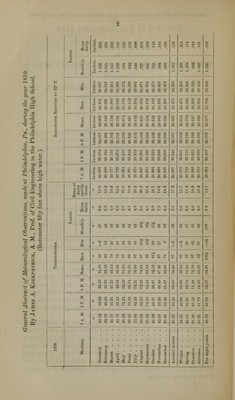
![% [Extracted from The American Journal of the Medical Sciences for April, I860.] IfflrMitg 0f <§\ihM$\h Ux 1859. R E P O E T ON METEOROLOGY AND EPIDEMICS BEAD BEFORE THE COLLEGE OF PHYSICIANS OF PHILADELPHIA, FEBTiTT.A-iRrsr 1, I860. BY WILSON JEWELL, M.D. The accompanying meteorological observations are entirely reliable, and are from the record as taken by Prof. James A. Kirkpatrick, of the Phila- delphia High School, for the Smithsonian Institution. I am indebted to his uniform politeness for this abstract. The mean temperature of the year (1859) was three-quarters of a degree below that of 1858, and almost two-tenths of a degree above the average for the last eight years. The maximum temperature for the year, 97°, was attained on the 13th of July, and the 4th of August. The minimum temperature was two de- grees below zero, on the 10th of January. The warmest day of the year was the 13th of July, when the mean tem- perature was 861 degrees. The coldest day was the 10th of January, the mean for that day being but two degrees. The winter and spring were nearly 3° above the average temperature for the last eight years, while the summer and autumn were nearly 2° below the average. Of the months, the greatest variation from the average was experienced- in March, which was more than 7° warmer than usual; indeed, the mean, temperature of that month was 5° higher than any March in the last eight years. This change in the temperature of March may have been occasioned in part by the more southerly direction of the wind, the prevailing direction being 9° further south of west than it usually is, north of that point. The large amount of rain—4 inches more than the average—may also have had a modifying effect upon the temperature. The highest point of pressure shown by the barometer, was 30.478 inches,, on the 24th of January ; and the lowest was 28.890, on the 23d of April; The amount of rain that fell during the year was 54| inches, which is ten inches more than the average for the last eight years. It was more than 13 inches greater than the quantity which fell in 1858. The greatest difference was in the winter and autumn, each of which shows 5 inches of rain more than the average, while the spring and summer show an increase of but little over one inch.](https://iiif.wellcomecollection.org/image/b21133414_0001.jp2/full/800%2C/0/default.jpg)