The nation's food : a statistical study of a physiological and social problem / by Raymond Pearl.
- Raymond Pearl
- Date:
- 1920
Licence: In copyright
Credit: The nation's food : a statistical study of a physiological and social problem / by Raymond Pearl. Source: Wellcome Collection.
232/282 page 230
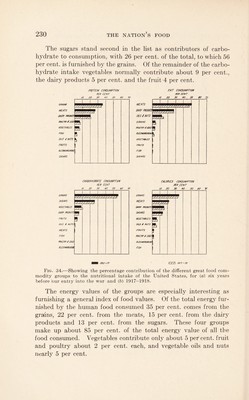
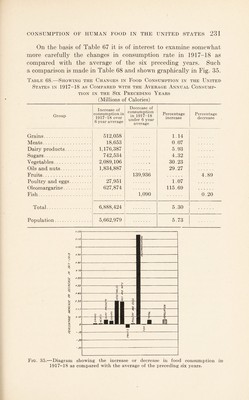
![The sugars stand second in the list as contributors of carbo¬ hydrate to consumption, with 26 per cent, of the total, to which 56 per cent, is furnished by the grains. Of the remainder of the carbo- hydrate intake vegetables normally contribute about 9 per cent., the dairy products 5 per cent, and the fruit-4 per cent. pfiprm coNSuMPTm PCR CCNT /O 20 so 40 SO 60 70 CARBOHYDRATE CONBDMPTIOH PER CENT to 20 so 40 SO 60 70 FAT COATSVAfPT/ON PER CENT 70 20 SO 40 SO eo 70 CALOR/ES CONSmPT/ON PER CENT 70 20 so ' 40 SO 60 V MB 7911-n VW] 7977-/3 Fig. 34.—Showing the percentage contribution of the different great food com¬ modity groups to the nutritional intake of the United States, for (a) six years before bur entry into the war and (b) 1917-1918. The energy values of the groups are especially interesting as furnishing a general index of food values. Of the total energy fur¬ nished by the human food consumed 35 per cent, comes from the grains, 22 per cent, from the meats, 15 per cent, from the dairy products and 13 per cent, from the sugars. These four groups make up about 85 per cent, of the total energy value of all the food consumed. Vegetables contribute only about 5 per cent, fruit and poultry about 2 per cent, each, and vegetable oils and nuts nearly 5 per cent.](https://iiif.wellcomecollection.org/image/b29810875_0232.jp2/full/800%2C/0/default.jpg)