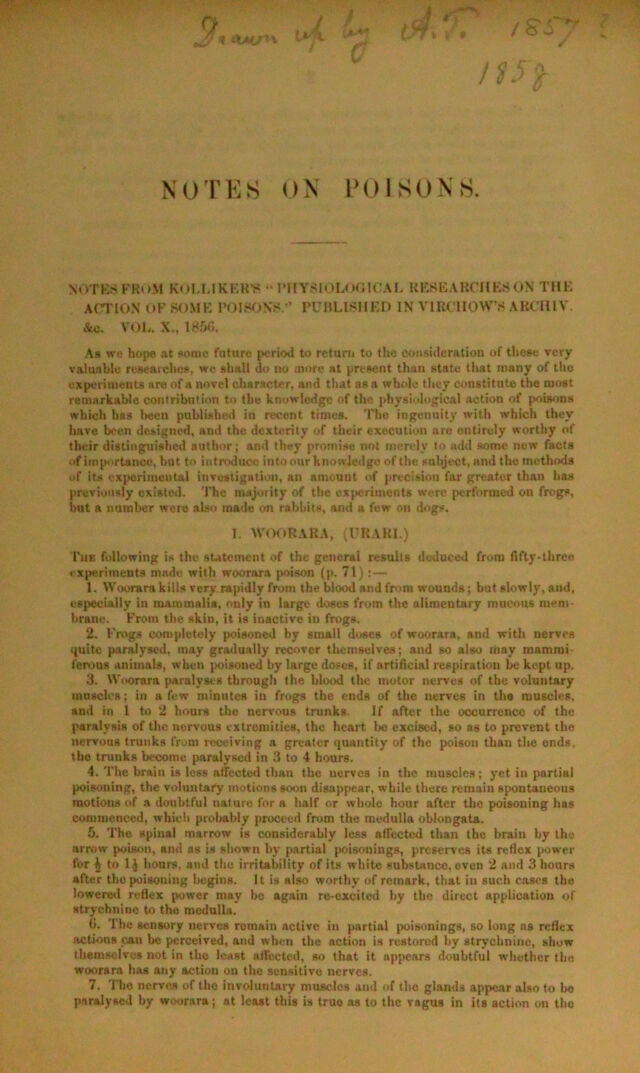
Notes on poisons : notes from Kolliker's "Physiological researches on the action of some poisons" published in Virchow's Archiv. &c. Vol. X, 1856.
- Allen Thomson
- Date:
- [1857?]
Licence: Public Domain Mark
Credit: Notes on poisons : notes from Kolliker's "Physiological researches on the action of some poisons" published in Virchow's Archiv. &c. Vol. X, 1856. Source: Wellcome Collection.
Provider: This material has been provided by The University of Glasgow Library. The original may be consulted at The University of Glasgow Library.
3/12
![and 2nd, That the action upon them was though absorptioo by the blood; but 3rd, That the irritability of the muscles remained entire; and 4th, That the afferent nerves, and to a certain extent the nervous centres were not affected. After a considerable time the redex action ceased to be called forth, but the muscles continued irritable to direct stimulation. II. CONIINE. At p. 80, Kdlliker sutes the result of six experimenU made with eoniim to bo very similar to those with woorara,vix. that it acts more immediately on the motor nerves through absorption, and not upon the voluntary muscles or heart, and not upon the sensory nerves or nervous centres. Coniine, however, operates from the stomach as well as from wounds. III. STRYCHNINE. .At p. 81, the following results of some experiments on the action of ttri/chnine are stated:— 1. Stryclmine has not through the blood the slightest influence on the motor nerves. 2. tftrychnine paralyses the nerves of the voluntary muscles by the over- excitation of the tetanus produced, so lliat the nerves are cither little or not at all active. 3. On the other hand, the senstiry nerves arc not affeclwl by this poison. 4. The heart is little affected by strychnine, and at the most only beats some- what slower; but the post-lymphatic hearts at each attack of tetanus cease to act, and then go on again actively in the intervals. 5. The tetanus from strychnine may either be produced by stimuli which act upon the sensory nerves, or by excitation of the spinal roariow from the brain. 6. After strong strychnine-tetanus, the muscles are little irritable, and the rigor mortis oomes on sooner than usual. IV. OPIUM. P. 90. 0])ium ojierates on frogs in a manner very similar to strychnine. 1. Opium like, strychnine, produces in frogs tetanus, which may be induced either as a reflex action,-or by direct excitement from the brain. 2. This tetanus is not dependent on the presence of the brain, and Kdlliker, therefore, differs from Valentin and Stanuius, who assert that there is no tetanus from opium in animals deprived of the brain. 3. Opium-tetsmuB may also persist after removal of the medulla oblongata; but does not occur when the spinal marrow is cut below the fifth vertebra. But this is not surprising, since it lias been ascertained by Harless, that the part of the spinal marrow below tho fifth vertebra has no reflex action, and even in poisoning with strychnine remains inactive. 4. Opium does not operate through tho blood upon the peripheral nerves. It is only when a strung solution is locally applied to the nerves that it paralyses them; but thi.s is probably a physical action. 6. Tho tetanus excite<l by opium, interferes with the irritability of the motor nerves by over exertion (Uberaustrengung), in the same manner as strychnine. 6. Voluntary muscles affected with opium-tetanus lose their irritability soon, and rapidly become rigid. 7. Tho non-striatod muscles, likewise, soon lose their irritability through opium. 8. The heart is le.ss affected by opium, and was twice seen beating for six, and once for eighteen hoars. Nevertlieless, it is always somewhat paralysed, its action being much slower. In one instance during the tetanus, a suspension of the heart’s action in diastole was observed, which, if confirmed, proves a CO-operatiou of the medulla oblongata and excitation of the vagi. 9. The lymphatic hearts stopjted during iho tetanus, hut recovered again in the intervals, though irtegularly j and finally ceased as tho spinal marrow lost its power.](https://iiif.wellcomecollection.org/image/b2493138x_0003.jp2/full/800%2C/0/default.jpg)