Notes on poisons : notes from Kolliker's "Physiological researches on the action of some poisons" published in Virchow's Archiv. &c. Vol. X, 1856.
- Allen Thomson
- Date:
- [1857?]
Licence: Public Domain Mark
Credit: Notes on poisons : notes from Kolliker's "Physiological researches on the action of some poisons" published in Virchow's Archiv. &c. Vol. X, 1856. Source: Wellcome Collection.
Provider: This material has been provided by The University of Glasgow Library. The original may be consulted at The University of Glasgow Library.
1/12
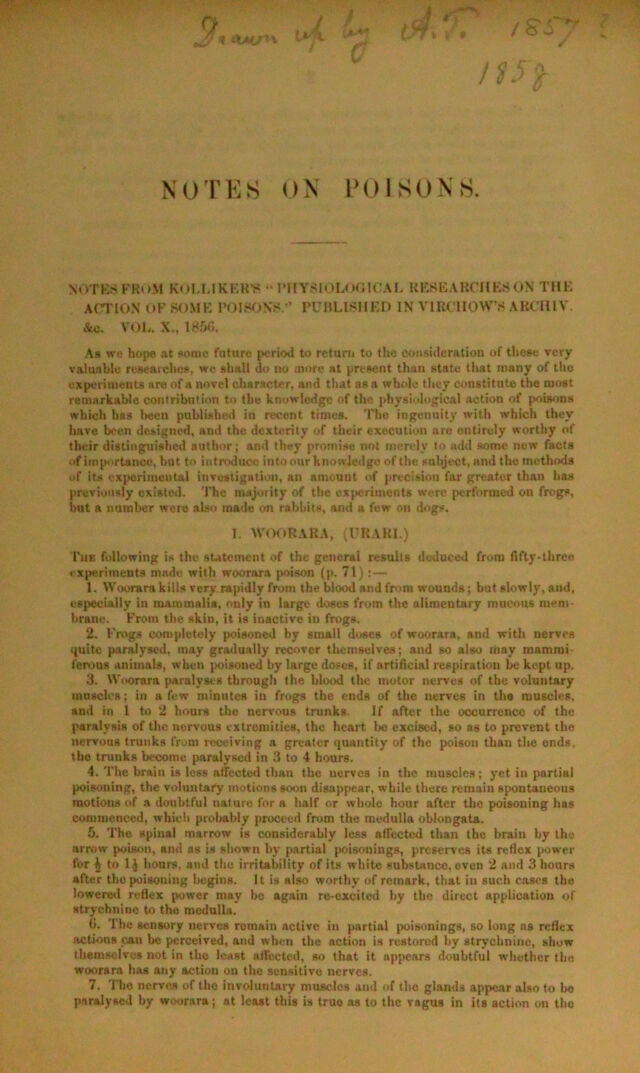
![iX-Uj' X V ✓ XOTES OX IM)ISONS. NoTKSKRuM KoI.LIKKKV “ PHYSlOLor.ICAL RKSEAKCUKSON THE ACTION OF SOME FOIrV)N'.< ’ PUHLIsnED IN VIRCHOWS AKCIll V. Ac. VOL. X., 185C. As we hop« at Romo futnre period to returu to the consideration of these very valuable researches, we shall do no more at present than state that many of the experiments are of a novel character, and that as a whole they constitute the moat remarkable contribution to the knowledge of the physiological action of poisons which has been published in recent times. The ingenuity with which they Imre been designed, and the dexterity of their execution are entirely worthy of their distinguished author; and they promise not merely to add some new facta of importance, but to introduce into our knowledge of the snbject, and the methods of its ex}>oriiueutal investigation, an amount of precision far greater thau has previously existed, 'llie majority of the experiments were jrerformed on frogs, but a number were also made on rabbits, and a few on dogs. 1. WOORAKA, ^URARI.) The following is the sutement of the general results deduced from fifty-three cx])«riments made with woorara poison (p. 71):— 1. Woorarakiils very rapidly from the blood and from wounds; but slowly, and, especially in mammalia, only in large doses from the alimentary mucous mem- brane. From the skin, it is inactive iu frogs. 2. Frogs completely poisoned by small doses of woorara, and with nerves quite paralysed, may gradually recover themselves; and so also may mammi- ferous animals, when poisoned by large doses, if artificial respiration 1^ kept up. 3. Woorara paralyses through the blood the motor nerves of the voluntary mnscles; in a few minutes in frogs the ends of the nerves in the muscles, and in 1 to 2 hours the nervous trunks. If after the occurrence of the paralysis of the nervous extremities, the heart be excised, so as to prevent the nervous trunks from receiving a greater quantity of the poison than the ends, the trunks become paralysed in 3 to 4 hours. 4. The brain is less affected than the nerves in the muscles; yet in partial poisoning, the voluntaiT motions soon disappear, while there remain spontaneous motions of a doubtful nature for a half or whole hour after the poisoning has commenced, whidi probably proceed from the medulla oblongata. 5. The spinal marrow is considerably less aflected than the braiit by the arrow poison, and as is shown by partial poisonings, preserves its reflex power for i to 1J hours, and the irritability of its white substance, oven 2 and 3 hours after the poisoning begins. It is also worthy of remark, that in such cases the loweretl n-flex power may be again rc-cxcitcd by the direct application of strychnine to the mcdnlla. li. The sensory nerves remain active in partial poisonings, so long as reflex actions can be perceived, and when the action is restored by strychnine, show tltemselvos not in the least alfectcd, so that it appears doubtful whether the woorara has any action on the sensitivo nerves. 7. 'I'ho nerves of the involuntary muscles and of the glands appear also to ho paralysed by woorara; at least this is true as to the vagus in its action on the](https://iiif.wellcomecollection.org/image/b2493138x_0001.jp2/full/800%2C/0/default.jpg)