The properties of polymethylene bistrimethylammonium salts / by W.D.M. Paton and E.J. Zaimis.
- William Paton
- Date:
- [1949?]
Licence: In copyright
Credit: The properties of polymethylene bistrimethylammonium salts / by W.D.M. Paton and E.J. Zaimis. Source: Wellcome Collection.
1/2
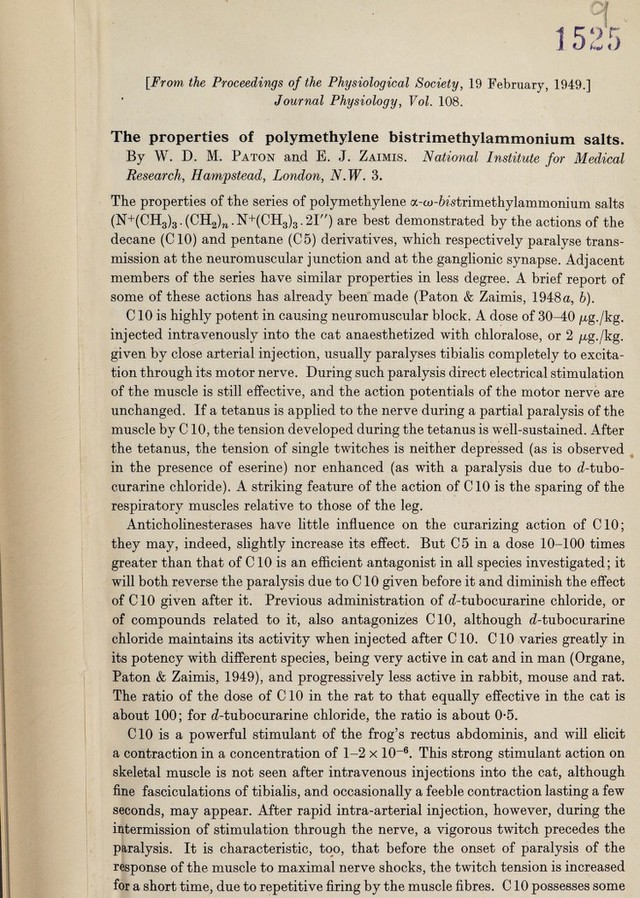
![[From the Proceedings of the Physiological Society, 19 February, 1949.] * Journal Physiology, Vol. 108. The properties of polymethylene bistrimethylammonium salts. By W. D. M. Paton and E. J. Zaimis. National Institute for Medical Research, Hampstead, London, N.W. 3. The properties of the series of polymethylene a-aj-6istrimethylammonium salts (N+(CH3)3.(CH2)n.N+(CH3)3.2I) are best demonstrated by the actions of the decane (CIO) and pentane (C5) derivatives, which respectively paralyse trans¬ mission at the neuromuscular junction and at the ganglionic synapse. Adjacent members of the series have similar properties in less degree. A brief report of some of these actions has already been made (Paton & Zaimis, 1948 a, b). C10 is highly potent in causing neuromuscular block. A dose of 30-40 jug./kg. injected intravenously into the cat anaesthetized with chloralose, or 2 /xg./kg. given by close arterial injection, usually paralyses tibialis completely to excita¬ tion through its motor nerve. During such paralysis direct electrical stimulation of the muscle is still effective, and the action potentials of the motor nerve are unchanged. If a tetanus is applied to the nerve during a partial paralysis of the muscle by C10, the tension developed during the tetanus is well-sustained. After the tetanus, the tension of single twitches is neither depressed (as is observed in the presence of eserine) nor enhanced (as with a paralysis due to d-tubo- curarine chloride). A striking feature of the action of CIO is the sparing of the respiratory muscles relative to those of the leg. Anticholinesterases have little influence on the curarizing action of CIO; they may, indeed, slightly increase its effect. But C5 in a dose 10-100 times greater than that of C10 is an efficient antagonist in all species investigated; it will both reverse the paralysis due to C10 given before it and diminish the effect of CIO given after it. Previous administration of d-tubocurarine chloride, or of compounds related to it, also antagonizes CIO, although d-tubocurarine chloride maintains its activity when injected after C10. CIO varies greatly in its potency with different species, being very active in cat and in man (Organe, Paton & Zaimis, 1949), and progressively less active in rabbit, mouse and rat. The ratio of the dose of CIO in the rat to that equally effective in the cat is about 100; for d-tubocurarine chloride, the ratio is about 0*5. CIO is a powerful stimulant of the frog’s rectus abdominis, and will elicit a contraction in a concentration of 1-2 x 10⁻⁶. This strong stimulant action on skeletal muscle is not seen after intravenous injections into the cat, although fine fasciculations of tibialis, and occasionally a feeble contraction lasting a few seconds, may appear. After rapid intra-arterial injection, however, during the intermission of stimulation through the nerve, a vigorous twitch precedes the paralysis. It is characteristic, too, that before the onset of paralysis of the response of the muscle to maximal nerve shocks, the twitch tension is increased for a short time, due to repetitive firing by the muscle fibres. CIO possesses some](https://iiif.wellcomecollection.org/image/b3063278x_0001.jp2/full/800%2C/0/default.jpg)