A new or improved implement for cutting, paring, filing and performing like operations on the nails, corns and the like / [Ernst Kaufmann].
- Kaufmann, Ernst
- Date:
- 1903
Licence: Public Domain Mark
Credit: A new or improved implement for cutting, paring, filing and performing like operations on the nails, corns and the like / [Ernst Kaufmann]. Source: Wellcome Collection.
1/6
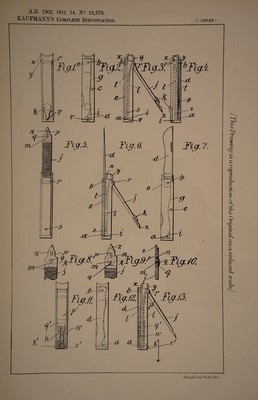
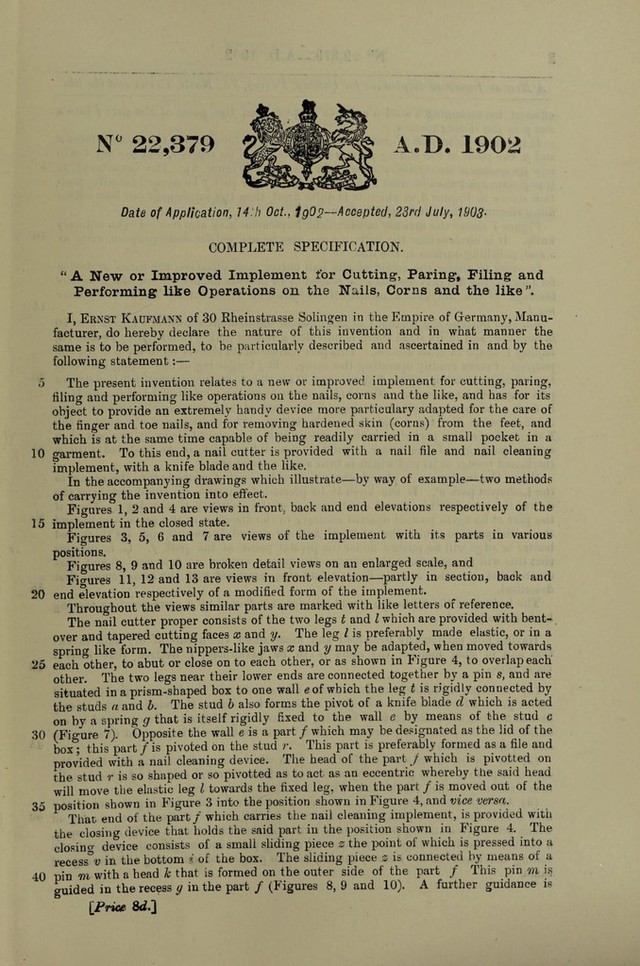
![5 10 15 20 25 30 35 40 N° 22,379 A/D.1902 Date of Application, Oct., IgO j?—Accepted, 23rd July, 1903- COMPLETE SPECIFICATION. “ A New or Improved Implement for Cutting', Paring, Filing and Performing like Operations on the Nails, Corns and the like”. I, Ernst Kaufmann of 30 Rheinstrasse Solingen in the Empire of Germany, Manu¬ facturer, do hereby declare the nature of this invention and in what manner the same is to be performed, to be particularly described and ascertained in and by the following statement:— The present invention relates to a new or improved implement for cutting, paring, filing and performing like operations on the nails, corns and the like, and has for its object to provide an extremely handy device more particulary adapted for the care of the finger and toe nails, and for removing hardened skin (corns) from the feet, and which is at the same time capable of being readily carried in a small pocket in a garment. To this end, a nail cutter is provided with a nail file and nail cleaning implement, with a knife blade and the like. In the accompanying drawings which illustrate—by way of example—two methods of carrying the invention into effect. Figures 1, 2 and 4 are views in front, back and end elevations respectively of the implement in the closed state. Figures 3, 5, 6 and 7 are views of the implement with its parts in various positions. \ Figures 8, 9 and 10 are broken detail views on an enlarged scale, and Figures 11, 12 and 13 are views in front elevation—partly in section, back and end elevation respectively of a modified form of the implement. Throughout the views similar parts are marked with like letters of reference. The nail cutter proper consists of the two legs t and l which are provided with bent--, over and tapered cutting faces a? and y. The leg l is preferably made elastic, or in a spring like form. The nippers-like jaws x and y may be adapted, when moved towards each other, to abut or close on to each other, or as shown in Figure 4, to overlap each other. The two legs near their lower ends are connected together by a pin s, and are situated in a prism-shaped box to one wall * of which the leg t is rigidly connected by the studs n and b. The stud b also forms the pivot of a knife blade cl which is acted on by a spring g that is itself rigidly fixed to the wall e by means of the stud c (Figure 7). Opposite the wall e is a part / which may be designated as the lid of the box; this part / is pivoted on the stud r. This part is preferably formed as a file and provided with a nail cleaning device. The head of the part f which is pivotted on the stud r is so shaped or so pivotted as to act as an eccentric whereby the said head will move the elastic leg l towards the fixed leg, when the part / is moved out of the position shown in Figure 3 into the position shown in Figure 4, and vice versa. F That end of the part / which carries the nail cleaning implement, is provided with the closing device that holds the said part in the position shown in Figure 4. The elosino- device consists of a small sliding piece 0 the point of which is pressed into a recess°y in the bottom i of the box. The sliding piece 0 is connected by means of a pin m with a head k that is formed on the outer side of the part / This pin m is guided in the recess y in the part / (Figures 8, 9 and 10). A further guidance is \Price Si2/]](https://iiif.wellcomecollection.org/image/b3074006x_0001.jp2/full/800%2C/0/default.jpg)