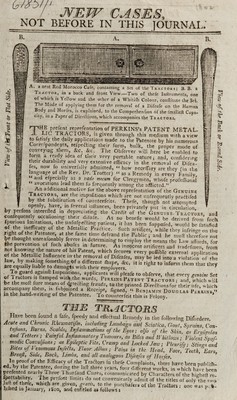
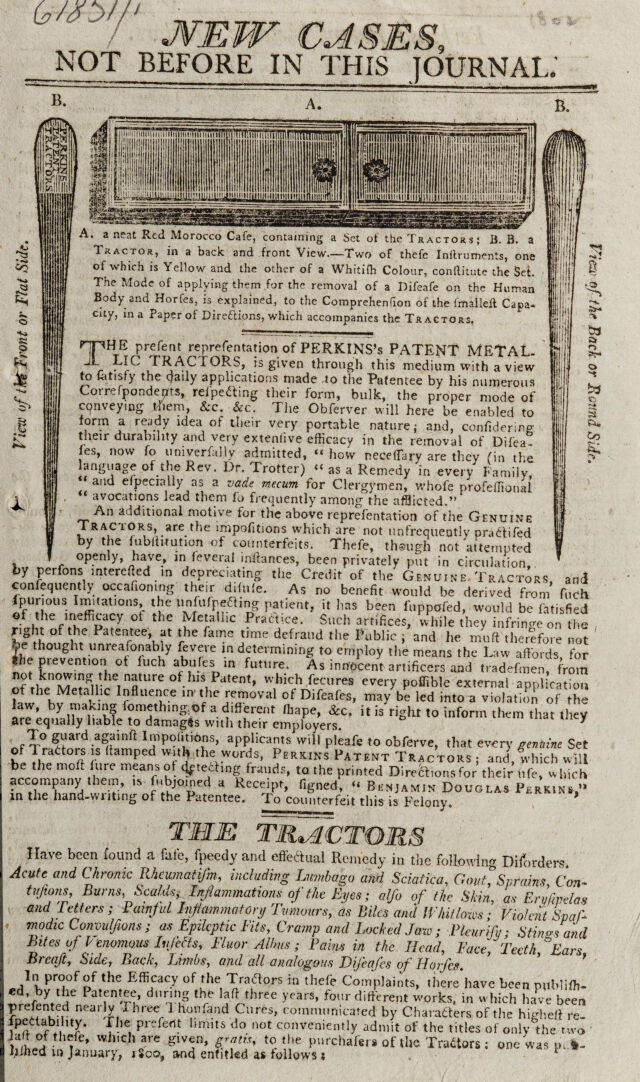
New cases, not before in this journal. ... The present representation of Perkins's patent metallic tractors, is given through this medium with a view to satisfy the daily applications made to the patentee by his numerous correspondents.
- Benjamin Douglas Perkins
- Date:
- [1802]
Licence: Public Domain Mark
Credit: New cases, not before in this journal. ... The present representation of Perkins's patent metallic tractors, is given through this medium with a view to satisfy the daily applications made to the patentee by his numerous correspondents. Source: Wellcome Collection.
4/4
![THE REV. JAMES SHUTTLEWORTH, of Cowling-Hill, near Skipton, York/hire, Augujl l§th, 1801, addrefTed to B. D. Perkins, many important obfervations on the Metallic Practice ; but the prefent limits allow of but the following extraft. “ The opportunity firft given me of trying the merits of your Trazors, by my worthy friend, the Rev. Dr. Rippon, of Southwark, London, who lent me his fet, foon Ipread their fame in this neighbourhood ; for their effects in the cafes tried much exceeded our expectations. As foon as my own fet came to hand, many perfons afflicted applied to me ; but no fooner were the fimple and contemptible-looking Traftors exhibited to their view, than their confidence was turned to difgufi. This, indeed, I find, has been the fituation of-moft of my patients, which proves that if Imagination have any concern in the Metallic PraClice, it operates againft it. But the Traylors, I find, as foon relieve the infidel, the fcornful and the contemner, as thofe who have a better opinion of them. The cures mod worthy of communicating, are, T hree of TootH-A..CH, two of Chronic Head-Ach, two Burns, one fevere Scald, two violent Contusions, and many Cafes of Inflamed Eyes, a diforder very prevalent with us at this time.” [Mr. Shuttleworth next proceeds to detail feveral Cafes, among which are two cures of very obftinate Sore Legs, of long (landing, but we have room only for the following.] “ Case I.—Severe Inflammation in an Eye.—A perfon had for three years been much afflidded with a rheum about one of her eyes. For ten days before fhe applied to me, the eye had been fo covered with a web, that fhe could not fee at all. Her Phylician, who had ufed a wafh, without any benefit, feared the fight was irrecoverably loll : fhe could neither deep nor red from the violence of the pain and inflammation. 1 applied the TraCtors thirty minutes, during which die found great eafe, and foon after was ena¬ bled to fee. I ufed them again only twice during the two following days, when the eye was well; the pain and inflammation being gone, and the fight redored.” “ Case II.—Ajf 'eHion of the Eye.—An infant child had an inflammation in the eye for two months. The ball was much funk, and of a dark purple color. A large white 1'peck then appeared, which Covered half of the fight, and mod of the white of the eye. The Phyfician advifed to blider the back of the neck, and then to take off the fpeck with the knife. The parents however prevailed on me fird to try the Trailers, which I did, with but little hope. On the fird application, the watery difehatge cealed much, and the eve was rendered more plump and bright. The fecond trial took off the purple color. The third removed a red fibre, which feemed to feed the fpeck j and the fourth and fifth applications, to my great furprize, removed the fpeck itlelf. It is impofilble to tell, from the appearance, which of the eyes were affected” THE REV. HENRY GAUNTLETT, of Botlcy, near Southampton, OSiober 7tli, 1801, to B. D. Perkins, writes ; “I have had repeated opportunities of trying your Tra£lors,and of lending them among my neighbours ; and have no doubt of their having been ferviceable. As I have fufficienf evidence to fatisfy my mind of the Efficacy of the Metallic Practice, in proper cafes, I com fider myfelf bound to recommend it.” 11 1 ■ HENRY GREVISION, ESQ. of Kenfington, London, (late of Etton, Yorkfhire ,) well known for his numerous Adis of Philanthropy, Augujl 22, 1801, fated to B. D. Perkins, the following “ Case.—Very obftinate Chronic Iiheumatifm.—A poor widow of the name of Perry, Seventy-two years of age, was for a long time afflicted with the Rheumatifm in the Hip, extending down the leg. Since March laft, fhe had been able to hobble about only by the aftiftance of a (faff; I lent her your Tradiors, diredting her daughter how to ufe them; after three applications, (lie was able to walk to town without her (faff, and, to ufe her own expreffion, I had made her a thoufand pounds better, in lefs than a week fhe was completely recovered, and a few days fince, without a fupportj walked into Kent, 40 miles, to pick hops.” . .- .—— THE TRACTORS, fo neceffary in every Family, and among Horfes, may he had, with new and improved Directions for ufing them ; rendering the mode of Application perfectly intelligible to eveiy Capacity, for Five Guineas the Set, of Benjamin Douglas Pirkins, A.M. the Paten¬ tee, in the Houle of the late J©hn Huntir, Surgeon, Leiccfter Square ; of Fride r i ck Sm i r h, Chemift and Druggifl, in the Haymarket, London; and of Chari.es Whitteu, Chemiit and Dr uggift, Bridge Street, Chefter.-r-Their portable Nature renders their Conveyance to any Part of Great Britain, by Coach, and even by Polt, perfectly convenient. Letters (Pojl paid) cnelofing 1 their Amount in a Bill or Check, will be punctually attended to. V PRINTED BY GEORGE COOKE, DUNoT^YhiTlTtOVTR.STREET.](https://iiif.wellcomecollection.org/image/b30389574_0004.jp2/full/800%2C/0/default.jpg)


 No text description is available for this image
 No text description is available for this image
 No text description is available for this image