[Report 1918] / Medical Officer of Health, Alnwick (Union) R.D.C.
- Alnwick (England). Rural District Council.
- Date:
- 1918
Licence: Attribution 4.0 International (CC BY 4.0)
Credit: [Report 1918] / Medical Officer of Health, Alnwick (Union) R.D.C. Source: Wellcome Collection.
1/2
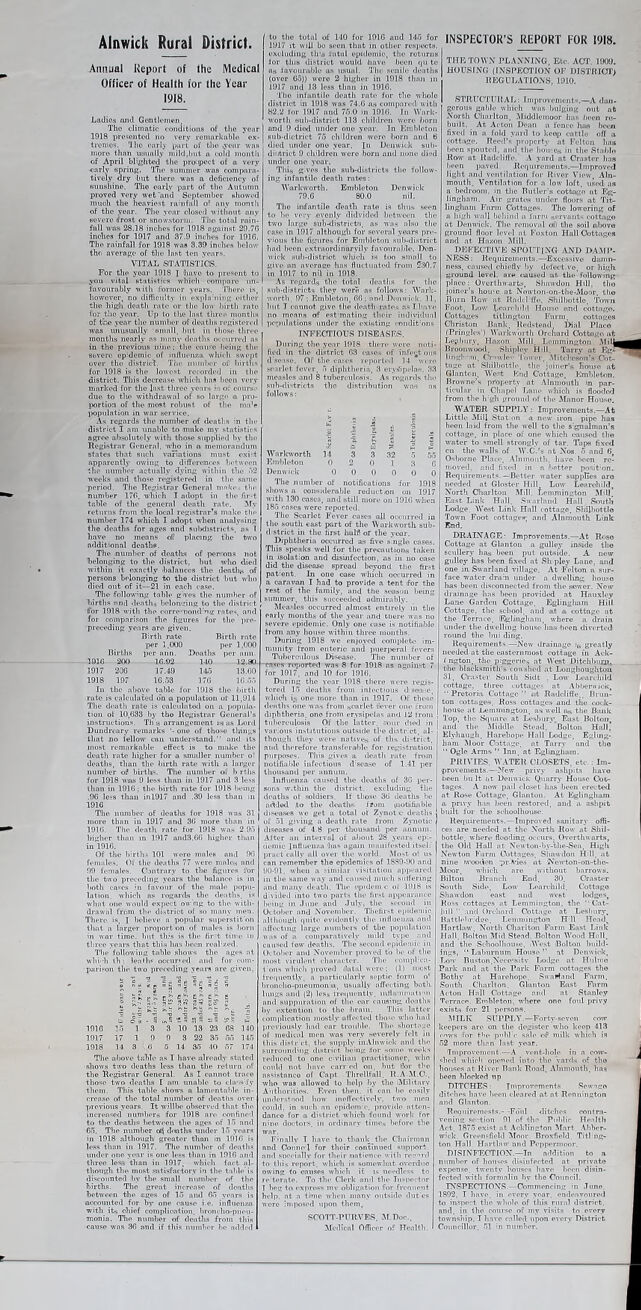
![Alnwick Rural District. Aniiyal Report of the Medical Officer of Health for the Year 1918. Lndic.s ruul GcJitlomen The climatic conditions of the year 1918 presented no very remarkable * ex- tremes. 'Jhc (’nrl\ p.ifl of the vVear svn.H more than nsntvlly mild,l)ut a cold month of April bli^5hte<l the pro.ipoct of « very ■early spring. iTie summer was compara- tively dry but there was a deJicieticy of sunshine. Tlie early part of the Autumn proved very wefand September showed inuoh the heaviest rainfall of any montli of the year. The year closed without any severe tfrost or snow.stonn. TIte total rain- fall was 28.18 inches for 1918 a^gaiiist 29.79 inches for 1917 and 37.9 inches for 1919. The rainfall for 1918 was 3,39 inches holow tho average of the last ten years. VITAL STATISTICS. For the year 1918 T have to present to you vital statistics which compare un- favourably witli iliormer years. Tliero is, however, no difficulty in cx])lii’jiiiig either the higli death rate or the low iiirth rate for tho year. U]) to the last tiirec montlm of the year the number of deaths registcrctl was rmusuftlly small, but in those three months nearly as many deaths oeeiirred as in the prcvioais iiiiie; tlie eau«e being tiie severe epidemic of influonzn which swept over the district. The muiiber of births, for 1918 is the lowest recorded in tlte district. Tliis decrease which has liecii very irmrked for tlie In.st three yCitrs i-icourse due. to the withdrawal of so large o pro- portion of the most robust of the maV iwpfilation in war .service. .\s regards the number of (U*ntlis -n tlu’ district I am unable to make my statistics agree absolutely wit1i those supplied by the Registrar General, who in a. memorandum states tliat such variations must exi-t apparently mving to differences betueon flip number actually dying within the •’>2 weeks and those registered in the same period. The Registrar General mnke. the number 179. which I adopt in tiu' fir-t table of the general death rate. lily returns from the local registrar’s make the nunilter 174 which I adopt when analysing the deaths for ages and sulKlistncts. as T have no means c£ placing the two additional death®. The number of deaths of iwr-'ons not holonging to the district, but wbo died within it exactly halanccs the deatlus of persons belonging to the district but ivlio died out of it—21 in each case. The .follffwmg table gh’es the number of hirtbs and deaths helom.dng to the distri-ct for 1918 with the corre-noiurng ratc-i, and for comparison tlm figures for the pre- precediiig years are given. Birtli rate Birtli rate per 1.000 per 1 .(X)0 Births per nun. Loatlis per iiiiu. 1016 200 16.92 1-10 12.«) 1917 206 17.49 145 13.00 1918 197 16.r>3 176 19..”) In the above table for 1918 tlie Oiirtli •rate is calculated on <a population of 11,914 Tlie dentil rate is cnleulatod on a popula- tion of 10.633 by tho Registrar Geiieral’.s instructions. Tli s arrangement is as J-aiid Dundreary remarks one of those tilings that no fellow can understand.” and its most remarkable effect is to make tlie death rate higher for a smaller number o‘ deaths, than the birth rate with a lunger number of births. The number of b rtlis for 1918 wsis 9 loss than in 1917 and 3 loss thaiii in 1916; the birth rate for 1918 being .96 less than inl917 and .39 less than in 1916 Tlie number of deatlis for 1918 ivas 31 more than in 1917 and 36 more tliaii in 1916. The dentil rate for 1918 was 2.9.) higher than m 1917 aiul3.66 liigber thuin in 1916. Of the birtb> 101 were males ami 96 females. Of the deaths 77 were males nn<l 99 females. Oantrary to the figure.s liir the two preceding years the balance is in both c-n'os in favour of the nirale poim- latioii, M-hieh as rogarib! tlie deatlis. is wlmt one would expect ow ing to the witli- drawal from the di>trift of so matiy men. There is. I believe a poirulnr superstifon that a larger proporfon of males is born in war time, but this i.s tlie fir-t time in three yc!ir.s that tliis lias hcoji renl’zed. The following table sliows tlie ages at wbi’-b ih: lenUi*-' occur'ed and for com- parison the two prcecding years are given. 1916 1.0 1 3 3 10 13 23 68 140 1917 17 1 9 9 3 22 36 .6.) 14.6 1918 14 3 6 5 14 3.6 -10 67 17-1 The above table as T have already stated shows two deaths less tbaii the return n-f the Registrar General. As I cannot trace those two deaths I aim unable to cla.'iH.Fy them. This table shorn? a lamentable iii- croasp of tlip total number of deaths over pi evioiis years. It willbe observed that tho iiurea«ed iiumbors for 1918 are coiifiiip'l to tlip deaths lietweeii the ages of 1.6 and 6.5. The number ofif di-eitlis under 1.6 years in 1918 althouirh greater than in 1916 is less than in 1917. The number of deaths under one year is one less than in 1916 and three lesis than in 1917, which fact Jil- thougli tho most satisfactory in the table is discounted by the small number of the births. The great increase of dontlis between the ages of 1.6 and 6. years is aecounted for by one cause i.e. influenza with its obief complication, bronclio-pneu- Tnonia. The number of deaths from this cause was 36 and if this number be added to the total of 140 for 1916 and 146 for 1917 it will bo seen tlmt jii other respects, excluding th's latal epidomie, the returns lor tins district would linve been qii to a« Javouriuble us usual. The senile deaths (over 65)) were 2 liiglier in 1918 than in 1917 and 13 less than in 1916. Tho infantile death rate for tlie whole district in 1918 was 74.G a« comparedi with 82.2 lor 1917 and 75.0 m 1916. In Wark- worth eiiib-district 113 cliihlren were born mid 9 died under one year. In Enibicton Biib-dictrict 75 children were born and 6 died under ono year. In Deuwiclc suli- I dii^itrict 9 children were born and none died under one year. Tlii^ g.ves tlie suh-districts the follow- ing infantile death rates: V’larkwortli. Embleton Denwiek 79.6 80.0 nil. The infantile (Tenth rate is tlms seen to be very oveiil.v didvided hetwesm tiie two large sul)-distriet‘), as was also the case in 1917 nlthougli for .several years pre- vious the fiigure.s for Em'bletim sub-di.-itrict liad been pxtruordinaryily favourable. Den- wiek smb-distriot wtucli fs too small to give an avcrnce has fluctuated from 2.30.7 in 1917 to nil in 1918. .As regards the total deatlis for the sub-districts they were as follows: Warlc- wortb. 97: Embleton, 66; and Denwiek. 11, bill T cannot give the death rate< as T liavc no means of pst’mnting their individual pr^Yulations under the exwting coiidit'ons INFROTIOUS DI.8E.-VSR?:. During the year 1918 there were noti- fied in the district 63 eases of infer^t oiis d'sease. Of tlie cases reported 14 uire scarlet fever. 6 diphtheria. 3 eryrfipela'S. 33 mea.sle.s ,ind 8 tuberculosis. As regards tho siib-di'-tricts the distribution was as follows: INSPECTOR’S REPORT FOR 1918. THE TOWN PLANNING. Etc. ACT. 1909. HOU.«;lNG (INSPEOTION OK DJ,STKiai'> REGUI/ATIO.NS, 1910. STIirClTTl.AIi: Imjirovcnicnt'-.—A dan- gerous gnlile which ivas bulging out at North C’liarlton. .Middlcmoor lias been re- built. At Acton Dea’ii a fence Iwi bcH'n fixed in a fold .vard to l;eop cattle off a cottage. Reed’s property at Felton 1ms been spouted, and the liou-c« in the Sta-blo Row at Radcliffe. .A .yard at Crastcr has been pared Rcf|Uireiiient-s.—Improved light .nnvl ventilation for River View, Aln- mouth, Ventilation for a low loft, used, as a bedroom, m tiie Riitler’s cottago at Eg- linglmm. Air gratis imdcr floors at Tit- linghoin Farm Cottages. Tlie lowering of a liigb wall bcliind a farm servants cott.ago at Dcnwielv. The removal olf) tlio soil nbovo ground floor level at Foxton Hall Oottajgea and .it Hazon Idill. DEI-’ECTIVE SPOITINO AND DAMP- NESS: Requirements.—Excessive diunn- ness. caused chiefl.v by defec-t.ve, or higlL ground level, are caiused ut the following place; Ovcrtliwarts, Sliawdon Htll, tbo joiner’s hoice at Nuwton-on-tlie-Aloor. tlio Burn Row at Radcl tfc. .Shilbottle, 'Dvwri Foot. Low I.caifliild House ond oottago. Cottages titlijigton Farm. cottiiges Cliriston Bank. Redstead Dial Place fPringles ) Workwortli Orchard Cottage, at Le^ibur.v. Hazon Mill, Lcinmington Miiy Broouwo(Kl, Sliiplov Hill Tarry at Eg- tingb-m. CV-^wlev 'I'owor. .Mitche.son’s Cot- tage at Shilbottle, the joiner’s house at Glantr-ii. Vest End Cottage, Embleton. Browne’s property at Alnmoiith in par- ticular in Chapel I/niie which is floodcvl from the Ir-gh ground of the Manor Hou«e. Den 0 2 9 0 1 0 The number of notifications for 1918 sliiows a coimulernble reducton on 1917 with 130 cases, and «>till more oil 1916 when 185 cn.scs were reported. The Scarlet Fever cases all occurred in the south east ixart of tlie AAarkworth sub- district in the first bnlfl of the year. Diphtheria occurred as five s nglc cases. This speaks well for the precautions taken in isolation and disuifcction. as in no case did the disease spread beyond the first patient. In one case which occurred in a caravan I had to provide a tent for the rest of tho family, and the season being summer, this succeeded admirably. Meades occurred almost entirely in the early months of the .year and tliere was no severe epidemic. Only one case is notifiable from any liousp within three mouths. During 1918 we enjoyed complete im- munity from oiiterio nncl puer|>eral fcvor.s Tuber(’ulous Di.sease. Tlie number of ■rases ri^jortccl was 8 for 1918 as ngaiii't 7 for 1917, and 10 for 1916. During the year 1918 there were regis- tered 15 deaths from iirteetioiis d seiai-e, ivliich i-j one more than in 1917. Of those dotths one was from ^rarlet flever one froii diphtheria, one from er>-sipelas and J2 Irom tnbcreulosia Of tlie latter. .HtPiir died in various institutions outside the district, al- though they were native-, of ths di-trict, and therefore transh'rable for registmtioii piirpose«. This gives a death rate fmm notifiable infectious d’soai-c of 1.41 per thousand per annum. Infliiciiza caused the dc\iths of 36 per- sons w.tliin the district, excluding fhe deaths of soldiers. If those 36 deatlis he ari'Jixl ,to tile doiith« from (uotlifuible dix'a.se.s wc get a total of Z.vnot c deaths of 51 giving a death rate from Zynotic diseases of 4.8 per thousand per annum. After an interval of about 28 years epi- demic InHuoiiza lias again manifested itself prnct (ally all over the world. Mo-t of us can remember the epidemics of 1889.90 and 90-91, when a '•imilar vi'-itation appeared in the same any and caused mucli sulfering and many death. The opidcni c oi 1918 is dii’ided into two parts the first appearance lu’iiig in June and July, tlie second in October and November. Tiielii-t epidemic aldimigh (piitc evidently the inHuenz.a and afi'i'cting largo numbers of the iiopulation wa.s of a comparatively mild t.vpe and caused few deaths. Tlie .second epiileiiiic in October and Novemln-r juoved to be ikf the most virulent clwiractcr. Tin- l•olupl:c:l- i'ons which proved .I'atal were; (1) most frequently, a particularly septic form o* broiK'lio-pneumoniia, usuall.v affecting both, lungs and (2) k‘8.s lre(|uently. mfiti.iuinati-ui ami suppuration of tlie isir causnig doaths by extention to tho brain. This latter comiilicntion mostl.v uffiM-ted tlio-e wlioluid prcviousl.v bad ear troni'ile. Tlu> sliorti'._'e of meJiuiil men uvis very severely felt In tliis dis1 r et. tho supjJv in.Alnwiek ami tbo suiToiimihig district liemg for some weeks reiliiced to one civilian practitioner, wlin coiih) not have curr'ed on. but Ulor the assistauco of Capt Threllfall. R..A.M.C.. who was allowed to help by the iMilitarv Autliorkies. F.veii then, it can be easily understood how ineffectivel.v. two men could, in smb an opidmirc. provide atten- dance for a district which foiiml work for nine doctov-s, in ordinary times before the F'nnllv T have to thank the Clunrmnn mid Coiinc'l for their contTnued support and .snecially for their .nntiimce witli rec''’rd to this reiiort. wbicli i.s soiuewliat overdue Giving to onuses which it is needless to rekernte. To the Clerk and tlie Inspector T hog to express mv obligation for fronnent help, at a timie when uinny outside dut'es wore Imposed upon them. SCOn'-RURVES. .M.Doc.. Afcdicnl Officer of IToaltb. WATER SUPPLY : Improvements.—At Little Aliil .Station a nv-w iron pipe has been laid from tJie well to tlie s'gnalman’s cottage, in place of one which (^a^^scd the water to smell strongly of tar. Taps fixed cn the walls of W.C.’s at Noa. 5 and 6 Osborne Placr‘. Alnmontli, have been re- moved. and fixed in a better posit’on. Requirements.—Better water supplies nro needed at Glostcr Hill, Low Learohild, North Cliarlton Afill. Lemmington Mill, East Link Hall, .^warlniid Hall South Lodge. We-st Link Hall l ottage. Shilbottle Town Foot cottiige.s; and Alnmouth Link End. DRAINAGE- Improvements.—At Rose Cottage aT Glanton a gulley inside tho scullery has been put outside. A new gulley has been fixed at Shpjey Lane, and one in. Swarland village. At Felton a sur- face water drivn under a dwelling homo ha.s been disconnected from the sewer. Now di'.Tinage hn.s been provided at Hnuxle.v Lane Garden Cottage, Egliugliam Hiil Cotta.se, the school, and at a cottage at the Terraco, 'Egiiagliam, where a drain under the d'vcHiiig house has been diverted round the Imi ding. Requirements.—New drainage greatly needed at the easternmost c-ottage I'n Ack- fngton, the piggeries at West Ditchbmm. the blacksmith’s (owslunl at I/onglioughtoii 31. CVastcr Soiitli Sidt . Low Learcliild cottage, three cott.agC'- at .Abtierwick, •‘Pretoria Cottage” mt Radcliffe.. ton cottages. Ross cottages and the codc- liouse at Lemmington, as well n<A tlie Bank I Top, tlie S<iuaro at Lesbury, East Bolton I and the ^liddle Stead, Bolton Hall, Elyhaugh, Hiireliope Hall Lodge, Egling- ham Jloor C.-ittagc. at Tairv and tho Ogle Arms ” Inn. at Eglingluiiin. PRIVIES. AVATER CLO.SETS. etc. ; Im- provements.—New privy ashpits have been bu It .m Denwiek Quarry House Cot- tages. A now pad claset has been erected nt Rose Cottage, Glniiton. At Eglingliam ,T. privy lia5? been restored, and a ashpit built for the selioolliousc. Requirements.—Improi-ed sanit.ary offi- ces are needed nt the North Row at Sliil- ' bottle, where flooding occurs, Overthwarts, the Old Hal! at NcwtQii-h.v-^lie-Seii, High Newton Farm tAittages. Sliawdon Hill, at nine m’ooden pr.h-Ie.-? at 'Neu'ton-c>n--tli<i- Moor, which are without barrows. Bilton Branch End. 30. Crastcr South Side. Low LMi-c-hild. Cottage Shawdon east and west lodges^ Koss cottages at Lemmington. the Cat- bill” and Oiflinrd Cottage at Lcsbury, Battlebridsc. Lemmington HU Head.. Hartlaw, Nortli Charlton Farm Eu.st Link Hall. Bolton Mid Stead. .Bolton Wood Hall, and the Sclioollmu.se. .West Bolton build- ings. ‘‘Laburnum House” at Denwiek. T,ow Buston.Nocp^sitv T/odgo at Hulmo Park and at tlie Park Farm cottages the Rotliy at Harehopp. SwnHaiid Farm. South Charlton. Glanton East Farm .Acton Hall Cottage and at Stanlc.v Terraco. Embleton, where onr> foul privy exists for 21 iiersons. .MILK S'UPPT.Y.—Forty-seven cow keepci-s arc on tlie degistcr who keep 413 fo-;vs for tlip puhl'c sale dP mill; which is 62 more than last year. Improvement.—.A vent-hole in a cow- shed which opened into the vard'? of tho houses at River Bank Road. Alnmouth, has been blocked up DITCHES; Impror''mrnts Sewogo ditches have been cleared at at Rennington and Glanton. Reqniremcsts.- -Fihil ditches eontra- vciiing se-tion 91 of the Public Healtli •Act. 1875 exist nt .Acklington Afart. .Abhcr- wick- Grcpn?field Aloor Broxfield. Titl iig- ton Hall, Hartlaw and Poppermoor. DISINFECTION.—In addition to a jiiimhcr of houses disinfected at private expense, twentv houses hare been disin- fected with formalin by the Council. TN.8PECTI0N.8.—Commencing in .Time. 1892. T have, in overr year, endeavonrod to inspect tlie whole of this rural district, and. in the course of my visits to cverv township, T have called upon every District Conncillor. 61 -n number.](https://iiif.wellcomecollection.org/image/b28800576_0001.jp2/full/800%2C/0/default.jpg)