[Report 1944] / Medical Officer of Health, East Sussex County Council.
- East Sussex (England). County Council
- Date:
- 1944
Licence: Attribution 4.0 International (CC BY 4.0)
Credit: [Report 1944] / Medical Officer of Health, East Sussex County Council. Source: Wellcome Collection.
1/12 page 1
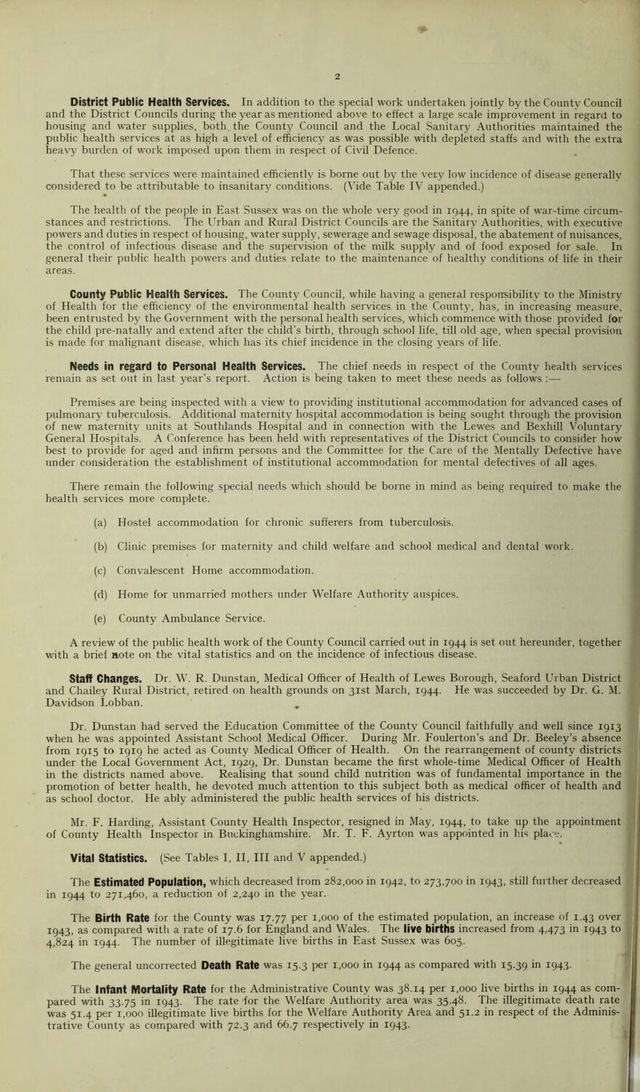
![-p- 1 O. f*AFfKS ROAD, oxf’o-^o EAST SUSSEX COUNTY COUNCIL. ANNUAL REPORT OF THE COUNTY MEDICAL OFFICER OF HEALTH UPON THE HEALTH AND SANITARY CONDITION OF THE COUNTY FOR THE YEAR ENDED 31st DECEMBER) 1944. To the Chairman and Members of the East Sussex County Council. Mr. Chairman, My Lords, Ladies and Gentlemen, I have the honour to submit my seventeenth Annual Report, and the fiftieth of the series, on the Health of the Administrative County of East Sussex. The Report deals with the calendar year 1944, a year of great activity in preparation for the further development of the public health services. National Health Service. Early in the year the Government indicated that they proposed to bring the Country’s full resources to bear upon reducing ill health and promoting good health in all its citizens and to that end they published their proposals in a White Paper entitled “A National Health Service.” The com- prehensive state medical service therein set forth, embracing full domiciliary medical care and complete hospital provision for every member of the community invoh'ed far-reaching changes in regard to medical attention in sickness, both domiciliary and institutional, for the whole community and a considerable change I in local government administration. The proposals received full consideration and were the subject of a ! memorandum by the County Medical Officer of Health to the Clerk of the County Council. Rural Housing. The Government also represented to County Councils and Rural District Councils that steps should be taken to give effect to the recommendations of the Report of the Central Housing Advisory ! Committee on Rural Housing, which was issued in May, 1944, and to that end to unite in making a combined effort to raise the standard of working class housing and to improve such allied services as water, sewerage, and the County health services. A Conference of representatives of the County Council and of the Rural I District Councils was held in September, 1944, following which a Joint County Committee was formed to I consider the whole question of rural housing including post-war programmes and standards. A Technical Committee, comprising officers of the Authorities, was appointed which drew up a suggested uniform standard for the demolition, reconditioning and repair of houses. This standard was accepted by the Joint Committee I and recommended for adoption by the Constituent Authorities. The Technical Committee’s report on the , Survey of working-class houses was also accepted and recommended to be put into operation by the District Councils. ' Water Supply. The need for improving the Water supply throughout the County, which was stressed I by the Central Housing Committee, was, in 1944, the subject of another Conference consisting of representatives of the County Council, Local Authorities and Water Companies. Following this the Joint Advisory Committee I on Water Supplies was reconstituted, with three Committees covering the whole County in areas most con- veniently grouped for water supply purposes, i I The Committees gave serious consideration to the needs both present and future of these areas and to ! the means by which these needs could best be met. Considerable progress has been made by the North- Western Area Committee in whose area conditions are particularly favourable to combination of effort. The I other two Committees have made progress in their work of ascertainment of the possibilities of providing an adequate and sufficient piped water supply throughout their areas. I Civil Defence and Casualty Services. The County Council, while retaining the general direction of the civil defence services of the County, delegated from the early days of the war the detailed arrangements to the District Councils. These set up a complete organisation under District Sub-Controllers assisted by A.R.P. I Organisers comprising a headquarters staff, and a service of wardens to report incidents, and of rescue and I first-aid parties, decontamination squads, etc. The local Casualty Services included ambulances with drivers and attendants, first-aid posts both fixed and mobile with medical and trained and auxiliary nursing staff. In the rur^l districts many first-aid points were established and staffed by voluntary workers. District ' Medical Officers of Health with their sanitary officers were generally in charge of the casualty services, which involved them in much administrative and executive work and attendance at frequently held practices and demonstrations to maintain the efficiency of staff and vehicles. The County Medical Officer of Health, in I addition to acting as medical adviser to Mr. Martin, the County Controller, and to Colonel Hickie, the A.R.P. j Organiser, in regard to the Casualty Services of the County, held the office of County Ambulance Officer and ■ administrative Gas Identification Officer. In the latter office most able assistance was given bv Mr. Jessop, the County Health Inspector, who acted also as an A.R.P. Training Officer and as officer in charge of all County I civil defence stores and also of stores supplied through the Ministry of Health for war time hospitals and I institutions. .1 At the time of writing the war is officially at an end and tributes have been paid by the Ministry of Health ; all connected with the civil defence services. It is with full knowledge of the self-sacrificing labours of j fose who were engaged in the Casualty Services both central and local that I can say that the Minister’s were well deserved by all engaged in these services throughout East Sussex and very specially by ] the devoted band of voluntary workers. I](https://iiif.wellcomecollection.org/image/b29186821_0003.jp2/full/800%2C/0/default.jpg)