An improved construction of stretcher for sick and wounded persons, and of vehicles and apparatus employed in combination therewith / [Michael Tell].
- Tell, Michael.
- Date:
- 1890
Licence: Public Domain Mark
Credit: An improved construction of stretcher for sick and wounded persons, and of vehicles and apparatus employed in combination therewith / [Michael Tell]. Source: Wellcome Collection.
3/8 page 3
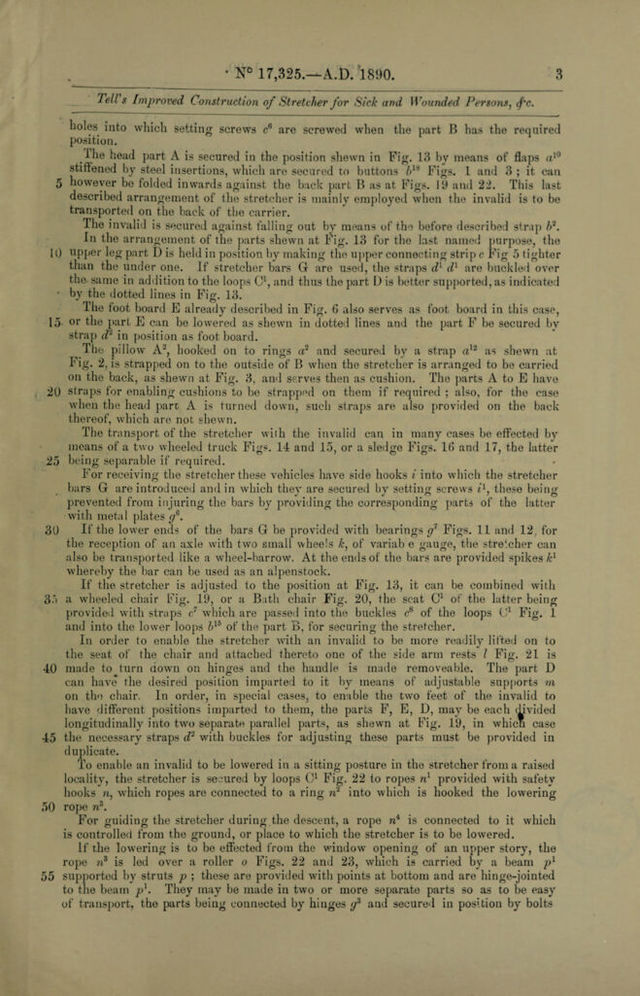
![Tell s Improved Construction of Stretcher for Sick and Wounded Persons, <f'c. 25 boles into which setting screws c6 are screwed when the part B has the required position. Ihe head part A is secured in the position shewn in Fig. 13 by means of flaps a10 stiffened by steel insertions, which are secured to buttons b1H Figs. 1 and 3 ; it can 5 however be folded inwards against the back part B as at Figs. HI and 22. This last described arrangement of the stretcher is mainly employed when the invalid is to be transported on the back of the carrier. The invalid is secured against falling out by means of the before described strap h2. n the arrangement of the parts shewn at Fig. 13 for the last named purpose, the 10 tipper leg part D is held in position by making the upper connecting strip c Fig 5 tighter than the under one. If stretcher bars G are used, the straps dl dl are buckled over the same in addition to the loops C1, and thus the part 1) is better supported, as indicated • by the dotted lines in Fig. 13. The foot board E already described in Fig. 6 also serves as foot board in this case, 15- 0l’ the part E can be lowered as shewn in dotted lines and the part F be secured by strap dr in position as foot board. The pillow A2, hooked on to rings a? and secured by a strap a12 as shewn at Fig. 2, is strapped on to the outside of B when the stretcher is arranged to be carried on the back, as shewn at Fig. 3, and serves then as cushion. The parts A to E have 20 straps for enabling cushions to be strapped on them if required ; also, for the case when the head part A is turned down, such straps are also provided on the back thereof, which are not shewn. The transport of the stretcher with the invalid can in many cases be effected by means of a two wheeled truck Figs. 14 and 15, or a sledge Figs. 16 and 17, the latter _ # i i ~ ' O c5 / being separable if required. For receiving the stretcher these vehicles have side hooks i into which the stretcher bars G are introduced and in which they are secured by setting screws i1, these being prevented from injuring the bars by providing the corresponding parts of the latter with metal plates g6. If the lower ends of the bars G be provided with bearings g7 Figs. 11 and 12, for the reception of an axle with two small wheels k, of variab e gauge, the stretcher can also be transported like a wheel-barrow. At the ends of the bars are provided spikes w hereby the bar can be used as an alpenstock. If the stretcher is adjusted to the position at Fig. 13, it can be combined with a wheeled chair Fig. 19, or a Bath chair Fig. 20, the scat C1 of the latter being provided with straps c7 which are passed into the buckles c8 of the loops (J1 Fig. 1 and into the lower loops b15 of the part B, for securing the stretcher. In order to enable the stretcher with an invalid to be more readily lifted on to the seat of the chair and attached thereto one of the side arm rests l Fig. 21 is made to turn down on hinges and the handle is made removeable. The part D can have the desired position imparted to it by means of adjustable supports m on the chair. In order, in special cases, to enable the twro feet of the invalid to have different positions imparted to them, the parts F, E, D, may be each divided longitudinally into two separate parallel parts, as shewn at Fig. 19, in whicn case 45 the necessary straps d2 with buckles for adjusting these parts must be provided in duplicate. To enable an invalid to be lowered in a sitting posture in the stretcher from a raised locality, the stretcher is secured by loops C1 Fig. 22 to ropes nl provided with safety hooks /g which ropes are connected to a ring nr into which is hooked the lowering rope n3. For guiding the stretcher during the descent, a rope n4 is connected to it which is controlled from the ground, or place to which the stretcher is to be lowered. If the lowering is to be effected f rom the window opening of an upper story, the rope n3 is led over a roller o Figs. 22 and 23, which is carried by a beam pl supported by struts p ; these are provided with points at bottom and are hinge-jointed to the beam p]. They may be made in two or more separate parts so as to be easy of transport, the parts being connected by hinges <f and secured in position by bolts 30 3: 40 50 55](https://iiif.wellcomecollection.org/image/b30740800_0003.jp2/full/800%2C/0/default.jpg)