An improved construction of stretcher for sick and wounded persons, and of vehicles and apparatus employed in combination therewith / [Michael Tell].
- Tell, Michael.
- Date:
- 1890
Licence: Public Domain Mark
Credit: An improved construction of stretcher for sick and wounded persons, and of vehicles and apparatus employed in combination therewith / [Michael Tell]. Source: Wellcome Collection.
1/8
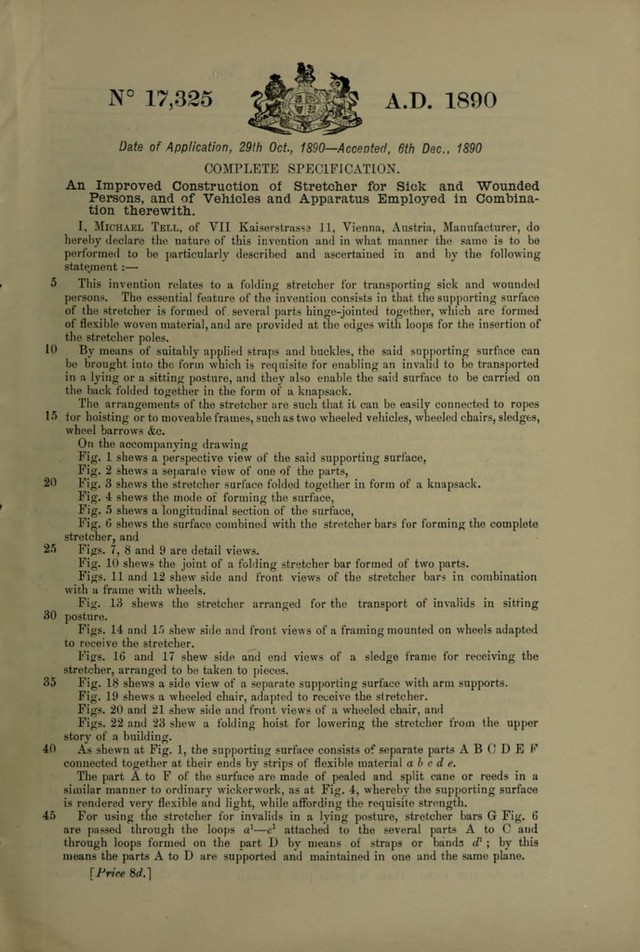
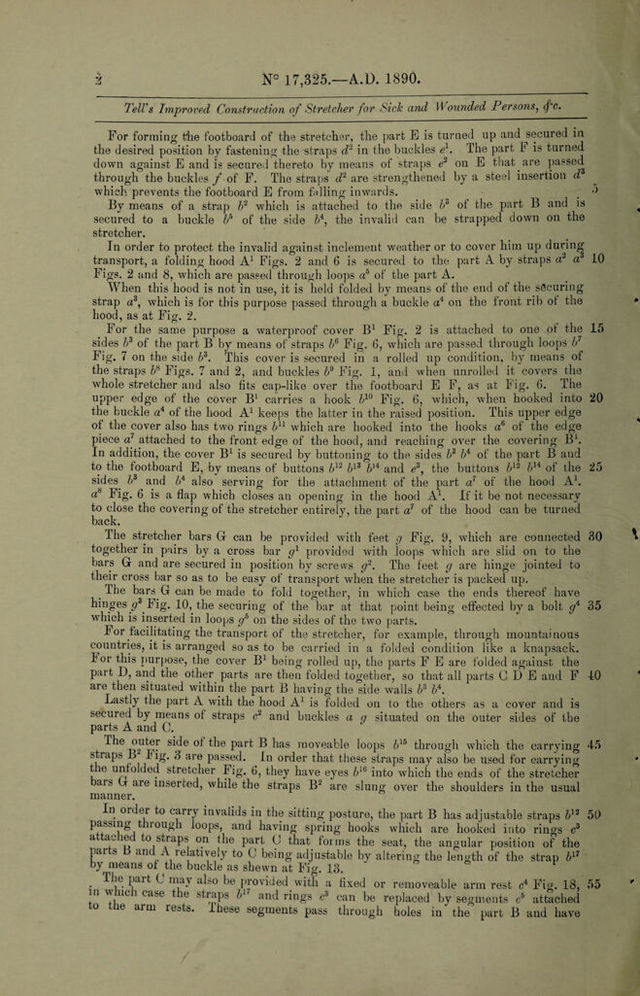
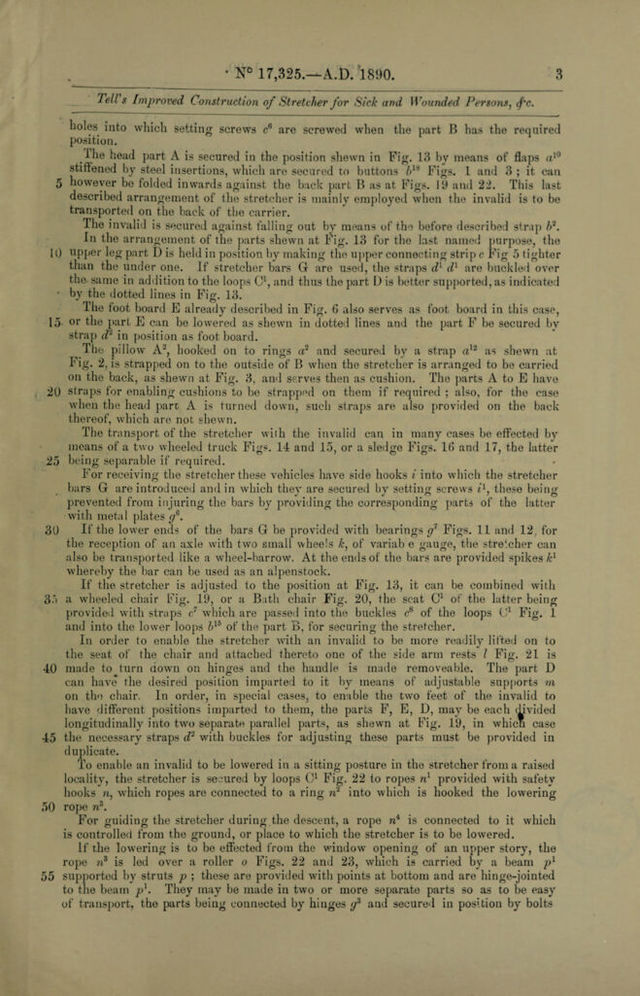
![10 15 20 25 30 35 40 45 N° 17,325 A.D. 1800 Date of Application, 29th Oct, 1890—Accented, 6th Dec., 1890 COMPLETE SPECIFICATION. An Improved Construction of Stretcher for Sick and Wounded Persons, and of Vehicles and Apparatus Employed in Combina¬ tion therewith. I, Michael Tell, of VII Kaiserstrassa 11, Vienna, Austria, Manufacturer, do hereby declare the nature of this invention and in what manner the same is to he performed to be particularly described and ascertained in and by the following statement :— This invention relates to a folding stretcher for transporting sick and wounded persons. The essential feature of the invention consists in that the supporting surface of the stretcher is formed of several parts hinge-jointed together, which are formed of flexible woven material, and are provided at the edges with loops for the insertion of the stretcher poles. By means of suitably applied straps and buckles, the said supporting surface can be brought into the form which is requisite for enabling an invalid to be transported in a lying or a sitting posture, and they also enable the said surface to be carried on the back folded together in the form of a knapsack. The arrangements of the stretcher are such that it can be easily connected to ropes for hoisting or to moveable frames, such as two wdieeled vehicles, wheeled chairs, sledges, wheel barrows &c. On the accompanying drawing Fig. 1 shews a perspective view of the said supporting surface, Fig. 2 shews a separale view of one of the parts, Fig. 3 shews the stretcher surface folded together in form of a knapsack. Fig. 4 shews the mode of forming the surface, Fig. 5 shews a longitudinal section of the surface, Fig. 6 shews the surface combined with the stretcher bars for forming the complete stretcher, and Figs. 7, 8 and 9 are detail views. Fig. 10 shews the joint of a folding stretcher bar formed of two parts. Figs. 11 and 12 shew* side and front views of the stretcher bars in combination with a frame with wheels. Fig. 13 shews the stretcher arranged for the transport of invalids in sitting posture. Figs. 14 and 15 shew side and front views of a framing mounted on wheels adapted to receive the stretcher. Figs. 16 and 17 shew side and end views of a sledge frame for receiving the stretcher, arranged to be taken to pieces. Fig. 18 shews a side view of a separate supporting surface with arm supports. Fig. 19 shews a wheeled chair, adapted to receive the stretcher. Figs. 20 and 21 shew side and front views of a wheeled chair, and Figs. 22 and 23 shew a folding hoist for lowering the stretcher from the upper story of a building. As shewn at Fig. 1, the supporting surface consists of separate parts ABODE F connected together at their ends by strips of flexible material ah c d e. The part A to F of the surface are made of pealed and split cane or reeds in a similar manner to ordinary wickerwork, as at Fig. 4, whereby the supporting surface is rendered very flexible and light, while affording the requisite strength. For using the stretcher for invalids in a lying posture, stretcher bars G Fig. 6 are passed through the loops a1—c1 attached to the several parts A to C and through loops formed on the part D by means of straps or bands dl ; by this means the parts A to D are supported and maintained in one and the same plane. [Price 8(7.]](https://iiif.wellcomecollection.org/image/b30740800_0001.jp2/full/800%2C/0/default.jpg)