On the influence of the position of the body on the position of the heart and on intracardiac pressure / by C.J. Bond.
- Charles John Bond
- Date:
- [1885]
Licence: Public Domain Mark
Credit: On the influence of the position of the body on the position of the heart and on intracardiac pressure / by C.J. Bond. Source: Wellcome Collection.
Provider: This material has been provided by The Royal College of Surgeons of England. The original may be consulted at The Royal College of Surgeons of England.
1/4
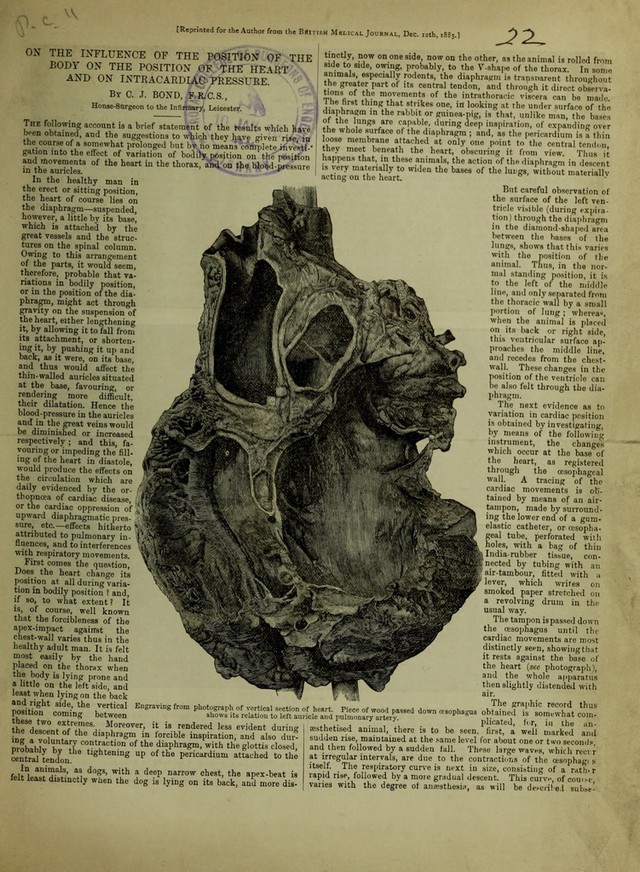
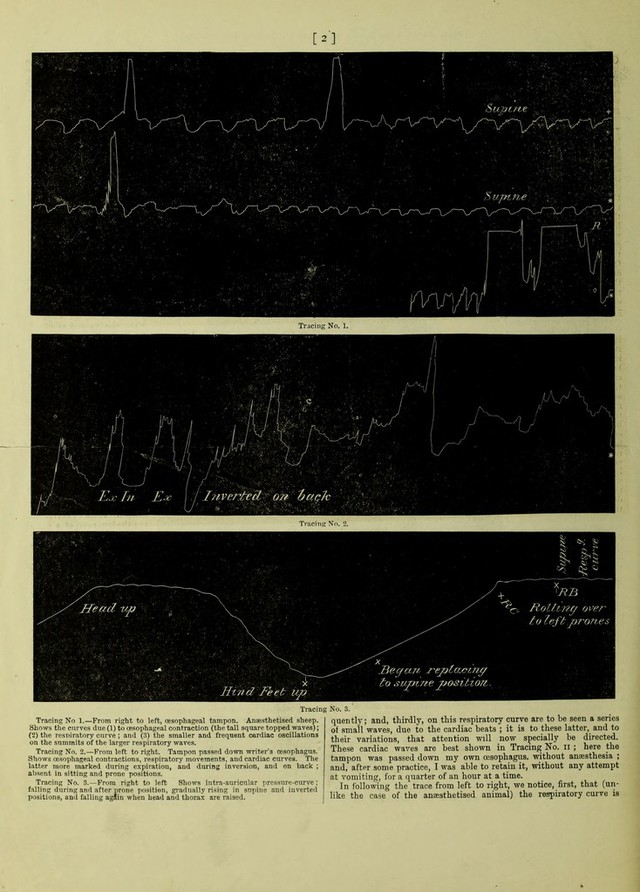
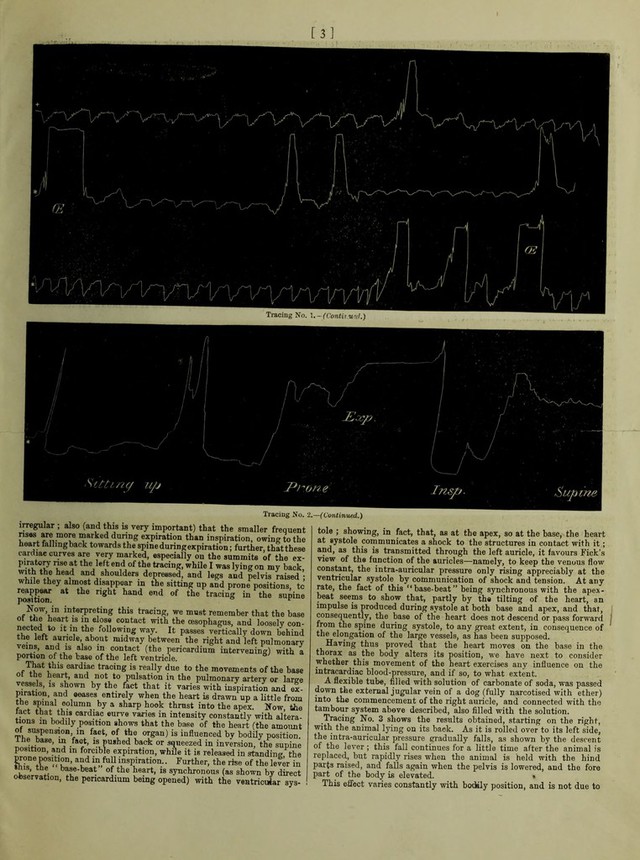
![[Reprinted for the Author from the BiUtish Msmcal Journal, Dec. mh, .885.] ON THE INFLUENCE OF THE POSITION OF THE BODY ON THE POSITION OF THE HEART AND ON INTRACARDIAC PRESSURE. By C. J. BOND, F.R.C.S., Honse-Sargeon to the Infirmary, Leicester. The following account is a brief statement of the results which have been obtained, and the suggestions to which they have given rise, in ™tionTt °!i? 802lerHt Pro?onged but by .no means complete investi-' gation into the effect of variation of bodily position on the position and movements of the heart in the thorax, and on the blood-pressure In the healthy man in the erect or sitting position, the heart of course lies on the diaphragm—suspended, however, a little by its base, which is attached by the great vessels and the struc- tures on the spinal column. Owing to this arrangement of the parts, it would seem, therefore, probable that va- riations in bodily position, or in the position of the dia- phragm, might act through gravity on the suspension of the heart, either lengthening it, by allowing it to fall from its attachment, or shorten- ing it, by pushing it up and back, as it were, on its base, and thus would affect the thin-walled auricles situated at the base, favouring, or rendering more difficult, their dilatation. Hence the blood-pressure in the auricles and in the great veins would be diminished or increased respectively ; and this, fa- vouring or impeding the fill- ing of the heart in diastole, would produce the effects on the circulation which are daily evidenced by the or- thopncea of cardiac disease, or the cardiac oppression of upward diaphragmatic pres- sure, etc.—effects hitherto attributed to pulmonary in- fluences, and to interferences with respiratory movements. First comes the question, Does the heart change its position at all during varia- tion in bodily position ? and, if so, to what extent? It is, of course, well known that the forcibleness of the apex-impact against the chest-wall varies thus in the healthy adult man. It is felt most easily by the hand placed on the thorax when the body is lying prone and a little on the left side, and least when lying on the back and right side, the vertical position coming between tinctly, now on one side, now on the other, as the animal is rolled from side to side, owing, probably, to the V-shape of the thorax. In some animals, especially rodents, the diaphragm is transparent throughout the greater part of its central tendon, and through it direct observa- « °f .\h-6 m°vemeritis of the intrathoracie viscera can be made, he first thing that strikes one, in looking at the under surface of the diaphragm in the rabbit or guinea-pig, is that, unlike man, the bases ,s /re c.aP*blj. dl*nng deeP inspiration, of expanding over the whole surface of the diaphragm ; and, as the pericardium is a thin tbeSv !itacuedvat 0nly 0ne point to the central tendon, they meet beneath the heart, obscuring it from view. Thus it happens that, in these animals, the action of the diaphragm in descent is very materially to widen the bases of the lungs, without materially But careful observation of the surface of the left ven- tricle visible (during expira- tion) through the diaphragm in the diamond-shaped area between the bases of the lungs, shows that this varies with the position of the animal. Thus, in the nor- mal standing position, it is to the left of the middle line, and only separated from the thoracic wall by a small portion of lung j tvhereas when the animal is placed on its back or right side, this ventricular surface ap- proaches the middle line, and recedes from the chest- wall. These changes in the position of the ventricle can be also felt through the dia- phragm. The next evidence as to variation in cardiac position is obtained by investigating, by means of the following instrument, the changes which occur at the base of the heart, as registered through the oesophageal wall. A tracing of the cardiac movements is ob- tained by means of an air- tampon, made by surround- ing the lower end of a gum- elastic catheter, or oesopha- geal tube, perforated with holes, with a bag of thin India-rubber tissue, con- nected by tubing with an air-tambour, fitted with a lever, which writes on smoked paper stretched on a revolving drum in the usual way. The tampon is passed down the oesophagus until the cardiac movements are most distinctly seen, showing that it rests against the base of the heart (see photograph), and the whole apparatus then slightly distended with air. Engraving from photograph of vertical section of heart. Piece of wood passed down oesophagus ob^ned^^ln thUS shows its relation to left auricle and pulmonary artery cesophagus obtained is somewhat com- J plicated, for, 111 the ■— the descent «f elTeSd- M°reover> lb is rendered less evident during ins S t the dlallhra£m, ln forcible inspiration, and also dm? probably bv%TflC^ wCtl°n °f th® dlaPhragm, with the glottis closed, central tendon* ^ tlghtenln® UP of tbe pericardium attached to the felHe^t1^3’ u d°?S’ Wi,th a deeP narrow chest, the apex-beat is felt least distinctly when the dog is lying on its back, and more dis- sesthetised animal, there is to be seen, first, a well marked and sudden rise, maintained at the same level for about one or two seconds and then followed by a sudden fall. These large waves, which reer.r at irregular intervals, are due to the contractions of the oesophagi s itself. The respiratory curve is next in size, consisting of a ratfnr rapid rise, followed by a more gradual descent. This curve, of com.-e varies with the degree of ansesthesia, as will be described subse-](https://iiif.wellcomecollection.org/image/b22473877_0003.jp2/full/800%2C/0/default.jpg)