Meat, milk, and wheat : an elementary introduction to the chemistry of farming : to which is added a review of the questions at issue between Mr. Lawes and Baron Liebig / by Thomas Dyke Acland, jun.
- Acland, Sir Thomas Dyke, 1809-1898.
- Date:
- 1857
Licence: Public Domain Mark
Credit: Meat, milk, and wheat : an elementary introduction to the chemistry of farming : to which is added a review of the questions at issue between Mr. Lawes and Baron Liebig / by Thomas Dyke Acland, jun. Source: Wellcome Collection.
Provider: This material has been provided by The Royal College of Surgeons of England. The original may be consulted at The Royal College of Surgeons of England.
18/104 page 12
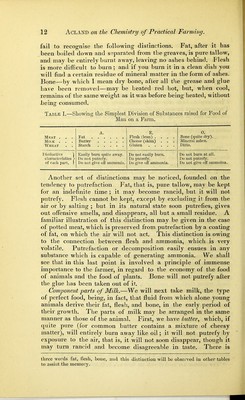
![fail to recognise the following distinctions. Fat, after it has been boiled down and separated from the greaves, is pure tallow, and may be entirely burnt away, leaving no ashes behind. Flesh is more difficult to burn; and if you burn it in a clean dish you will find a certain residue of mineral matter in the form of ashes. Bone—by which I mean dry bone, after all the grease and glue have been removed—may be heated red hot, but, when cool, remains of the same weight as it was before being heated, without being consumed. Table I.—Showing the Simplest Division of Substances raised for Food of Man on a Farm. Meat . . Milk . . . Wheat . . A. Fat Butter Starch E. Flesh (lean) .... Cheese (skim) . . . Gluten 0. Bone (quite dry). Mineral ashes. Ditto. Distinctive ] Easily hum quite away. Do not easily burn. Do not bum at all. characteristics > Do not putrefy. Do putrefy. Do not putrefy. of each part. I Do not give off ammonia. Do give off ammonia. Do not give off ammoiiia. Another set of distinctions may be noticed, founded on the tendency to putrefaction Fat, that is, pure tallow, may be kept for an indefinite time ; it may become rancid, but it will not putrefy. Flesh cannot be kept, except by excluding it from the air or by salting ; but in its natural state soon putrefies, gives out offensive smells, and disappears, all but a small residue. A familiar illustration of this distinction may be given in the case of potted meat, which is preserved from putrefaction by a coating of fat, on which the air will not act. This distinction is owing to the connection between flesh and ammonia, which is very volatile. Putrefaction or decomposition easily ensues in any substance which is capable of generating ammonia. We shall see that in this last point is involved a principle of immense importance to the farmer, in regard to the economy of the food of animals and the food of plants. Bone will not putrefy after the glue has been taken out of it. Component parts of Milk.—We will next take milk, the type of perfect food, being, in fact, that fluid from which alone young animals derive their fat, flesh, and bone, in the early period of their growth. The parts of milk may be arranged in the same manner as those of the animal. First, we have butter, which, if quite pure (for common butter contains a mixture of cheesy matter), will entirely burn away like oil; it will not putrefy by exposure to the air, that is, it will not soon disappear, though it may turn rancid and become disagreeable in taste. There is three words fat, flesh, boue, and this distiuction will be observed in other tables to assist the memory.](https://iiif.wellcomecollection.org/image/b22349893_0020.jp2/full/800%2C/0/default.jpg)