Meat, milk, and wheat : an elementary introduction to the chemistry of farming : to which is added a review of the questions at issue between Mr. Lawes and Baron Liebig / by Thomas Dyke Acland, jun.
- Acland, Sir Thomas Dyke, 1809-1898.
- Date:
- 1857
Licence: Public Domain Mark
Credit: Meat, milk, and wheat : an elementary introduction to the chemistry of farming : to which is added a review of the questions at issue between Mr. Lawes and Baron Liebig / by Thomas Dyke Acland, jun. Source: Wellcome Collection.
Provider: This material has been provided by The Royal College of Surgeons of England. The original may be consulted at The Royal College of Surgeons of England.
24/104 page 18
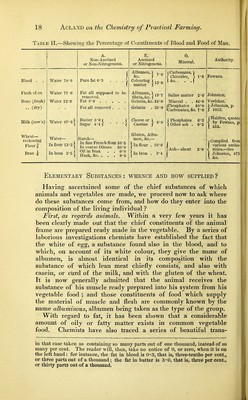
![Table II.—Showing the Percentage of Constituents of Blood and Food of Man. A. Non-Azotized or Non-Nitrogenous. E. Azotized or Nitrogenous. 0. Mineral. Authority. Blood . Water 78-0 Pui’ofatO'3 . . . 1 Albumen, I „ „ &c. ] ^ ° Colouring j.3 matter W* “ (Carbonates, 1 < Chlorides, y I'O l&c. . , .j Fownes. ! f Flesh of ox Bone (fresh) (dry) Water 77'0 Water 12-0 Fat all supposed to be remoTed. Fat 8 • 0 Fat all removed . . . Albumen, 7 , a ^ fibrin,&c.5 Gelatin, &c. 24*0 Gelatin . 35*0 Saline matter 2*0 Mineral .46*0 (Phosphates 58*0 ICarbonates, &c. V • 0 Johnston. Voelcker. j Johnston, p. J 1013. Milk (cow's) Water 87-31 Butter 3 • 0 ) f Sugar i-if • • Cheese or I ... Caseine f (Phosphates 0-3 I Other ash . 0'2 j Haidlen, quoted < by F'ownes, p| 1 552. Wheat— reckoning Flour g Bran g Water— In flour 13'31 In bran 2’5| Starch— In fine French flour 58 • 5 In coarse Odessa 50*0 Oil in bran . . 0*8 Husk, &c. . . . 9*0 Gluten, Albu- men, &c.— 1 In flour . 10'0 In bran . 3'4 |Ash—about 2'0 1 Compiled froit j various autho- < Titles.—See 1 Johnston, 871 1 &c. 1 1 Elementary Substances : whence and how supplied ? Having ascertained some of the chief substances of which animals and vegetables are made, we proceed now to ask where do these substances come from, and how do they enter into the composition of the living individual ? First, as regards animals. Within a very few years it has been clearly made out that the chief constituents of the animal frame are prepared ready made in the vegetable. By a series of laborious investigations chemists have established the fact that the white of egg, a substance found also in the blood, and to which, on account of its white colour, they give the name of albumen, is almost identical in its composition with the substance of which lean meat chiefly consists, and also with casein, or curd of the milk, and with the gluten of the wheat. It is now generally admitted that the animal receives the substance of his muscle ready prepared into his system from his vegetable food ; and those constituents of food rvhich supply the material of muscle and flesh are commonly known by the name albuminous, albumen being taken as the type of the group. With regard to fat, it has been shown that a considerable amount of oily or fatty matter exists in common vegetable food. Chemists have also traced a series of beautiful trans- in that case taken as containing so many parts out of one thousand, instead of so many per cent. The reader will, then, take no notice of 0, or zero, when it is on the left hand: for instance, the fat in blood is 0-3, that is, three-tenths per cent, or three parts out of a thousand; the fat in butter is 3 • 0, that is, three per cent., or thirty parts out of a thousand.](https://iiif.wellcomecollection.org/image/b22349893_0026.jp2/full/800%2C/0/default.jpg)