Assessment of "cold cures" : [letter to the editor of "The Lancet"] / W.D.M. Paton, F. Fulton, C.H. Andrewes.
- William Paton
- Date:
- [1948]
Licence: In copyright
Credit: Assessment of "cold cures" : [letter to the editor of "The Lancet"] / W.D.M. Paton, F. Fulton, C.H. Andrewes. Source: Wellcome Collection.
1/2
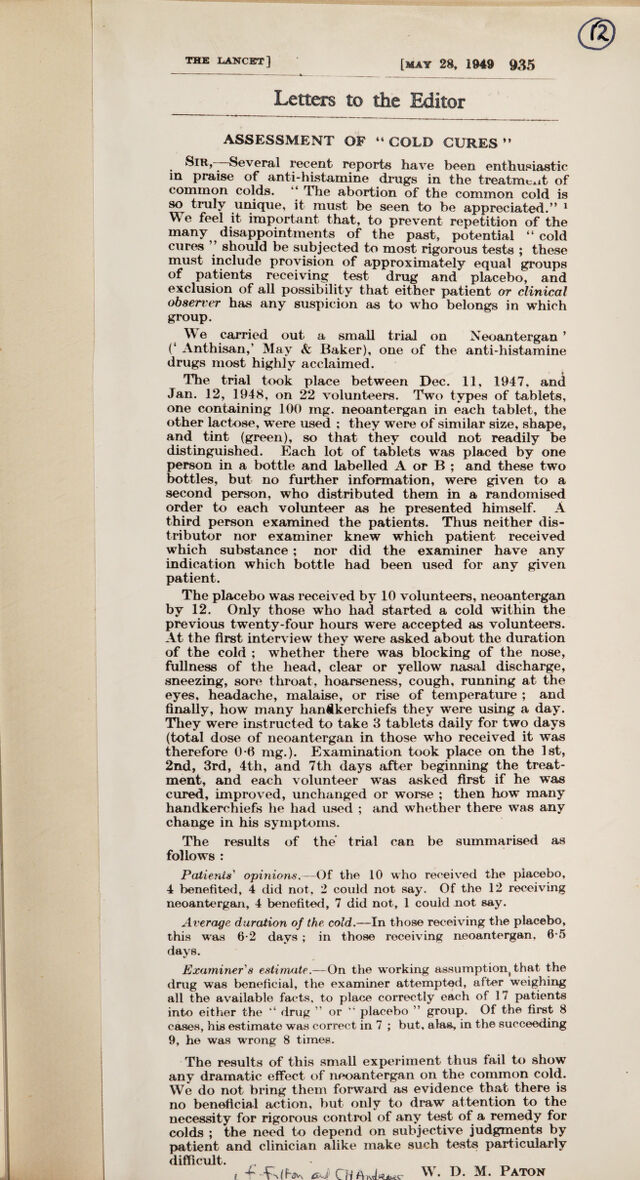
![THE LANCET] [may 28, 1949 935 Letters to the Editor ASSESSMENT OF “ GOLD CURES ” Sir,-—Several recent reports have been enthusiastic in praise of anti-histamine drugs in the treatmc^it of common colds. “ The abortion of the common cold is so truly unique, it must be seen to be appreciated.” 1 We feel it important that, to prevent repetition of the many disappointments of the past, potential “ cold cures ’ should be subjected to most rigorous tests ; these must include provision of approximately equal groups of patients receiving test drug and placebo, and exclusion of all possibility that either patient or clinical observer has any suspicion as to who belongs in which group. W e carried out a small trial on Neoantergan ’ (‘ Anthisan,’ May & Baker), one of the anti-histamine drugs most highly acclaimed. The trial took place between Dec. 11, 1947. and Jan. 12, 1948, on 22 volunteers. Two types of tablets, one containing 100 mg. neoantergan in each tablet, the other lactose, were used ; they were of similar size, shape, and tint (green), so that they could not readily be distinguished. Each lot of tablets was placed by one person in a bottle and labelled A or B ; and these two bottles, but no further information, were given to a second person, who distributed them in a randomised order to each volunteer as he presented himself. A third person examined the patients. Thus neither dis¬ tributor nor examiner knew which patient received which substance ; nor did the examiner have any indication which bottle had been used for any given patient. The placebo was received by 10 volunteers, neoantergan by 12. Only those w'ho had started a cold within the previous twenty-four hours were accepted as volunteers. At the first interview thev were asked about the duration •/ of the cold ; whether there was blocking of the nose, fullness of the head, clear or yellow nasal discharge, sneezing, sore throat, hoarseness, cough, running at the eyes, headache, malaise, or rise of temperature ; and finally, howr many handkerchiefs they were using a day. They were instructed to take 3 tablets daily for two days (total dose of neoantergan in those who received it was therefore 0-6 mg.). Examination took place on the 1st, 2nd, 3rd, 4th, and 7th days after beginning the treat¬ ment, and each volunteer was asked first if he was cured, improved, unchanged or worse ; then how many handkerchiefs he had used ; and whether there was any change in his symptoms. The results of the trial can be summarised as follows : Patients' opinions.—Of the 10 who received the placebo, 4 benefited, 4 did not, 2 could not say. Of the 12 receiving neoantergan, 4 benefited, 7 did not, 1 could not say. Average duration of the cold.—In those receiving the placebo, this was 6-2 days ; in those receiving neoantergan, 6-5 days. Examiner's estimate.—On the working assumption that the drug was beneficial, the examiner attempted, after weighing all the available facts, to place correctly each of 17 patients into either the ‘‘ drug ” or 1,4 placebo ” group. Of the first 8 cases, his estimate was correct in 7 ; but, alas, in the succeeding 9, he was wrong 8 times. The results of this small experiment thus fail to show any dramatic effect of neoantergan on the common cold. We do not bring them forward as evidence that there is no beneficial action, but only to draw attention to the necessity for rigorous control of any test of a remedy for colds ; the need to depend on subjective judgments by patient and clinician alike make such tests particularly difficult. i -f W. D. M. Paton](https://iiif.wellcomecollection.org/image/b30632596_0001.jp2/full/800%2C/0/default.jpg)