Improvements in frameless spectacles and eye glasses / [Walter Scott Essick].
- Essick, Walter Scott.
- Date:
- 1896
Licence: Public Domain Mark
Credit: Improvements in frameless spectacles and eye glasses / [Walter Scott Essick]. Source: Wellcome Collection.
1/4
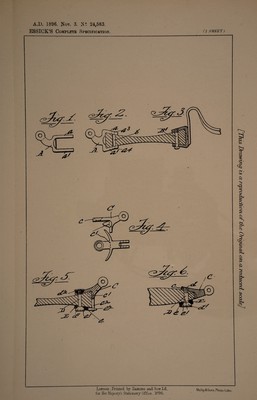
![N° 24,583 A.D. 1890 Date of Application, 3rd Nov., 1896— Accepted, 5th Dec., 1896 COMPLETE SPECIFICATION. Improvements in Frameless Spectacles and Eye Glasses. I, Walter Scott Essick, Machinist, of Reading, State of Pennsylvania, TJ.S.A. do hereby declare the nature of this invention and in what manner the same is to be performed, to be particularly described and ascertained in and by the following statement:— 5 This invention relates to that class of spectacles and eye glasses known as “ frameless,” in which the nose piece and temple joints are secured directly to the lens. Heretofore these fittings have been made in the form of clips the opposing ears of which span the lens and are bound together against the opposite faces of the 10 latter, a screw commonly passing through perforations in one of the ears and in the lens ; and engaging a screw threaded perforation in the opposite ear. A very serious objection to this construction is that it necessitates the keeping in stock of a variety of clip fittings adapted to various thicknesses of lens ; and even with such variety, it is practically difficult if not impossible to properly fit them 15 to the lenses. A further serious objection is that even when carefully fitted and fastened the liability of breakage of the lenses is so great as to cause many to prefer the framed construction. It is my object to overcome both of these objections and this I have accomplished by means of the simple but important improvements described in connection with the accompanying drawing, the novel 20 features of which are specified in the claims. Fig. 1 shows a clip fitting of ordinary form ; and Figures 2 and 3 represent the same applied to lenses of considerable curvature. Fig. 4 shows my improved single ear fitting ; and Figure 5 represents the same applied to the lens shown in Figure 2. 25 Fig. 6 shows my improved fitting in modified form applied to a lens of opposite curvature from that shown in Figure 5. The fittings represented in Figures 1 and 4 are temple joints ; but it will be under¬ stood that the invention relates equally to other attachments such as the nose pieces of either spectacles or eye glasses. The ordinary form of fitting A, represented in 30 Figure 1 , is provided with two parallel ears a a1 between which the lens is inserted and ordinarily clamped by means of a clamping screw which passes through one ear and the lens and screws into the other ear. Owing to the endless variety of lenses both as to curvature and thickness, fittings of various dimensions and shape must be made and kept in stock by7 all dealers pretending to be properly equipped. 35 Moreover in Fig. 2 is indicated one of the difficulties arising in the practical use of these fittings, the ears a a1 being so bent as to approximately fit the double concave lens on both faces, which is an obviously difficult operation ; while proper alignment of the holes a3 a4 in the ears of the fitting with the perforation b in the lens is more so. When these difficulties are successfully overcome however as 40 indicated in Figure 3, the clamping by means of a screw B1 is very ineffective owing to the unequal strain brought to bear upon the lens around the hole b, as indicated ; a defect which is not only liable to quickly cause the loosening of the connection but also to cause breakage of the lens, eveu in the act of tightening up the clamping screw. 45 In my improved fitting C I provide a bearing against one face only of the lens, thus rendering it at once equally applicable to lenses of all thicknesses. The single ear may be readily bent to suit the curvature of the surface against which it is to bear, and it is then clamped against said surface as firmly as possible without danger ot strain or breakage, by means of a clamping screw and washer I) Z0 and E as shown in Figure 5 and G. In these constructions the hemi-spherical | Pi ice 8dk ]](https://iiif.wellcomecollection.org/image/b30739470_0001.jp2/full/800%2C/0/default.jpg)