Minutes of evidence taken by the Departmental Committee on Sleeping Sickness.
- Great Britain. Colonial Office. Committee on Sleeping Sickness.
- Date:
- 1914
Licence: Public Domain Mark
Credit: Minutes of evidence taken by the Departmental Committee on Sleeping Sickness. Source: Wellcome Collection.
10/346
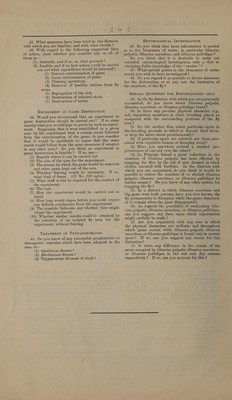
![] 42. What measures have been tried in the districts with which you are familiar, and with what results ? 43. With regard to the following suggested lines of action, state whether you consider any or all of them as—- ; (1) desirable, and if so, on what grounds ? (2) feasible, and if so, how action could be carried ont and what expenditure would be incurred ? (1) General extermination of game. (2) Local extermination of game. (3) Clearing operations, (4) Removal of healthy natives from fly areas. (5) Segregation of the sick. (6) Destruction of infected stock. (7) Destruction of tsetse. EXPERIMENT IN GAME DESTRUCTION. 44, Would you recommend that an experiment in game destruction should be carried out? If so, state exactly what you would hope to prove by such an experi- ment. Supposing that it were established in a given area by the experiment that a certain result followed from the extermination of the game, do you consider that it would be justifiable to argue that the same result would follow from the same measures if adopted in any other area? Do you think an experiment in game destruction is feasible? If so, say— (1) Exactly where it can be carried out. (2) The size of the area for the experiment. (3) The means by which the game would be removed and other game kept out of the area. (4) Whether fencing would be necessary. If so, what kind of fence. (Cf. No. (10) infra.) (5) What staff would be required for the conduct of the experiment. (6) The cost. ; (7) How the experiment would be carried out in detail. (8) How long would elapse before you could expect any definite conclusions from the experiment. (9) The possible fallacies, and whether they might vitiate the experiment. (10) Whether similar results could be obtained by the selection of an isolated fly area for the experiment, without fencing. TREATMENT OF TRYPANOSOMIASIS. 45. Do you know of any successful prophylactic or therapeutic remedies which have beeu adopted in the case of— (1) Gambiense disease ? (2) Rhodesiense disease ? (3) Trypanosome diseases of stock ? ENTOMOLOGICAL INVESTIGATION. 46. Do you think that more information is needed as to the bionomics of tsetse, in particular Glossina palpalis, Glossina morsitans, and Glossina pallidipes ? Do you think that it is desirable to carry out extended entomological investigation with a view to obtaining fuller knowledge of the “ carrier ” ? 47. What special points in the bionomics of tsetse would you wish to have investigated ? 48. Do you regard it as possible to devise measures for the destruction, or at any rate the limitation of the numbers, of the fly ? SPECIAL QUESTIONS FOR ENTOMOLOGISTS ONLY. 49. In the fly districts with which you are personally acquainted, do you know where Glossina palpalis, Glossina morsitans, or Glossina pallidipes breed ? 50. Is there any peculiar physical character (e.g., soil, vegetation, moisture) in these breeding places as compared with the surrounding portions of the fly area ? 51. Do the mother flies select particular spots in the breeding grounds in which to deposit their larve, or drop the latter about promiscuously ? 52. If particular spots are selected, are these asso- ciated with vegetable humus or decaying wood ? 53. Have you anywhere noticed a marked pre- ponderance of one sex over the other ? 54. In Principe Island a great reduction in the numbers of Glossina palpalis has been effected by trapping the flies by the aid of men dressed in black clothes smeared with birdlime. In the districts with which you are acquainted, do you think it would be possible to reduce the numbers of or abolish Glossina palpalis, Glossina morsitans, or Glossina pallidipes by similar means? Do you know of any other system for trapping the fly ? 55. In a district in which Glossina morsitans and big game were both present, have you ever known the fly permanently to disappear while the game remained, or to remain when the game disappeared ? 56. As regards the possibility of eradicating Glos- sina palpalis, Glossina morsitans, or Glossina pallidipes, can you suggest any lines upon which experiments might usefully be made ? 57. Are you acquainted with any area in which the physical characters are uniform, and throughout which game occurs, while Glossina palpalis, Glossina morsitans, or Glossina pallidipes is found only in certain spots? If so, can you suggest any reason for this limitation ? 58. Is there any difference in the extent of the areas occupied by Glossina palpalis, Glossina morsitans, or Glossina pallidipes in the wet and dry seasons respectively ? If so, can you account for this ?](https://iiif.wellcomecollection.org/image/b32178104_0010.jp2/full/800%2C/0/default.jpg)